Marmota broweri
| Alaska Marmot
(Marmota broweri) | |
|---|---|
| Range | |
 | |
| Taxonomic classification | |
| Order: | Rodentia |
| Suborder: | Sciuromorpha |
| Family: | Sciuridae |
| Subfamily: | Xerinae |
| Tribe: | Marmotini |
| Genus: | Marmota |
| Subgenus: | Marmota (subgenus) |
| Binomial details | |
| Marmota broweri E. R. Hall & Gilmore, 1934 | |
| Other resources | |
| Full taxonomic details at MDD | |
The Alaska Marmot (Marmota broweri) is a large ground squirrel found on open alpine tundra associated with talus slopes and rocky outcroppings in Alaska (Wilson et al., 2016).
Description
Marmota broweri was considered a subspecies of the Hoary Marmot (Marmota caligata). The face is all black rather than marked by an extensize white area between and in front of the eyes and the feet are mostly white rather than black or blackish brown (Hall and Gilmore, 1934).


Museum images
-

Holotype: MVZ:Mamm:51675. Marmota broweri. Point Lay, Arctic Ocean, Alaska, United States. Collected 10 December 1931. Dorsal view of the skin. -
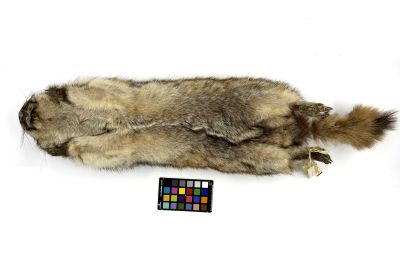
Holotype: MVZ:Mamm:51675. Marmota broweri. Point Lay, Arctic Ocean, Alaska, United States. Collected 10 December 1931. Ventral view of the skin.


External measurements
Length measurements are in millimeters (mm) and weight measurements are in grams (g), unless stated otherwise. If available, the sample size (n=) is provided. If a range is not provided and n= is not given, then the listed measurement represents an average.
| Part of range | Reference | Total length | Tail length | Hindfoot length | Ear length | Mass |
|---|---|---|---|---|---|---|
| Alaska (Galbraith Lake) | Gunderson et al. (2009) | 404–628 (n=3) | 95–136 (n=3) | 67–88 (n=3) | 23–28 (n=3) | 3.3–4.25 kg (n=2) |
| Alaska (Kokrines Hills) | Gunderson et al. (2009) | 591 (n=1) | 152 (n=1) | 83 (n=1) | 35 (n=1) | 2.83 kg (n=1) |
| Alaska (Kukpowruk River) | Gunderson et al. (2009) | 640 (n=1) | 160 (n=1) | 80 (n=1) | 25 (n=1) | 4.6 kg (n=1) |
| Alaska (Lake Peters) | Gunderson et al. (2009) | 552 (n=1) | 121–147 (n=2) | 71–80 (n=2) | 18–26 (n=2) | 2.12 kg (n=1) |
| Alaska (Ray Mountains) | Gunderson et al. (2009) | 504–635 (n=6) | 120–148 (n=6) | 76–83 (n=6) | 23–28 (n=6) | 2.0–3.65 kg (n=6) |
| Alaska (Slope Mountain) | Gunderson et al. (2009) | 517–640 (n=4) | 140–166 (n=4) | 74–90 (n=4) | 22–35 (n=4) | 1.6–3.85 kg |
| Alaska (Tupikchak Mountain) | Gunderson et al. (2009) | 607–700 (n=6) | 143–193 (n=6) | 83–93 (n=6) | 27–32 (n=6) | 3.1–5.9 kg (n=6) |
Skull
-

Holotype: MVZ:Mamm:51675. Marmota broweri. Point Lay, Arctic Ocean, Alaska, United States. Collected 10 December 1931. Dorsal view of the skull. -

Holotype: MVZ:Mamm:51675. Marmota broweri. Point Lay, Arctic Ocean, Alaska, United States. Collected 10 December 1931. Ventral view of the skull. -

Holotype: MVZ:Mamm:51675. Marmota broweri. Point Lay, Arctic Ocean, Alaska, United States. Collected 10 December 1931. Ventral view of the skull. Lateral view of the skull. -
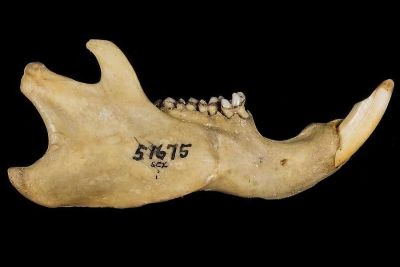
Holotype: MVZ:Mamm:51675. Marmota broweri. Point Lay, Arctic Ocean, Alaska, United States. Collected 10 December 1931. Ventral view of the skull. Lateral view of the right mandible.


Taxonomy and distribution
For detailed information on the taxonomy and distribution of this species, see Gunderson et al. (2009).
Similar species
Key to North American species of Marmota
Comparison with Marmota caligata
Marmota broweri was considered a subspecies of the Hoary Marmot (Marmota caligata). In Marmota broweri, the face is all black rather than marked by an extensize white area between and in front of the eyes and the feet are mostly white rather an black or blackish brown (Hall and Gilmore, 1934). Additionally, Braun et al. (2011) provide the following: "M. caligata differs from M. broweri (Alaska marmot) by coarse rather than soft dorsal pelage, uniformly colored or lightly tipped dorsal guard hairs, black cap extending from nose to neck interrupted with a white patch between the eyes and nose, black lips, a longer angular process of the mandible (52.79 mm versus 47.83 mm, males), longer rostrum (27.85 mm versus 25.06 mm, males), smaller postorbital width (16.32 mm versus 16.84 mm, males), more well developed sagittal and lambdoidal crests, gradually tapering nasals with a slightly convex or straight margin, larger mastoid width (45.12 mm versus 39.51 mm, males), and rectangular-shaped lachrymal bones (Hoffmann et al. 1979; Rausch 1953)."
-

Alaska Marmot (Marmota broweri) photographed by Robert Weeden near Toolik Field Station, Brooks Range, Alaska. -

Hoary Marmot (Marmota caligata) photographed by Eemeli Haverinen in Denali National Park, Alaska. -

Borrowed from Hall and Gilmore (1934). Views corresponding to those shown of Marmota broweri are shown in figures 1-3 and those of Marmota caligata are shown in figures 4-6. "Note especially as between broweri and caligata, difference in shape of the nasal bone; difference in shape of the anterior palatine foramina; longer palate, and smaller angular process of the lower mandible and more nearly straight inferior margin of lower mandible in broweri."

References
Gunderson AM, Jacobsen BK, Olson LE. 2009. Revised distribution of the Alaska marmot, Marmota broweri, and confirmation of parapatry with hoary marmots. Journal of Mammalogy 90(4):859-869. https://doi.org/10.1644/08-MAMM-A-253.1
Hall ER, Gilmore RM. 1934. Marmota caligata broweri, a new marmot from northern Alaska. Canadian Field Naturalist 48:57–59. https://www.biodiversitylibrary.org/page/28103713#page/77/mode/1up
Wilson DE, Lacher Jr TE, Mittermeier RA. 2016. Sciuridae. In: Handbook of the Mammals of the World – Volume 6 Lagomorphs and Rodents I. Barcelona: Lynx Edicions: 648-837, ISBN: 978-84-941892-3-4, DOI: http://doi.org/10.5281/zenodo.6840226