Geomyidae
| Family Geomyidae | |
|---|---|
| Range | |
 | |
| Taxonomic classification | |
| Order: | Rodentia |
| Suborder: | Supramyomorpha |
| Infraorder: | Castorimorphi |
| Superfamily: | Geomyoidea |
Pocket gophers are burrowing rodents in the family Geomyidae. They are cryptic species and can be very difficult to distinguish based on external morphological characters alone. There are nearly 50 recognized species in the family. All are found in North America with one species reaching as far south as Columbia in South America. The highest diversity is found in Mexico. In the United States, 29 species are present.
Species in the United States
Cratogeomys
-

Yellow-faced Pocket Gopher (Cratogeomys castanops) photographed by Marco Zozaya in Coahuila, Mexico. Moderately large pocket gopher, dull yellowish brown in color, and feet blackish (whitish in most other gophers). One deep groove on outer face of each upper incisor.
Geomys
Species not pictured: Brazos Pocket Gopher (Geomys brazensis). Three species of pocket gophers are currently recognized in eastern Texas, Geomys attwateri, Geomys brazensis, and Geomys bursarius and they are difficult to distinguish on the basis of external characteristics; the coloration of all three species is variable and can range from pale brown to black.
-

Dorsal view of a Attwater's Pocket Gopher (Geomys attwateri) collected in 1892 in Aransas County, Texas. Pale brown to black and usually paler ventrally. Two longitudinal grooves on outer face of each incisor. -

Desert Pocket Gopher (Geomys arenarius) photographed by Robert Dowler near El Paso, Texas. Dull, pale-brown pocket gopher with feet and underparts white. Two longitudinal grooves on outer face of each incisor. -

Baird's Pocket Gopher (Geomys breviceps) photographed by adaws1509 near Fort Smith, Arkansas. Dorsal coloration in this species varies from pale brown to black. Two longitudinal grooves on outer face of each incisor. -

Plains Pocket Gopher (Geomys bursarius) photographed by Yinan Li in Reno County, Kansas. Dorsal coloration in this species varies from buff, reddish brown, liver brown, or chestnut to black. Two longitudinal grooves on outer face of each incisor. -

Hall's Pocket Gopher (Geomys jugossicularis) photographed by Robert Dowler in Cibola National Forest, Dalhart, Texas. Specimen deposited in Angelo State Natural History Collections. Two longitudinal grooves on outer face of each incisor. -
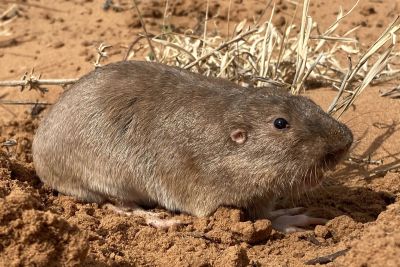
Jones's Pocket Gopher (Geomys knoxjonesi) photographed by Robert Dowler in Gaines County, Texas. Coloration pale; upper parts buffy-brown, paler on sides and venter; some areas on venter covered with almost pure white hair; feet white. Two longitudinal grooves on outer face of each incisor. -

Alabama Pocket Gopher (Geomys mobilensis) photographed by Eric Soehren in Bullock County, Alabama. Two longitudinal grooves on outer face of each incisor. -
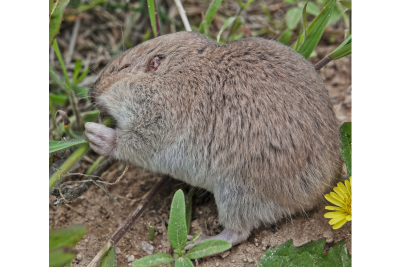
Sand Hills Pocket Gopher (Geomys lutescens) photographed by Colin Croft in Scotts Bluff County, Nebraska. Dorsal pelage pale brown to brown but generally with buff to pale yellowish shades and back darker than flanks; fur of under parts paler than flanks. Two longitudinal grooves on outer face of each incisor. -

Texas Pocket Gopher (Geomys personatus) photographed by Ben Horstmann on Padre Island, Corpus Christi, Texas. A large, pale drab or grayish drab species with relatively long, scant-haired tail, the distal half nearly naked; underparts marbled white and dusky Two longitudinal grooves on outer face of each incisor. -

Southeastern Pocket Gopher (Geomys pinetis) photographed by birdieboo near Live Oak, Florida. Two longitudinal grooves on outer face of each incisor. -
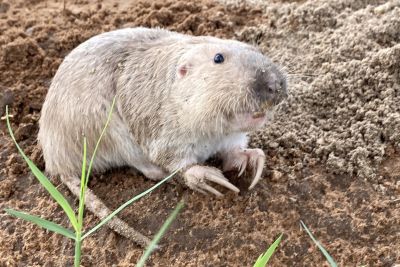
Strecker's Pocket Gopher (Geomys streckeri) photographed by Robert Dowler near Carrizo Springs, Texas. Grayish coloration. Two longitudinal grooves on outer face of each incisor. -

Llano Pocket Gopher (Geomys texensis) photographed by George Afghan in Mason County, Texas. Liver-brown dorsum mixed with black-tipped hairs, a white venter, and white feet. Two longitudinal grooves on outer face of each incisor.
Megascapheus (smooth-toothed, tooth-digging pocket gophers)
-

Southwestern Texas Pocket Gopher (Megascapheus baileyi) photographed by Mickey Dylan in Jeff Davis County, Texas. Pelage color ranges from buffy-yellow to pinkish-buff to cinnamon to dark gray. Incisors are smooth and lack grooves. -

Dorsal view of a Botta's Pocket Gopher (Megascapheus bottae) collected in 1894 in Merced County, California. Incisors are smooth and lack grooves. -

Camas Pocket Gopher (Megascapheus bulbivorus) photographed by Luis Cuellar Robles in Portland, Oregon. The dorsum is sooty brown and the ears and nose blackish; the venter is lead colored except for an irregular-shaped white patch on the throat. Incisors are smooth and lack grooves. -

New Mexico Pocket Gopher (Megascapheus connectens) collected in 1935 in Bernalillo County, New Mexico. Fresh summer pelage is cinnamon buff; whitish below with plumbeous areas and with cinnamon buff extending onto the pectoral region. Winter pelage with a reduced amount of cinnamon buff on the upper parts producing a "gray" coat." Incisors are smooth and lack grooves. -

Fulvous Pocket Gopher (Megascapheus fulvus) photographed by dumplingbug around Tucson, Arizona. Incisors are smooth and lack grooves. -

Dorsal view of a Northern California Pocket Gopher (Megascapheus laticeps) collected in 1905 in Mendocino County, California. Incisors are smooth and lack grooves. -

Dorsal view of a Southern California Pocket Gopher (Megascapheus nigricans) collected in 1893 in Riverside County, California. Incisors are smooth and lack grooves. -

Ruidoso Pocket Gopher (Megascapheus ruidosae) collected in 1931 in Lincoln County, New Mexico. Color is fuscous to fuscous-black above with underparts having a strong wash of ochraceous-tawny; its tail is black except for the distal third which is white; its feet and ankles are white. Incisors are smooth and lack grooves. -

Dorsal view of a Townsend's Pocket Gopher (Megascapheus townsendii) collected in 1913 Canyon County, Idaho. Incisors are smooth and lack grooves. -

Dorsal view of a Southern Pocket Gopher (Megascapheus umbrinus) collected in 1908 in Hidalgo County, New Mexico. Incisors are smooth and lack grooves.
Thomomys (smooth-toothed, claw-digging pocket gophers)
Key to the species of Thomomys
-

Dorsal view of a Idaho Pocket Gopher (Thomomys idahoensis) collected in 1890 in Lemhi County, Idaho. Dorsal color is variable ranging from yellowish brown with hair tipped with a dark brown to grayish brown or a dark brown. Venter is light gray and often suffused with yellowish or yellowish brown. This species lacks completely, or nearly so, any dark periauricular patches. The feet are whitish and the tail coloration is variable. Incisors are smooth and lack grooves. -

Wyoming Pocket Gopher (Thomomys clusius) photographed by Britt Brito. © Britt Brito. Pelage is pale, yellowish-gray with slight brownish tinge. The venter, foot, and tail are white, but the snout is blackish. Incisors are smooth and lack grooves. -

Dorsal view of a Western Pocket Gopher (Thomomys mazama) collected in 1896 in Klamath County, Oregon. Coloration is variable. Nose and face usually are dusky, plumbeous, or blackish; chin, feet, and tip of tail commonly are light gray, white, or buff; and the chest commonly contains white splotches. The dark patch of fur behind the ear is five to six times as large as the ear. Incisors are smooth and lack grooves. -

Dorsal view of a Mountain Pocket Gopher (Thomomys monticolus) collected in 1898 in Siskiyou County, California. Dull pale reddish brown above, strongly tinged with gray; below ashy white, sometimes with a faint tinge of buff; feet and tail whitish; no white throat spot; ears in a large blackish area. Incisors are smooth and lack grooves. -

Northern Pocket Gopher (Thomomys talpoides) photographed by ML Watson in Conejos County, Colorado. Color varies geographically from dark brown or yellow-brown to pale, grayish yellow. Chin is white and postauricular patches (area behind the ear) blackish or grayish black. The feet commonly are white or partly white. Incisors are smooth and lack grooves.
Range maps
-

Yellow-faced Pocket Gopher (Cratogeomys castanops) -

Desert Pocket Gopher (Geomys arenarius) -

Attwater's Pocket Gopher (Geomys attwateri) -

Brazos Pocket Gopher (Geomys brazensis) -

Baird's Pocket Gopher (Geomys breviceps) -

Plains Pocket Gopher (Geomys bursarius) -

Hall's Pocket Gopher (Geomys jugossicularis) -

Jones's Pocket Gopher (Geomys knoxjonesi) -

Sand Hills Pocket Gopher (Geomys lutescens) -

Alabama Pocket Gopher (Geomys mobilensis) -

Texas Pocket Gopher (Geomys personatus) -

Southeastern Pocket Gopher (Geomys pinetis) -

Strecker's Pocket Gopher (Geomys streckeri) -

Llano Pocket Gopher (Geomys texensis) -
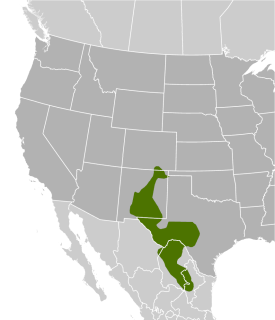
Southwestern Texas Pocket Gopher (Megascapheus baileyi). Elevated to specific status by Bradley et al. (2023). -
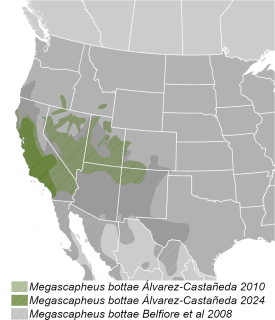
Botta's Pocket Gopher (Megascapheus bottae). Warning! The ranges above may be unreliable. Recent molecular analyses have led to significant changes in our understanding of the distribution of this species. The most recent published range of this species was by Álvarez-Castañeda (2024) in Mammals of North America-Volume 2: Systematics and Taxonomy; however, this is not a peer reviewed publication. That range map is based on earlier, peer-reviewed molecular analyses by Álvarez-Castañeda (2010), which lists the range of bottae as rest of California, north and west of the Colorado River." Based on Figure 2. in Álvarez-Castañeda (2010), the range of bottae should include southern Oregon, southern Idaho, California, Nevada, Utah, Colorado, northern Arizona, and northern New Mexico. The range discrepancy between Álvarez-Castañeda (2010) and Álvarez-Castañeda (2024) is substantial. -

Camas Pocket Gopher (Megascapheus bulbivorus) -

New Mexico Pocket Gopher (Megascapheus connectens). Elevated to specific status by Bradley et al. (2023). Distribution (dark green) of connectens is based on Sands and Finley (1959). Distribution (light green) of connectens is based on Bradley et al. (2023). Bradley et al. (2023) note that their distribution is approximated. -

Fulvous Pocket Gopher (Megascapheus fulvus) Elevated to specific status by Bradley et al. (2023). Warning! The ranges above may be unreliable. Recent molecular analyses have led to significant changes in our understanding of the distribution of this species. The most recent published range (light green) of this species was by Álvarez-Castañeda (2024) in Mammals of North America-Volume 2: Systematics and Taxonomy; however, this is not a peer reviewed publication. That range map is based on earlier, peer-reviewed molecular analyses by Álvarez-Castañeda (2010), which lists the range of fulvus as "south and east of the Colorado River to the Sierra Madre Occidental in Sonora." The range presented in dark green is based on Álvarez-Castañeda (2010) and Bradley et al. (2023). The range discrepancy between Álvarez-Castañeda (2010) and Álvarez-Castañeda (2024) is substantial. -

Northern California Pocket Gopher (Megascapheus laticeps) -

Southern California Pocket Gopher (Megascapheus nigricans) -

Ruidoso Pocket Gopher (Megascapheus ruidosae). Elevated to specific status by Bradley et al. (2023). The dark green area represents the distribution of Megascapheus ruidosae according to Bradley et al. (2023). The light green area represents the range of Megascapheus baileyi subspecies actuosus and an area of uncertainty for Megascapheus ruidosae. Accordingly to Bradley et al. (2023), some individuals of actuosus from the type locality in Corona, NM, possessed a mtDNA haplotype reflective of actuosus, whereas others possessed a haplotype associated with ruidosae: "Further studies are needed to determine whether samples of actuosus that presumably hybridize with ruidosae should be assigned to this new species". -

Townsend's Pocket Gopher (Megascapheus townsendii) -

Southern Pocket Gopher (Megascapheus umbrinus) -

Wyoming Pocket Gopher (Thomomys clusius) -

Idaho Pocket Gopher (Thomomys idahoensis) -

Western Pocket Gopher (Thomomys mazama) -

Mountain Pocket Gopher (Thomomys monticolus) -

Northern Pocket Gopher (Thomomys talpoides)
Morphological differences between genera
In Cratogeomys, the upper incisors each have one longitudinal groove. In Geomys, the upper incisors each have two longitudinal grooves. In Megascapheus and Thomomys, the upper incisors lack conspicuous longitudinal grooves and further examination of the skull and teeth is required, as discussed below.
Morphological differences between Megascapheus in relation to Thomomys
Genetic analyses (CytB and COI) by Álvarez-Castañeda and Segura-Trujillo (2025) found that the two subgenera within the genus Thomomys Wied-Neuwied, 1839 — Megascapheus and Thomomys — are genetically distinct. Morphological and genetic data support considering these differences sufficient at the genus level. Both subgenera Megascapheus and Thomomys were elevated to the taxonomic rank of genus by Álvarez-Castañeda and Segura-Trujillo (2025). From Álvarez-Castañeda and Segura-Trujillo (2025): "Morphological difference between Megascapheus in relation to Thomomys are: the upper incisors procumbent and their root between the fourth upper premolars and the first upper molars vs upper incisors not procumbent and their root above the fourth upper premolars; sphenoidal fissure open vs closed (except for some specimens of T. clusius); angular process continuous, with a well-developed flange along the ventral ramus side vs not continuous, with a weakly developed flange along the ventral ramus side; rostrum heavy vs rostrum slender; base of the first lower premolars inclined anteriorly vs nearly perpendicular to the occlusal surface of the toothrow; infraorbital canal openings anterior to the incisive foramina vs directly above or slightly posterior to the incisive foramina; anterior enamel plate of the first lower premolars not recurved vs recurved, frequently forming a shallow re-entrant angle; anterior enamel plate of the first lower premolars narrow and broadly separated from the lateral enamel plate on the lingual side, vs only slightly separated from the posterior enamel plate (rarely continuous), with the lateral enamel plate on the lingual side; chromosome number of living forms from 74 to 82 vs from 40 to 60 (Nelson and Goldman 1934; Russell 1968; Álvarez-Castañeda 2024).
Available taxon pages
The following subfamilies are available on WhiskerWiki for this family:
- Subfamily: Geomyinae
- Tribe: Thomomyini
- Genus: Megascapheus
- Genus: Thomomys
- Subgenus: No information
- Tribe: Geomyini
- Genus: Cratogeomys
- Subgenus: No information
- Genus: Geomys
- Genus: Cratogeomys
- Tribe: Thomomyini
References
Álvarez-Castañeda ST. 2010. Phylogenetic structure of the Thomomys bottae–umbrinus complex in North America. Molecular Phylogenetics and evolution 54(3): 671-679.