Soricidae
| Family Soricidae | |
|---|---|
| Taxonomic classification | |
| Order: | Eulipotyphla |
| Suborder: | Erinaceota |
Introduction
True shrews belong to the family Soricidae. They are small mammals with short legs, a long flexible nose, small ears, and tiny eyes. As of 2025, there are 497 recognized species worldwide in 28 genera in the family Soricidae. In the United States, over thirty species of shrews are recognized, representing four genera—Blarina, Cryptotis, Notiosorex, and Sorex, all of which are in the subfamily Soricinae (red-toothed shrews).
From van Zyll de Jong (1983): "Most soricids are terrestrial, some are semi-fossorial (Cryptotis, Blarina), and others are adapted to a semi-aquatic way of life (e.g. Sorex palustris). Shrews are active day and night and in all seasons. They are chiefly insectivorous; the large species, to some extent are also carnivorous and some are known to eat seeds seasonally. The semi-aquatic forms are more or less piscivorous."
The skull is recognized by an elongated rostrum (snout); lack of zygomata (or zygomatic arches); first incisor enlarged; tympanic bone is a simple ring; and lack of auditory bullae (Hoffmeister, 1986).
-

Northern Short-tailed Shrew (Blarina brevicauda), the largest shrew in North America. Image by Gilles Gonthier. -

A species of Notiosorex observed by Naturegirlkh. -

A species of Sorex observed by Asmedley. -

Lateral view of the skull of the Northern Short-tailed Shrew (Blarina brevicauda), showing an elongated rostrum, red-tipped teeth, and enlarged first incisors. -

Lateral view of the skull of Cryptotis parvus, showing an elongated rostrum, red-tipped teeth, and enlarged first incisors. -

Lateral view of the skull of the Desert Gray Shrew (Notiosorex crawfordi), showing an elongated rostrum, red-tipped teeth, and enlarged first incisors. -

Lateral view of the skull of of the Southern Montane Shrew (Sorex monticolus), showing an elongated rostrum, red-tipped teeth, and enlarged first incisors. -

Top (dorsal) view of a Sorex skull showing the location of the missing zygomata. All soricids lack zygomata. -

Tympanic rings (bones) on underside (ventral side) of the skull of the Southern Montane Shrew (Sorex monticolus). The tympanic ring is part of the auditory system in shrews of the family Soricidae.
Species in the United States
Short-tailed Shrews (genus: Blarina)
Blarina are relatively large shrews with short tails. Where their ranges overlap, they can be difficult to differentiate without careful measurement of size. In some areas, they may only be able to be differentiated using molecular methods. Both Blarina peninsulae and Blarina shermani are similar in appearance to Blarina carolinensis and were once considered subspecies of Blarina carolinensis.
-

Northern Short-tailed Shrew (Blarina brevicauda) -

Southern Short-tailed Shrew (Blarina carolinensis) -

Elliot's Short-tailed Shrew (Blarina hylophaga) -

Everglades Short-tailed Shrew (Blarina peninsulae) -

Sherman's Short-tailed Shrew (Blarina shermani)
Least or small-eared shrews (genus: Cryptotis)
Cryptotis are small shrews with very short tails and small ears that are often not clearly visible. Species not pictured: Berlandier's Least Shrew (Cryptotis berlandieri) and Florida Least Shrew (Cryptotis floridanus). Cryptotis berlandieri and Cryptotis floridanus were previously considered subspecies of Cryptotis parvus. Both species are similar in appearance, but average slightly larger than Cryptotis parvus.
-

North American Least Shrew (Cryptotis parvus)
genus: Notiosorex
Notiosorex are small, generally gray shrews with short tails and relatively large ears that are clearly visible. Species not pictured: Ticul's Gray Shrew (Notiosorex tataticuli). Notiosorex cockrumi and Notiosorex tataticuli are similar in appearance to Notiosorex crawfordii. Notiosorex cockrumi was recognized by Baker et al. (2003) as species separate from Notiosorex crawfordi. Notiosorex tataticuli was recognized as a separate species by Camargo & Álvarez-Castañeda (2020), based on populations previously attributed to Notiosorex crawfordi.
-

Desert Gray Shrew (Notiosorex crawfordi) -

Cockrum's Gray Shrew (Notiosorex cockrumi)
Long-tailed Shrews (genus: Sorex)
Members of Sorex have long tails, as the common name implies. For identification, note the difference in overall size, tail length, and coloration (dorsal, ventral, tail). However, use caution as color is not always a reliable character for differentiating between some Sorex species, particularly S. monticolus, S. obscurus, S. ornatus, and S. vagrans. Some species of Sorex may only be differentiated through careful examination of the teeth, comparison of skull measurements, or with the use of molecular methods. Confidently differentiating between S. cinereus and S. haydeni is accomplished only through genetic testing or karyotype analysis. Notice that S. tundrensis, S. ugyunak, and S. minutissimus have a bicolored or tricolored appearance. S. arcticus is also tricolored throughout much (but not all) of its range. S. trowbridgii is typically more dark gray in appearance but can lean toward brownish in parts of its range, such as California. Sorex longirostris and S. sonomae have a reddish dorsal coloration. Species not pictured: Eastern Water Shrew (Sorex albibarbis), Arizona Shrew (Sorex arizonae), Saint Lawrence Island Shrew (Sorex jacksoni), Pribilof Island Shrew (Sorex pribilofensis).
-
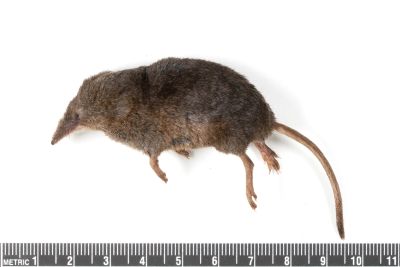
Arctic Shrew (Sorex arcticus). Adults are dark chocolate brown to blackish in color on their backs; sides are lighter brown; undersides are a pale gray-brown to whittish. The demarcation between each color is sharply distinct. Juveniles are generally browner than adults and bicolored. -

Marsh Shrew (Sorex bendirii). Blackish shrew with underparts usually as dark as the upper parts. Slight fringe of stiff hairs on the hind toes. On the Olympic Peninsula of Washington the underparts may be whitish. -

Masked Shrew (Sorex cinereus). Typically brown to dark grayish-brown. Dorsal and ventral coloration varies across the range of the species with some individuals appearing indistinctly tricolored, yellowish, or reddish. -

Masked Shrew (Sorex cinereus). Dorsal and ventral coloration varies across the range of the species with some individuals appearing indistinctly tricolored, yellowish, or reddish. -

Rock Shrew (Sorex dispar). Dorsal pelage is slate gray to brownish and ventral pelage is slightly paler. -

Western Pygmy Shrew (Sorex eximius). Dorsal coloration ranges from dark brown to reddish brown to gray-brown, shading to slightly paler on the venter. -

Maryland Shrew (Sorex fontinalis). Dorsal coloration is brown and ventral coloration is paler. Similar in appearance to Sorex cinereus. -

Smoky Shrew (Sorex fumeus). Coloration of this shrew varies seasonally and is brownish in summer and dark gray to almost black in winter. -

Prairie Shrew (Sorex haydeni). Brown dorsum, slightly paler sides, and whitish venter that is occasionally washed with yellow. -

Eastern Pygmy Shrew (Sorex hoyi). Small reddish brown to grayish brown shrew. Ventral coloration is lighter, ranging from grayish to buffy brown. -

Southeastern Shrew (Sorex longirostris). Dorsum is warm, rich brown to cinnamon brown. -

Southeastern Shrew (Sorex longirostris), subspecies eionis (dark chestnut brown) found only in portions of Florida. Very dark chestnut dorsally, becoming lighter and richer on the sides. -

Mount Lyell Shrew (Sorex lyelli). Upper parts brownish; underparts pale olive-gray or smoke-gray. -
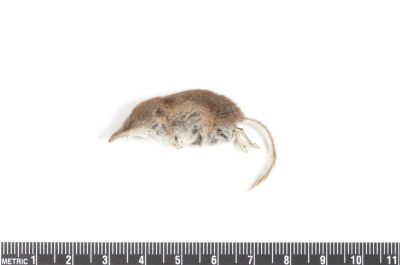
Eurasian Least Shrew (Sorex minutissimus). The pelage is slightly tricolored with the dorsum being brownish, the flanks near hair gray, and the ventrum pale smoke gray. -

Merriam's Shrew (Sorex merriami) -

Southern Montane Shrew (Sorex monticolus) -

Dwarf Shrew (Sorex nanus) -
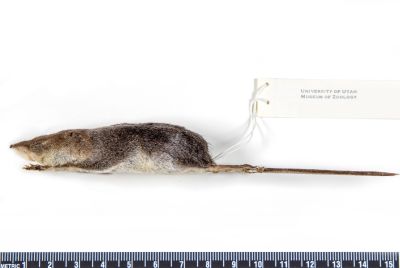
Western Water Shrew (Sorex navigator), note scale bar; this is a large shrew -

Northern Montane Shrew (Sorex obscurus) -

Ornate Shrew (Sorex ornatus) -

Pacific Shrew (Sorex pacificus) -

American Water Shrew (Sorex palustris) -

Preble's Shrew (Sorex preblei). -

Olympic Shrew (Sorex rohweri). Dorsal coloration is brown in the summer and dark gray in the winter. -

Fog Shrew (Sorex sonomae) -

Inyo Shrew (Sorex tenellus) -

Trowbridge's Shrew (Sorex trowbridgii) -

Tundra Shrew (Sorex tundrensis) -
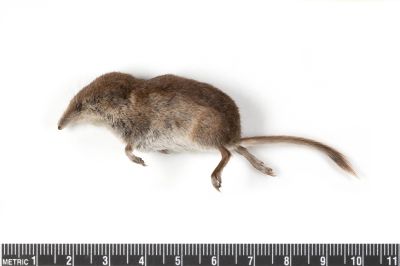
Tundra Shrew (Sorex tundrensis), subadult -

Barren Ground Shrew (Sorex ugyunak) -

Vagrant Shrew (Sorex vagrans), adult in summer coloration -

Vagrant Shrew (Sorex vagrans), adult in winter coloration, almost complete molt
Range maps
Short-tailed Shrews (genus: Blarina)
-

Northern Short-tailed Shrew (Blarina brevicauda) -

Southern Short-tailed Shrew (Blarina carolinensis) -

Elliot's Short-tailed Shrew (Blarina hylophaga) -

Everglades Short-tailed Shrew (Blarina peninsulae) -

Sherman's Short-tailed Shrew (Blarina shermani)
Small-eared shrews (genus: Cryptotis)
-

Berlandier's Least Shrew (Cryptotis berlandieri) -

Florida Least Shrew (Cryptotis floridanus). This species was split from Cryptotis parvus by Galfano et al. (2025). -

North American Least Shrew (Cryptotis parvus)
genus: Notiosorex
-

Cockrum's Gray Shrew (Notiosorex cockrumi) (recognized in 2003 by Baker et al. as species separate from Notiosorex crawfordi) -

Desert Gray Shrew (Notiosorex crawfordi) -

Ticul's Gray Shrew (Notiosorex tataticuli). Recognized as a separate species by Camargo & Álvarez-Castañeda (2020) based on populations previously attributed to Notiosorex crawfordi.
Long-tailed Shrews (genus: Sorex)
-

Eastern Water Shrew (Sorex albibarbis). Split from Sorex palustris by Hope et al. (2014). -

Arctic Shrew (Sorex arcticus) -

Arizona Shrew (Sorex arizonae) -

Marsh Shrew (Sorex bendirii) -

Masked Shrew (Sorex cinereus) -

Rock Shrew (Sorex dispar) -

Western Pygmy Shrew (Sorex eximius). Split from Sorex hoyi by Hope et al. (2020). -

Sorex fontinalis. The American Society of Mammalogists Mammal Diversity Database (v2.2, released June 13, 2025) tentatively includes fontinalis in Sorex cinereus. -

Smoky Shrew (Sorex fumeus) -

Prairie Shrew (Sorex haydeni) -

Eastern Pygmy Shrew (Sorex hoyi). Updated range: this species was split by Hope et al. (2020). -

Saint Lawrence Island Shrew (Sorex jacksoni) -

Southeastern Shrew (Sorex longirostris) -

Mount Lyell Shrew (Sorex lyelli) -

Merriam's Shrew (Sorex merriami) -

Eurasian Least Shrew (Sorex minutissimus). Range in North America shown. -

Southern Montane Shrew (Sorex monticolus). Updated range: this species was split into three clades by Demboski & Cook (2001). S. monticolus includes S. neomexicanus. -

Dwarf Shrew (Sorex nanus) -

Western Water Shrew (Sorex navigator). Split from S. palustris by Hope et al. (2014) and includes S. navigator alaskanus. -

Northern Montane Shrew (Sorex obscurus). Split from S. monticolus by Demboski & Cook (2001). -

Ornate Shrew (Sorex ornatus) -

Pacific Shrew (Sorex pacificus). Phylogentic analysis published by Demboski & Cook (2001) determined that the "coastal clade" contained S. pacificus, S. bairdi (now S. pacificus bairdi), and portions of what was previously considered S. monticolus. -

American Water Shrew (Sorex palustris). Updated range: this species was split by Hope et al. (2014).) -

Preble's Shrew (Sorex preblei). Dark green range is based on molecular analyses conducted by Hope et al. (2012); green hash shading includes the distribution of this species based on earlier morphological studies. -

Pribilof Island Shrew (Sorex pribilofensis) -

Olympic Shrew (Sorex rohweri) -

Fog Shrew (Sorex sonomae) -

Inyo Shrew (Sorex tenellus) -

Trowbridge's Shrew (Sorex trowbridgii) -

Tundra Shrew (Sorex tundrensis). Range in North America shown. -

Barren Ground Shrew (Sorex ugyunak) -

Vagrant Shrew (Sorex vagrans) -

Sorex sp. RM. This is an undescribed species that was genetically identified by Hope et al. (2012). -

Sorex sp. SW. This is an undescribed species that was genetically identified by Hope et al. (2012).
Available taxon pages
The following subfamilies are available on WhiskerWiki for this family:
- Subfamily: Soricinae
- Tribe: Soricini
- Genus: Sorex
- Sorex fontinalis
- Sorex sp. SW
- Sorex sp. RW
- Sorex lyelli
- Sorex longirostris
- Sorex merriami
- Sorex minutissimus
- Sorex monticolus
- Sorex nanus
- Sorex navigator
- Sorex obscurus
- Sorex ornatus
- Sorex pacificus
- Sorex palustris
- Sorex preblei
- Sorex pribilofensis
- Sorex rohweri
- Sorex sonomae
- Sorex tenellus
- Sorex trowbridgii
- Sorex tundrensis
- Sorex ugyunak
- Sorex vagrans
- Sorex albibarbis
- Sorex arcticus
- Sorex arizonae
- Sorex bendirii
- Sorex cinereus
- Sorex dispar
- Sorex eximius
- Sorex fumeus
- Sorex haydeni
- Sorex hoyi
- Sorex jacksoni
- Genus: Sorex
- Tribe: Blarinini
- Tribe: Notiosoricini
- Tribe: Soricini
References
Hoffmeister DF. 1986. Mammals of Arizona. Tucson (AZ, USA): University of Arizona Press.
van Zyll de Jong CG. 1983. Handbook of Canadian mammals-marsupials and insectivores. National Museums of Canada, Ottawa, 1:1-210.
Woodman N. 2018. American Recent Eulipotyphla: Nesophontids, Solenodons, Moles, and Shrews in the New World. Smithsonian Contributions to Zoology. https://doi.org/10.5479/si.1943-6696.650