Skull comparisons
This page provides a quick side-by-side comparison of the skulls of rodents, shrews, and moles found in the United States of America.

Family Soricidae (shrews)
The skull is recognized by an elongated rostrum (the anterior, snout-like portion of the skull); lack of zygomata (or zygomatic arches); first incisor enlarged; tympanic bone is a simple ring; and lack of auditory bullae (Hoffmeister, 1986). In the United States, all of our soricids are in the subfamily Soricinae, the red-toothed shrews. As the common name for the subfamily implies, all species of Blarina, Cryptotis, Notiosorex and Sorex have red-tipped teeth. The number and the size of the unicuspids relative to each other will help to determine the genus.
-

Top (dorsal) view of a Sorex skull showing the location of the missing zygomata. All soricids lack zygomata. -

Tympanic rings (bones) on underside (ventral side) of the skull of Sorex monticola. The tympanic ring is part of the auditory system in shrews. -

Black arrows point to the unicuspids, which are positioned behind the incisors and before the premolars. The number and the size of the unicuspids relative to each other will help to determine the genus. Individual shown is the North American Least Shrew (Cryptotis parvus).


Blarina
-

Dorsal view of the skull of the Elliot's Short-tailed Shrew (Blarina hylophaga), representing members of the genus Blarina. -

Lateral view of the skull of the Northern Short-tailed Shrew (Blarina brevicauda), representing members of the genus Blarina. Members of Blarina have a robust skull and coronoid process. Blarina have five unicuspids per side; the first 2 unicuspids are similar in size and larger than 3rd and 4th unicsupids, which are also similar in size. The 5th unicuspid is minute and may not be visible when viewed from the side.
Cryptotis
-

Dorsal view of the skull of the North American Least Shrew (Cryptotis parvus), representing members of the genus Cryptotis. -

Lateral view of the skull of the North American Least Shrew (Cryptotis parvus). Cryptotis have four unicuspids per side; three unicuspids are clearly visible in side view and the fourth is tiny.
Notiosorex
-

Dorsal view of the skull of the Desert Gray Shrew (Notiosorex crawfordi), representing members of the genus Notiosorex. -

Lateral view of the skull of the Desert Gray Shrew (Notiosorex crawfordi), representing members of the genus Notiosorex. Notiosorex have three unicsupids per side.
Sorex
-

Dorsal view of the skull of the Merriam's Shrew (Sorex merriami), representing members of the genus Sorex. -

Lateral view of the skull of the Masked Shrew (Sorex cinereus), representing members of the genus Sorex. Sorex have five unicuspids per side
Family Talpidae (moles)
Members of the family Talpidae have long skulls with narrow rostrums (the anterior, snout-like portion of the skull). The zygomatic arches are complete, unlike in members of the family Soricidae (above).
Condylura cristata
-

Dorsal view of skull of Star-nosed Mole (Condylura cristata). Condylura cristata is also the only living member of the genus Condylura and tribe Condylurini. -

Lateral view of skull of Star-nosed Mole (Condylura cristata).
Neurotrichus gibbsii
-

Dorsal view of the skull of the American Shrew Mole (Neurotrichus gibbsii), the only living member of the genus Neurotrichus. -

Lateral view of the skull of the American Shrew Mole (Neurotrichus gibbsii).


Parascalops
Scalopus aquaticus (Eastern Mole)
-

Dorsal view of the skull of the Eastern Mole (Scalopus aquaticus), the only living member of the genus Scalopus. -

Lateral view of the skull of the Eastern Mole (Scalopus aquaticus).
Scapanus
-

Dorsal view of the skull of a Townsend's Mole (Scapanus townsendii), representing members of the genus Scapanus. -

Lateral view of the skull of a Townsend's Mole (Scapanus townsendii).
Family Cricetidae (rats, mice, voles, lemmings, and relatives)
Subfamily Arvicolinae (voles, lemmings, and muskrats)
Members of the subfamily Arvicolinae have a postorbital process (a bony projection from the frontal bone that is located at the back, upper edge of the eye socket), which may be distinct or low and rounded. In some species, the upper incisors are grooved.
-

Arrows point to the postorbital process, which is present in all members of the subfamily Arvicolinae. The size and shape of the postorbital process varies by species.

Alexandromys
-

Skull of the Root Vole (Alexandromys oeconomus) showing large, squared braincase, short rostrum, and wide, robust zygomatic arches. -

Ventral view of the skull of the Root Vole (Alexandromys oeconomus). -

The upper incisors of the Root Vole (Alexandromys oeconomus).
Arborimus (tree voles)
-

Dorsal view of the skull of the White-footed Vole (Arborimus albipes), representing members of the genus Arborimus. -

Ventral view of the skull of the White-footed Vole (Arborimus albipes), representing members of the genus Arborimus.
Clethrionomys (red-backed voles)
-

Dorsal view of the skull of the Southern Red-backed Vole (Clethrionomys gapperi) shown, representing the genus Clethrionomys. -

Ventral view of the skull of the Southern Red-backed Vole (Clethrionomys gapperi) shown, representing the genus Clethrionomys.
Dicrostonyx (collared lemmings)
-

Skull of a Nearctic Collared Lemming (Dicrostonyx groenlandicus) shown, representing the genus Dicrostonyx. -

The upper incisors of the Nearctic Collared Lemming (Dicrostonyx groenlandicus) shown. Members of this genus lack grooved upper incisors.
Lemmiscus (sagebrush vole)
-

Skull of the Sagebrush Vole (Lemmiscus curtatus). This species is the only member of the genus Lemmiscus. -

The upper incisors of the Sagebrush Vole (Lemmiscus curtatus). This species is the only member of the genus Lemmiscus.
Lemmus (true lemmings)
-

Skull of the Beringian Brown Lemming (Lemmus nigripes) shown, representing the genus Lemmus. -

Upper incisors of the Beringian Brown Lemming (Lemmus nigripes) shown, representing the genus Lemmus.
Microtus (meadow voles)
-

Skull of the Long-tailed Vole (Microtus longicaudus) shown, representing members of the genus Microtus. -

Skull of the Long-tailed Vole (Microtus longicaudus) showing the upper incisors, which lack grooves. All members of the genus Microtus have upper incisors that lack grooves.
Mictomys borealis (northern bog lemming)
-

Dorsal view of the skull of the Northern Bog Lemming (Mictomys borealis). This is the only species in the genus. -

Skull of the Northern Bog Lemming (Mictomys borealis), showing grooved upper incisors. This is the only species in the genus.
Neofiber alleni (Round-tailed Muskrat)
-

Dorsal view of the skull of the Round-tailed Muskrat (Neofiber alleni). This is the only species in the genus. -

Ventral view of the skull of the Round-tailed Muskrat (Neofiber alleni). This is the only species in the genus.
Ondatra zibethicus (Common Muskrat)
-

Dorsal view of the skull of the Common Muskrat (Ondatra zibethicus). -

Ventral view of the skull of the Common Muskrat (Ondatra zibethicus).
Phenacomys (heather voles)
-

Dorsal view of the skull of the Western Heather Vole (Phenacomys intermedius). -

The upper incisors of Western Heather Vole (Phenacomys intermedius) lack grooves.
Synaptomys (southern bog lemming)
-

Dorsal view of the skull of the Southern Bog Lemming (Synaptomys cooperi). This is the only species in the genus. -

Skull of the Southern Bog Lemming (Synaptomys cooperi), showing grooved upper incisors. This is the only species in the genus.
Subfamily Neotominae (deer mice, woodrats, and relatives)
Members of the subfamily Neotominae have complete zygomatic arches and lack a postorbital process (see subfamily Arvicolinae, above). The upper incisors are smooth, except in Reithrodontomys they are grooved.
Baiomys (pygmy mice)
-

Dorsal view of the skull of the Northern Pygmy Mouse (Baiomys taylori). This is the only species in the genus. -

Upper molars of the Northern Pygmy Mouse (Baiomys taylori). This is the only species in the genus.
Neotoma (woodrats or packrats)
-

Skull of the White-throated Woodrat (Neotoma albigula), representing members of the genus Neotoma. -

Upper molars of the White-throated Woodrat (Neotoma albigula), representing members of the genus Neotoma.
Ochrotomys nuttali (Golden Mouse)
-

Dorsal view of the skull of the Golden Mouse (Ochrotomys nuttalli). -

Upper molars of the Golden Mouse (Ochrotomys nuttalli).
Onychomys (grasshopper mice)
-

Skull of the Northern Grasshopper Mouse (Onychomys leucogaster), representing members of the genus Onychomys. -

Upper molars of the Northern Grasshopper Mouse (Onychomys leucogaster), representing members of the genus Onychomys.
Oryzomys (rice rats)
-

Dorsal view of the skull of the Coues's Marsh Rice Rat (Oryzomys couesi), representing members of the genus Oryzomys. -

Upper molars of the skull of the Coues's Marsh Rice Rat (Oryzomys couesi), representing members of the genus Oryzomys.
Peromyscus (deer mice)
-

Skull of the Brush Deermouse (Peromyscus boylii) shown, representing members of the genus Peromyscus. -

Skull of the Brush Deermouse (Peromyscus boylii) showing incisors that lack grooves. All Peromyscus lack grooved upper incisors.
Podomys floridanus (Florida Mouse)
-

Dorsal view of the skull of the Florida Deermouse (Podomys floridanus). -

Upper molars of the Florida Deermouse (Podomys floridanus).
Reithrodontomys
-

Skull of the Fulvous Harvest Mouse (Reithrodontomys fulvescens) shown, representing members of the genus Reithrodontomys. -

Skull of the Fulvous Harvest Mouse (Reithrodontomys fulvescens) showing grooved upper incisors, which is characteristic of the genus.
Subfamily Sigmodontinae (cotton rats)
Sigmodon
-

Dorsal view of the skull of the Hispid Cotton Rat (Sigmodon hispidus), representing members of the genus Sigmodon. -
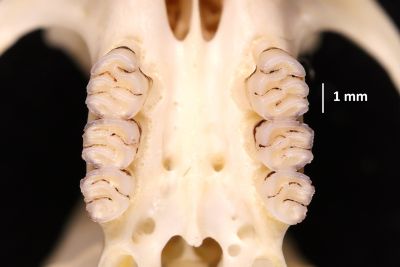
Upper molars of the Hispid Cotton Rat (Sigmodon hispidus), representing members of the genus Sigmodon. The name Sigmodon refers to the more or less "S" shape formed by the cusps on the molars, especially those of the third molar.
Family Muridae (old world rats and mice)
Mus musculus (House Mouse)
-

Skull of Mus musculus. -

Upper incisors of Mus musculus lack grooves.
Rattus
-

Dorsal view of the skull of the Roof Rat (Rattus rattus), representing members of the genus Rattus. -

Upper incisors of the skull of the Roof Rat (Rattus rattus), representing members of the genus Rattus. The upper incisors lack grooves.
Family Heteromyidae (kangaroo rats, pocket mice, and relatives)
Members of the family Heteromyidae have skulls that are somewhat triangular in shape, with complete zygomatic arches, enlarged auditory bullae, and grooved upper incisors.
Chaetodipus
-

Skull of the Desert Pocket Mouse (Chaetodipus penicillatus) shown, representing members of the genus Chaetodipus. -

Skull of the Desert Pocket Mouse (Chaetodipus penicillatus) showing the grooved upper incisors. All members of the genus Chaetodipus have grooved upper incisors.
Dipodomys
-

Skull of the Ord's Kangaroo Rat (Dipodomys ordii) shown, representing members of the genus Dipodomys. -

Skull of the Ord's Kangaroo Rat (Dipodomys ordii) showing the grooved upper incisors. Members of the genus Dipodomys have grooved upper incisors.
Microdipodops
-

Skull of a Kangaroo Mouse. Members of the genus Microdipodops have auditory bullae that are inflated so much so as to completely obscure the interparietal. White arrows point to the auditory bullae; yellow arrow points toward the interparietal bone.
Perognathus
-

Skull of the Silky Pocket Mouse (Perognathus flavus) shown, representing members of the genus Perognathus. -

Skull of Perognathus flavus showing grooved upper incisors. All members of the genus Perognathus have grooved upper incisors.
Family Zapodidae (jumping mice)
Members of the family Zapodidae have skulls with complete zygomatic arches, lack a postorbital process (see subfamily Arvicolinae, above), and have grooved upper incisors. Napaeozapus have 3 cheekteeth (molariform teeth); Zapus have four molariform teeth.
Napaeozapus
-

Dorsal view of the skull of the Western Woodland Jumping Mouse (Napaeozapus abietorum), representing members of the genus Napaeozapus. -

Upper incisors of the Western Woodland Jumping Mouse (Napaeozapus abietorum), representing members of the genus Napaeozapus. All members of Napaeozapus have grooved upper incisors.


Zapus
-

Dorsal view of the skull of the Southwestern Jumping Mouse (Zapus princeps), representing members of the genus Zapus. -

Grooved upper incisors of Southwestern Jumping Mouse (Zapus princeps), representing members of the genus Zapus.
Family Geomyidae (pocket gophers)
Four genera of pocket gophers are found in the United States. The skulls are robust and rather blocky. In Cratogeomys, the upper incisors each have one longitudinal groove. In Geomys, the upper incisors each have two longitudinal grooves. In Megascapheus and Thomomys, the upper incisors lack conspicuous longitudinal grooves and further examination of the skull and teeth is required. From Álvarez-Castañeda and Segura-Trujillo (2025): "Morphological difference between Megascapheus in relation to Thomomys are: the upper incisors procumbent and their root between the fourth upper premolars and the first upper molars vs upper incisors not procumbent and their root above the fourth upper premolars; sphenoidal fissure open vs closed (except for some specimens of T. clusius'); angular process continuous, with a well-developed flange along the ventral ramus side vs not continuous, with a weakly developed flange along the ventral ramus side; rostrum heavy vs rostrum slender; base of the first lower premolars inclined anteriorly vs nearly perpendicular to the occlusal surface of the toothrow; infraorbital canal openings anterior to the incisive foramina vs directly above or slightly posterior to the incisive foramina; anterior enamel plate of the first lower premolars not recurved vs recurved, frequently forming a shallow re-entrant angle; anterior enamel plate of the first lower premolars narrow and broadly separated from the lateral enamel plate on the lingual side, vs only slightly separated from the posterior enamel plate (rarely continuous), with the lateral enamel plate on the lingual side
Cratogeomys
-

Dorsal view of the skull of the Yellow-faced Pocket Gopher (Cratogeomys castanops). This is the only member in the genus Cratogeomys. -

Ventral view of the skull of the Yellow-faced Pocket Gopher (Cratogeomys castanops). This is the only member in the genus Cratogeomys. The upper incisors each have one longitudinal groove.
Geomys
-

Dorsal view of the skull of the Plains Pocket Gopher (Geomys bursarius), representing members of the genus Geomys. -

Ventral view of the skull of the Plains Pocket Gopher (Geomys bursarius), representing members of the genus Geomys. The upper incisors each have two longitudinal grooves.
Megascapheus (smooth-toothed pocket gophers)
-

Dorsal view of the skull of the Southwestern Texas Pocket Gopher (Megascapheus baileyi), representing members of the genus Megascapheus. The upper incisors lack conspicuous longitudinal grooves. -
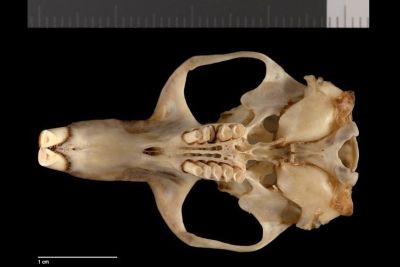
Ventral view of the skull of the Southwestern Texas Pocket Gopher (Megascapheus baileyi), representing members of the genus Megascapheus.
Thomomys (smooth-toothed pocket gophers)
-

Dorsal view of the skull of the Idaho Pocket Gopher (Thomomys idahoensis), representing members of the genus Thomomys. -

Ventral view of the skull of the Idaho Pocket Gopher (Thomomys idahoensis), representing members of the genus Thomomys. The upper incisors lack conspicuous longitudinal grooves.
Family Sciuridae (chipmunks, squirrels, marmots, and their relatives)
Members of the family Sciuridae have a sharply pointed postorbital process (a bony projection from the frontal bone that is located at the back, upper edge of the eye socket).
Ammospermophilus (antelope sqiurrels)

Dorsal view of the skull of the Harris's Antelope Squirrel (Ammospermophilus harrisii), representing members of the genus Ammospermophilus. 
Ventral view of the skull of the Harris's Antelope Squirrel (Ammospermophilus harrisii), representing members of the genus Ammospermophilus.
Callospermophilus (golden-mantled ground squirrels)
-

Dorsal view of the skull of the Common Golden-mantled Ground Squirrel (Callospermophilus lateralis), representing members of the genus Callospermophilus. -

Ventral view of the skull of the Common Golden-mantled Ground Squirrel (Callospermophilus lateralis), representing members of the genus Callospermophilus.
Cynomys (prairie dogs)
-

Dorsal view of the skull of the Gunnison's Prairie Dog (Cynomys gunnisoni), representing members of the genus Cynomys. -

Lateral view of the skull of the Gunnison's Prairie Dog (Cynomys gunnisoni), representing members of the genus Cynomys.
Glaucomys (flying squirrels)
-

Dorsal view of the skull of the Northern Flying Squirrel (Glaucomys sabrinus), representing members of the genus Glaucomys. -

Ventral view of the skull of the Northern Flying Squirrel (Glaucomys sabrinus), representing members of the genus Glaucomys.
Ictidomys ground squirrels
-

Dorsal view of the skull of the Thirteen-lined Ground Squirrel (Ictidomys tridecemlineatus), representing members of the genus Ictidomys. -

Ventral view of the skull of the Thirteen-lined Ground Squirrel (Ictidomys tridecemlineatus), representing members of the genus Ictidomys.
Marmota (marmots)
-

Dorsal view of the skull of the Hoary Marmot (Marmota caligata), representing members of the genus Marmota. -

Lateral view of the skull of the Hoary Marmot (Marmota caligata), representing members of the genus Marmota.
Neotamias and Tamias (chipmunks)
-

Dorsal view of the skull of the Least Chipmunk (Neotamias minimus), representing members of the genus Neotamias. -

Lateral view of the skull of the Least Chipmunk (Neotamias minimus), representing members of the genus Neotamias.
Otospermophilus (ground squirrels)
-

Dorsal view of the skull of the Common Rock Squirrel (Otospermophilus variegatus), representing member of the genus Otospermophilus. -

Lateral view of the skull of the Common Rock Squirrel (Otospermophilus variegatus), representing member of the genus Otospermophilus.
Poliocitellus franklinii (Franklin's Ground Squirrel)
Sciurus (tree squirrels)
-

Dorsal view of the skull of the Eastern Fox Squirrel (Sciurus niger), representing members of the genus Sciurus. -

Ventral view of the skull of the Eastern Fox Squirrel (Sciurus niger), representing members of the genus Sciurus.
Tamiasciurus (tree squirrels)
-

Dorsal view of the skull of the North American Red Squirrel (Tamiasciurus hudsonicus), representing members of the genus Tamiasciurus. -

Ventral view of the skull of the North American Red Squirrel (Tamiasciurus hudsonicus), representing members of the genus Tamiasciurus.
Urocitellus (ground squirrels)
-

Dorsal view of the skull of the Arctic Ground Squirrel (Urocitellus parryii), representing members of the genus Urocitellus. -

Ventral view of the skull of the Arctic Ground Squirrel (Urocitellus parryii), representing members of the genus Urocitellus.
Xerospermophilus (ground squirrels)
-

Dorsal view of the skull of the Spotted Ground Squirrel (Xerospermophilus spilosoma), representing members of the genus Xerospermophilus. -

Ventral view of the skull of the Spotted Ground Squirrel (Xerospermophilus spilosoma), representing members of the genus Xerospermophilus.
Family Aplodontiidae
Aplondontia rufa (Mountain Beaver)
-

Dorsal view of the skull of the Mountain Beaver (Aplodontia rufa). This is the only species in the family Aplodontiidae. -

Ventral view of the skull of the Mountain Beaver (Aplodontia rufa). This is the only species in the family Aplodontiidae.
Family Erethizontidae (porcupine)
Erethizon dorsatum (North American Porcupine)
-

Dorsal view of the skull of the North American Porcupine (Erethizon dorsatum). This is the only species in the family Erethizontidae. -

Lateral view of the skull of the North American Porcupine (Erethizon dorsatum). This is the family Erethizontidae.
Family Castoridae
Castor canadensis (North American Beaver)
-

Dorsal view of the skull of the North American Beaver (Castor canadensis). This is the only species in the family Castoridae. -

Dorsal view of the skull of the North American Beaver (Castor canadensis). This is the only species in the family Castoridae.