Range maps for pocket gophers
Pocket gophers, commonly referred to as gophers, are burrowing rodents of the family Geomyidae. Below are the range maps for all currently recognized species in the family Geomyidae that occur in the United States of America
Before using species range maps for any purpose, we urge you to exercise caution and be aware of potential limitations and challenges associated with their interpretation. While we have made efforts to create the most up-to-date range maps by synthesizing diverse data sources, including historical published range maps, occurrence data from natural history specimens, field guides, peer-reviewed published research, and personal communication with experts, these data may have varying degrees of accuracy and reliability, leading to potential inaccuracies and gaps in the representation of a species' distribution. For some species, data may be scarce or biased toward easily accessible areas, resulting in incomplete representation of their true range. Taxonomic revisions can affect species identification and may not be immediately reflected in range maps, potentially leading to misinterpretation. Exercise prudence in the application of these maps and acknowledge their limitations to make informed decisions for conservation, research, species identification, and project planning.
Cratogeomys (pocket gopher) in the United States
-

Yellow-faced Pocket Gopher (Cratogeomys castanops)
Geomys (pocket gophers) in the United States
-

Desert Pocket Gopher (Geomys arenarius) -

Attwater's Pocket Gopher (Geomys attwateri) -

Brazos Pocket Gopher (Geomys brazensis) -

Plains Pocket Gopher (Geomys bursarius) -

Hall's Pocket Gopher (Geomys jugossicularis) -

Jones's Pocket Gopher (Geomys knoxjonesi) -

Sand Hills Pocket Gopher (Geomys lutescens) -

Alabama Pocket Gopher (Geomys mobilensis) -

Texas Pocket Gopher (Geomys personatus) -

Southeastern Pocket Gopher (Geomys pinetis) -

Strecker's Pocket Gopher (Geomys streckeri) -

Llano Pocket Gopher (Geomys texensis)
Megascapheus (smooth-toothed, tooth-digging pocket gophers) in the United States
Genetic analyses (CytB and COI) by Álvarez-Castañeda and Segura-Trujillo (2025) found that the two subgenera within the genus Thomomys Wied-Neuwied, 1839 — Megascapheus and Thomomys — are genetically distinct. Morphological and genetic data support considering these differences sufficient at the genus level. As such, the subgenus Megascapheus in Thomomys Wied-Neuwied, was elevated to generic status (genus level).
-
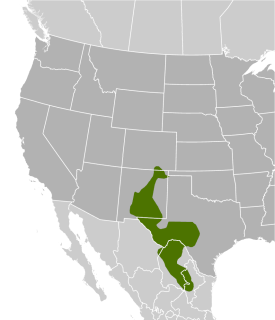
Southwestern Texas Pocket Gopher (Megascapheus baileyi). Elevated to specific status by Bradley et al. (2023). -
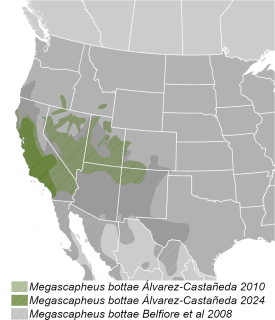
Botta's Pocket Gopher (Megascapheus bottae). Warning! The ranges above may be unreliable. Recent molecular analyses have led to significant changes in our understanding of the distribution of this species. The most recent published range of this species was by Álvarez-Castañeda (2024) in Mammals of North America-Volume 2: Systematics and Taxonomy; however, this is not a peer reviewed publication. That range map is based on earlier, peer-reviewed molecular analyses by Álvarez-Castañeda (2010), which lists the range of bottae as rest of California, north and west of the Colorado River." Based on Figure 2. in Álvarez-Castañeda (2010), the range of bottae should include southern Oregon, southern Idaho, California, Nevada, Utah, Colorado, northern Arizona, and northern New Mexico. The range discrepancy between Álvarez-Castañeda (2010) and Álvarez-Castañeda (2024) is substantial. -

Camas Pocket Gopher (Megascapheus bulbivorus) -

New Mexico Pocket Gopher (Megascapheus connectens). Elevated to specific status by Bradley et al. (2023). Distribution (dark green) of connectens is based on Sands and Finley (1959). Distribution (light green) of connectens is based on Bradley et al. (2023). Bradley et al. (2023) note that their distribution is approximated. -

Fulvous Pocket Gopher (Megascapheus fulvus) Elevated to specific status by Bradley et al. (2023). Warning! The ranges above may be unreliable. Recent molecular analyses have led to significant changes in our understanding of the distribution of this species. The most recent published range (light green) of this species was by Álvarez-Castañeda (2024) in Mammals of North America-Volume 2: Systematics and Taxonomy; however, this is not a peer reviewed publication. That range map is based on earlier, peer-reviewed molecular analyses by Álvarez-Castañeda (2010), which lists the range of fulvus as "south and east of the Colorado River to the Sierra Madre Occidental in Sonora." The range presented in dark green is based on Álvarez-Castañeda (2010) and Bradley et al. (2023). The range discrepancy between Álvarez-Castañeda (2010) and Álvarez-Castañeda (2024) is substantial. -

Northern California Pocket Gopher (Megascapheus laticeps) -

Southern California Pocket Gopher (Megascapheus nigricans) -

Ruidoso Pocket Gopher (Megascapheus ruidosae). Elevated to specific status by Bradley et al. (2023). The dark green area represents the distribution of Megascapheus ruidosae according to Bradley et al. (2023). The light green area represents the range of Megascapheus baileyi subspecies actuosus and an area of uncertainty for Megascapheus ruidosae. Accordingly to Bradley et al. (2023), some individuals of actuosus from the type locality in Corona, NM, possessed a mtDNA haplotype reflective of actuosus, whereas others possessed a haplotype associated with ruidosae: "Further studies are needed to determine whether samples of actuosus that presumably hybridize with ruidosae should be assigned to this new species". -

Townsend's Pocket Gopher (Megascapheus townsendii) -

Southern Pocket Gopher (Megascapheus umbrinus)
Thomomys (smooth-toothed, claw-digging pocket gophers) in the United States
-

Wyoming Pocket Gopher (Thomomys clusius) -

Idaho Pocket Gopher (Thomomys idahoensis) -

Western Pocket Gopher (Thomomys mazama) -

Mountain Pocket Gopher (Thomomys monticolus) -

Northern Pocket Gopher (Thomomys talpoides)