Mandible comparisons
This page provides a quick side-by-side comparison of the mandibles of rodents, shrews, and moles found in the United States of America.

Family Soricidae (shrews)
In the United States, all of our soricids are in the subfamily Soricinae, the red-toothed shrews. As the common name for the subfamily implies, all species of Blarina, Cryptotis, Notiosorex and Sorex have red-tipped teeth.
Blarina
-
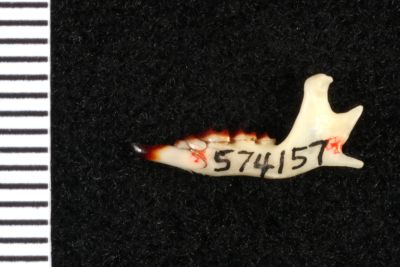
Lateral view of the left mandible of the Southern Short-tailed Shrew (Blarina carolinensis), representing members of the genus Blarina. -
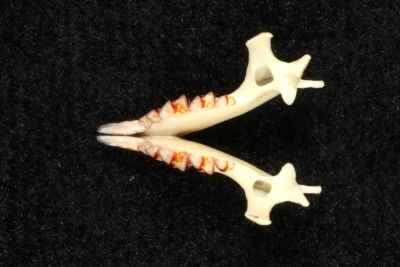
Dorsal view of the mandible of the Southern Short-tailed Shrew (Blarina carolinensis), representing members of the genus Blarina.
Cryptotis
Notiosorex
Sorex
-

Lateral view of the left mandible of the Marsh Shrew (Sorex bendirii), representing members of the genus Sorex. -

Dorsal view of the mandible of the Marsh Shrew (Sorex bendirii), representing members of the genus Sorex.
Family Talpidae (moles)
Members of the family Talpidae have long skulls with narrow rostrums (the anterior, snout-like portion of the skull). The zygomatic arches are complete, unlike in members of the family Soricidae (above).
Condylura cristata
-

Lateral view of skull of Star-nosed Mole (Condylura cristata).
Neurotrichus gibbsii
-

Lateral view of the skull of the American Shrew Mole (Neurotrichus gibbsii).

Parascalops
Scalopus aquaticus (Eastern Mole)
-

Lateral view of the left mandible of the Eastern Mole (Scalopus aquaticus), the only living member of the genus Scalopus. -

Dorsal view of the mandible of the Eastern Mole (Scalopus aquaticus), the only living member of the genus Scalopus.
Scapanus
-

Lateral view of the skull of a Townsend's Mole (Scapanus townsendii).
Family Cricetidae (rats, mice, voles, lemmings, and relatives)
Subfamily Arvicolinae (voles, lemmings, and muskrats)
Alexandromys
-

Dorsal view of the mandible of the Root Vole (Alexandromys oeconomus).
Arborimus (tree voles)
-

Lateral view of the left mandible of the White-footed Vole (Arborimus albipes), representing members of the genus Arborimus. -

Dorsal view of the mandible of the White-footed Vole (Arborimus albipes), representing members of the genus Arborimus.
Clethrionomys (red-backed voles)
-

Lateral view of the left mandible of the Southern Red-backed Vole (Clethrionomys gapperi) shown, representing the genus Clethrionomys. -

Dorsal view of the mandible of the Southern Red-backed Vole (Clethrionomys gapperi) shown, representing the genus Clethrionomys.
Dicrostonyx (collared lemmings)
-

Lateral view of the mandible of a Unalaska Collared Lemming (Dicrostonyx unalascensis) shown, representing the genus Dicrostonyx. -

Dorsal view of the mandible of a Unalaska Collared Lemming (Dicrostonyx unalascensis) shown, representing the genus Dicrostonyx.
Lemmiscus (sagebrush vole)
Lemmus (true lemmings)
Microtus (meadow voles)
-

Dorsal view of the mandible of the Long-tailed Vole (Microtus longicaudus) shown, representing members of the genus Microtus. -

Lateral view of the mandible of the Long-tailed Vole (Microtus longicaudus) shown, representing members of the genus Microtus.
Mictomys borealis (northern bog lemming)
Neofiber alleni (Round-tailed Muskrat)
-

Lateral view of the left mandible of the Round-tailed Muskrat (Neofiber alleni). -

Dorsal view of the mandible of the Round-tailed Muskrat (Neofiber alleni).
Ondatra zibethicus (Common Muskrat)
-

Lateral view of the left mandible of the Common Muskrat (Ondatra zibethicus). -

Dorsal view of the mandible of the Common Muskrat (Ondatra zibethicus).
Phenacomys (heather voles)
Synaptomys (southern bog lemming)
Subfamily Neotominae (deer mice, woodrats, and relatives)
Members of the subfamily Neotominae have complete zygomatic arches and lack a postorbital process (see subfamily Arvicolinae, above). The upper incisors are smooth, except in Reithrodontomys they are grooved.
Baiomys (pygmy mice)
Neotoma (woodrats or packrats)
-

Lateral view of the mandible of the White-throated Woodrat (Neotoma albigula), representing members of the genus Neotoma. -

Dorsal view of the mandible of the White-throated Woodrat (Neotoma albigula), representing members of the genus Neotoma.
Ochrotomys nuttali (Golden Mouse)
-

Lateral view of the mandible of the Golden Mouse (Ochrotomys nuttalli). -

Dorsal view of the mandible of the Golden Mouse (Ochrotomys nuttalli).
Onychomys (grasshopper mice)
-

Lateral view of the mandible of the Northern Grasshopper Mouse (Onychomys leucogaster), representing members of the genus Onychomys. -

Dorsal view of the mandible of the Northern Grasshopper Mouse (Onychomys leucogaster), representing members of the genus Onychomys.
Oryzomys (rice rats)
-
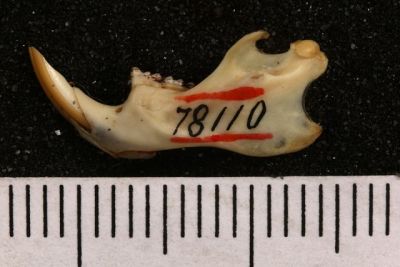
Lateral view of the mandible of the Coues's Marsh Rice Rat (Oryzomys couesi), representing members of the genus Oryzomys. -
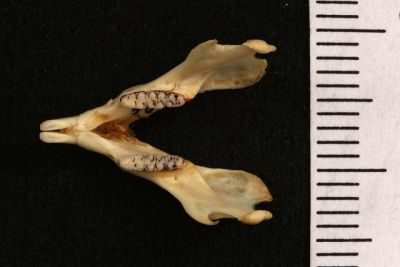
Dorsal view of the mandible of the Coues's Marsh Rice Rat (Oryzomys couesi), representing members of the genus Oryzomys.
Peromyscus (deer mice)
-
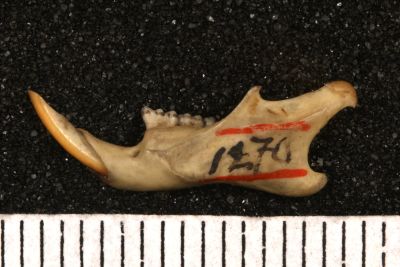
Lateral view of the mandible of the Brush Deermouse (Peromyscus boylii), representing members of the genus Peromyscus. -

Dorsal view of the mandible of the Brush Deermouse (Peromyscus boylii), representing members of the genus Peromyscus.
Podomys floridanus (Florida Mouse)
Reithrodontomys
-

Lateral view of the left mandible of the Fulvous Harvest Mouse (Reithrodontomys fulvescens) shown, representing members of the genus Reithrodontomys. -

Dorsal view of the mandible of the Fulvous Harvest Mouse (Reithrodontomys fulvescens) shown, representing members of the genus Reithrodontomys.
Subfamily Sigmodontinae (cotton rats)
Sigmodon
-

Lateral view of the left mandible of the Hispid Cotton Rat (Sigmodon hispidus), representing members of the genus Sigmodon. -

Dorsal view of the mandible of the Hispid Cotton Rat (Sigmodon hispidus), representing members of the genus Sigmodon.
Family Muridae (old world rats and mice)
Mus musculus (House Mouse)
-

Lateral view of the left mandible of the House Mouse (Mus musculus). -

Dorsal view of the mandible of the House Mouse (Mus musculus).
Rattus
-
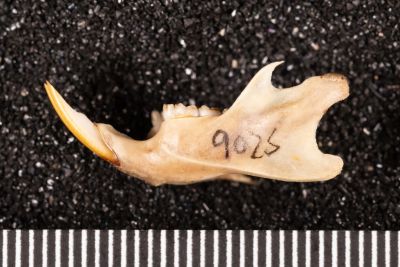
Lateral view of the left mandible of the Roof Rat (Rattus rattus), representing members of the genus Rattus. -

Dorsal view of the mandible of the Roof Rat (Rattus rattus), representing members of the genus Rattus.
Family Heteromyidae (kangaroo rats, pocket mice, and relatives)
Members of the family Heteromyidae have skulls that are somewhat triangular in shape, with complete zygomatic arches, enlarged auditory bullae, and grooved upper incisors.
Chaetodipus
-

Lateral view of the mandible of the San Diego Pocket Mouse (Chaetodipus fallax) shown, representing members of the genus Chaetodipus. -

Dorsal view of the mandible of the San Diego Pocket Mouse (Chaetodipus fallax) shown, representing members of the genus Chaetodipus.
Dipodomys
-

Lateral view of the mandible of the Chisel-toothed Kangaroo Rat (Dipodomys microps) shown, representing members of the genus Dipodomys. -

Dorsal view of the mandible of the Chisel-toothed Kangaroo Rat (Dipodomys microps) shown, representing members of the genus Dipodomys.
Microdipodops
-

Lateral view of the mandible of the No common name found for Microdipodops oregonus, representing members of the genus Microdipodops. -

Dorsal view of the mandible of the No common name found for Microdipodops oregonus, representing members of the genus Microdipodops.
Perognathus
-

Lateral view of the mandible of the Silky Pocket Mouse (Perognathus flavus), representing members of the genus Perognathus. -
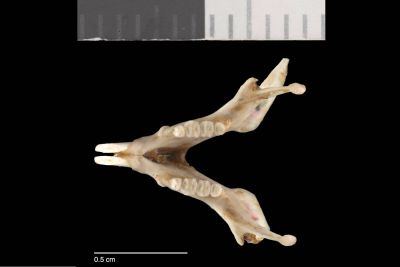
Dorsal view of the mandible of the Silky Pocket Mouse (Perognathus flavus), representing members of the genus Perognathus.
Family Zapodidae (jumping mice)
Members of the family Zapodidae have skulls with complete zygomatic arches, lack a postorbital process (see subfamily Arvicolinae, above), and have grooved upper incisors. Napaeozapus have 3 cheekteeth (molariform teeth); Zapus have four molariform teeth.
Napaeozapus
Zapus
-

Lateral view of the mandible of the Central Pacific Jumping Mouse (Zapus montanus), representing members of the genus Zapus. -

Dorsal view of the mandible of the Central Pacific Jumping Mouse (Zapus montanus), representing members of the genus Zapus.
Family Geomyidae (pocket gophers)
Cratogeomys
-

Lateral view of the mandible of the Yellow-faced Pocket Gopher (Cratogeomys castanops). This is the only member in the genus Cratogeomys. -

Dorsal view of the mandible of the Yellow-faced Pocket Gopher (Cratogeomys castanops). This is the only member in the genus Cratogeomys.
Geomys
-

Lateral view of the mandible of the Plains Pocket Gopher (Geomys bursarius), representing members of the genus Geomys. -

Dorsal view of the mandible of the Plains Pocket Gopher (Geomys bursarius), representing members of the genus Geomys. The upper incisors each have two longitudinal grooves.
Megascapheus (smooth-toothed pocket gophers)
-
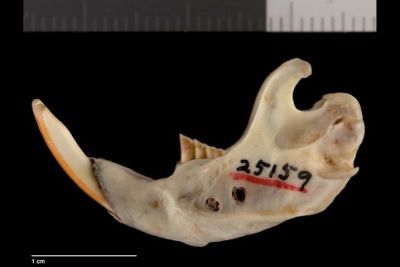
Lateral view of the mandible of the Southwestern Texas Pocket Gopher (Megascapheus baileyi), representing members of the genus Megascapheus. -
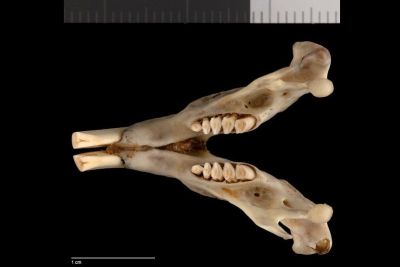
Dorsal view of the mandible of the Southwestern Texas Pocket Gopher (Megascapheus baileyi), representing members of the genus Megascapheus.
Thomomys (smooth-toothed pocket gophers)
-

Lateral view of the mandible of the Western Pocket Gopher (Thomomys mazama), representing members of the genus Thomomys. -

Dorsal view of the mandible of the Western Pocket Gopher (Thomomys mazama), representing members of the genus Thomomys.
Family Sciuridae (chipmunks, squirrels, marmots, and their relatives)
Members of the family Sciuridae have a sharply pointed postorbital process (a bony projection from the frontal bone that is located at the back, upper edge of the eye socket).
Ammospermophilus (antelope sqiurrels)

Lateral view of the mandible of the Harris's Antelope Squirrel (Ammospermophilus harrisii), representing members of the genus Ammospermophilus. 
Dorsal view of the mandible of the Harris's Antelope Squirrel (Ammospermophilus harrisii), representing members of the genus Ammospermophilus.
Callospermophilus (golden-mantled ground squirrels)
-
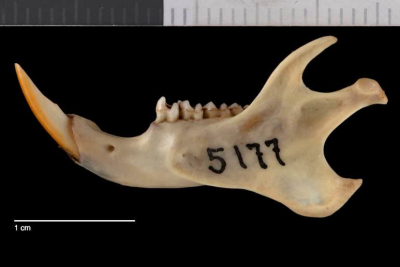
Lateral view of the mandible of the Common Golden-mantled Ground Squirrel (Callospermophilus lateralis), representing members of the genus Callospermophilus. -
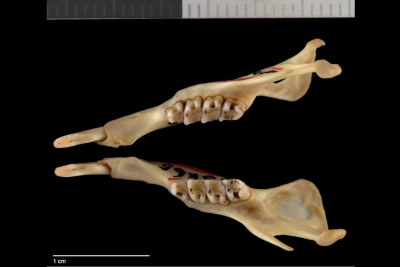
Dorsal view of the mandible of the Common Golden-mantled Ground Squirrel (Callospermophilus lateralis), representing members of the genus Callospermophilus.
Cynomys (prairie dogs)
-

Lateral view of the mandible of the White-tailed Prairie Dog (Cynomys leucurus), representing members of the genus Cynomys. -

Dorsal view of the mandible of the White-tailed Prairie Dog (Cynomys leucurus), representing members of the genus Cynomys.
Glaucomys (flying squirrels)
-

Lateral view of mandible of the Southern Flying Squirrel (Glaucomys volans), representing members of the genus Glaucomys. -

Dorsal view of the mandible of the Southern Flying Squirrel (Glaucomys volans), representing members of the genus Glaucomys.
Ictidomys ground squirrels
-
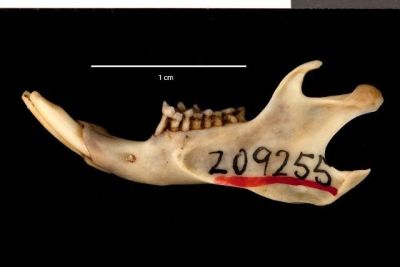
Lateral view of the mandilbe of the Thirteen-lined Ground Squirrel (Ictidomys tridecemlineatus), representing members of the genus Ictidomys. -

Dorsal view of the mandible of the Thirteen-lined Ground Squirrel (Ictidomys tridecemlineatus), representing members of the genus Ictidomys. -

Lateral view of the mandible of the Yellow-bellied Marmot (Marmota flaviventris), representing members of the genus Marmota. -

Dorsal view of the mandible of the Yellow-bellied Marmot (Marmota flaviventris), representing members of the genus Marmota. -

Lateral view of the mandible of the Least Chipmunk (Neotamias minimus), representing members of the genus Neotamias. -

Dorsal view of the mandible of the Least Chipmunk (Neotamias minimus), representing members of the genus Neotamias. -

Dorsal view of the mandible of the Eastern Chipmunk (Tamias striatus). -

Lateral view of the mandible of the Eastern Chipmunk (Tamias striatus). -

Dorsal view of the mandible of the California Ground Squirrel (Otospermophilus beecheyi), representing members of the genus Otospermophilus. -

Lateral view of the mandible of the California Ground Squirrel (Otospermophilus beecheyi), representing members of the genus Otospermophilus. -

Lateral view of the mandible of the Eastern Fox Squirrel (Sciurus niger), representing members of the genus Sciurus. -

Dorsal view of the mandible of the Eastern Fox Squirrel (Sciurus niger), representing members of the genus Sciurus. -

Lateral view of the mandible of the North American Red Squirrel (Tamiasciurus hudsonicus), representing members of the genus Tamiasciurus. -

Dorsal view of the mandible of the North American Red Squirrel (Tamiasciurus hudsonicus), representing members of the genus Tamiasciurus. -

Lateral view of the mandible of the Arctic Ground Squirrel (Urocitellus parryii), representing members of the genus Urocitellus. -

Dorsal view of the mandible of the Arctic Ground Squirrel (Urocitellus parryii), representing members of the genus Urocitellus. -

Lateral view of the mandible of the Mohave Ground Squirrel (Xerospermophilus mohavensis), representing members of the genus Xerospermophilus. -

Dorsal view of the mandible of the Mohave Ground Squirrel (Xerospermophilus mohavensis), representing members of the genus Xerospermophilus. -

Lateral view of the mandible of the Mountain Beaver (Aplodontia rufa). This is the only species in the family Aplodontiidae. -

Dorsal view of the mandible of the Mountain Beaver (Aplodontia rufa). This is the only species in the family Aplodontiidae. -
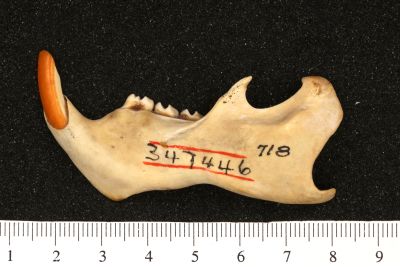
Lateral view of the mandible of the North American Porcupine (Erethizon dorsatum). This is the only species in the family Erethizontidae. -

Dorsal view of the mandible of the North American Porcupine (Erethizon dorsatum). This is the family Erethizontidae. -

Lateral view of the mandible of the North American Beaver (Castor canadensis). This is the only species in the family Castoridae. -

Dorsal view of the mandible of the North American Beaver (Castor canadensis). This is the only species in the family Castoridae.
Marmota (marmots)
Neotamias and Tamias (chipmunks)
Otospermophilus (ground squirrels)
Poliocitellus franklinii (Franklin's Ground Squirrel)