Neotoma magister
| Allegheny Woodrat
(Neotoma magister) | |
|---|---|
| Range | |
 | |
| Taxonomic classification | |
| Order: | Rodentia |
| Suborder: | Supramyomorpha |
| Infraorder: | Myomorphi |
| Superfamily: | Muroidea |
| Family: | Cricetidae |
| Subfamily: | Neotominae |
| Tribe: | Neotomini |
| Genus: | Neotoma |
| Binomial details | |
| Neotoma magister S. F. Baird, 1857 | |
| Other resources | |
| Full taxonomic details at MDD | |
The Allegheny Woodrat (Neotoma magister) is a woodrat found in a variety of rocky and forested habitats, such as boulder fields, caves, cliff faces, or talus slopes (Castleberry et al., 2006).
Description
From Castleberry et al. (2006): "Dorsal pelage is gray to brownish gray with more brown typically present in adults. Ventral surface is white from throat to tip of tail. Tail is long, moderately haired, and distinctly bicolored. A midventral gland is present in adults of both sexes."
From Best & Hunt (2020): "Allegheny woodrats are medium-sized rodents with pelage that is soft and gray or brownish-gray on the dorsum and white on the ventrum. A gland on the ventrum of both sexes produces a yellowish discoloration and a strong odor during the breeding season. The tail is well haired, long, and distinctly bicolored, with dark hairs on top and whitish hairs on the underside. Ears are conspicuous and rounded. Eyes are dark and prominent. Vibrissae are numerous and more than 51 mm long."

Museum specimens
-

CHAS:Mamm:2517. Allegheny Woodrat (Neotoma magister). Adult female. Shartlesville, Berks County, Pennsylvania. Collected in 1931. Dorsal view of the skin. -

CHAS:Mamm:2517. Allegheny Woodrat (Neotoma magister). Adult female. Shartlesville, Berks County, Pennsylvania. Collected in 1931. Ventral view of the skin. -

CHAS:Mamm:2517. Allegheny Woodrat (Neotoma magister). Adult female. Shartlesville, Berks County, Pennsylvania. Collected in 1931. Lateral view of the skin.


External measurements
Length measurements are in millimeters (mm) and weight measurements are in grams (g), unless stated otherwise. If available, the sample size (n=) is provided. If a range is not provided and n= is not given, then the listed measurement represents an average.
| Part of range | Reference | Total length | Tail length | Hindfoot length | Ear length | Mass |
|---|---|---|---|---|---|---|
| rangewide | Best & Dusi (2014) | 397 (311–451) (n=91) | 180 (147–210) (n=91) | 42 (35–46) (n=92) | 28 (23–34) (n=42) | males: 357 (n=48); females: 337 (n=36) |
| Virginia | Linzey (1998) | 350–425 | 150–200 | 200–365 |
Skull
-

DMNS:Mamm:3725. Neotoma magister. Female. Shartlesville, Blue Mountain Observatory, Berks County, Pennsylvania. Collected 7 March 1933. -

DMNS:Mamm:3725. Neotoma magister. Female. Shartlesville, Blue Mountain Observatory, Berks County, Pennsylvania. Collected 7 March 1933. -
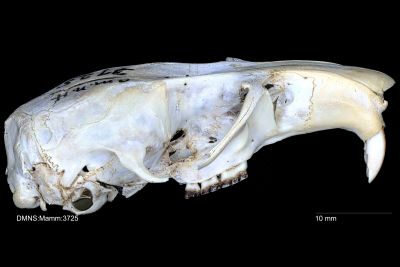
DMNS:Mamm:3725. Neotoma magister. Female. Shartlesville, Blue Mountain Observatory, Berks County, Pennsylvania. Collected 7 March 1933. -

DMNS:Mamm:3725. Neotoma magister. Female. Shartlesville, Blue Mountain Observatory, Berks County, Pennsylvania. Collected 7 March 1933. -

DMNS:Mamm:3725. Neotoma magister. Female. Shartlesville, Blue Mountain Observatory, Berks County, Pennsylvania. Collected 7 March 1933. -
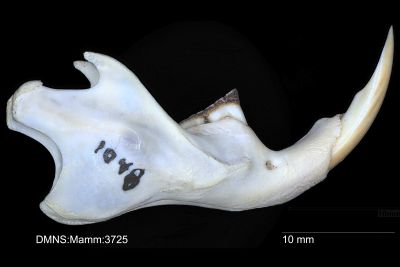
DMNS:Mamm:3725. Neotoma magister. Female. Shartlesville, Blue Mountain Observatory, Berks County, Pennsylvania. Collected 7 March 1933. -

DMNS:Mamm:3725. Neotoma magister. Female. Arrows point to the anteromedial flexus of the anteroloph of each upper molar (M1), which is notched.


Similar species
From Best & Hunt (2020): "The Allegheny woodrat is similar to the eastern woodrat [Neotoma floridana] but slightly larger and with slightly longer vibrissae. The most reliable way to tell the two species apart is by genetic analyses or by anatomical details of the skull because measurements overlap. Skulls of Allegheny woodrats posses a maxillovomerine notch on the posterior palate, and this notch rarely is present in eastern woodrats."
From Castleberry et al. (2006): "External morphology of N. magister is similar to that of N. floridana, the only parapatric Neotoma. Although N. magister generally is larger in mass and with longer vibrissae, identification based on single measurements is unreliable because of morphometric overlap (Ray 2000). Multivariate comparisons of cranial characters separate N. magister and N. floridana primarily on size (Hayes and Richmond 1993; Ray 2000). North–south clinal variation does not account for the differences (Hayes and Richmond 1993). The most reliable character for identifying N. magister is the presence of a maxillovomerine notch (present in all 418 N. magister skulls but in only 0.2% of 457 N. floridana skulls—Hayes and Richmond 1993). Additionally, only 1.7% of N. magister skulls exhibited bifurcation of the anterior palatal spine, whereas 70.9% of N. floridana skulls exhibited some degree of bifurcation."
-

Eastern Woodrat (Neotoma floridana)
References
Best TL, Hunt JL. 2020. Mammals of the southeastern United States. Tuscaloosa (AL, USA): University Alabama Press.
Castleberry SB, Mengak MT, Ford WM. 2006. Neotoma magister. Mammalian Species (789):1-5. https://doi.org/10.1644/789.1.
Hayes JP, Richmond ME. 1993. Clinal variation and morphology of woodrats (Neotoma) of the eastern United States. Journal of Mammalogy 74:204–216.
Ray DK. 2000. Phylogenetics and evolution of woodrats (genus Neotoma) in the southern Appalachian mountains. M.S. thesis, University of North Carolina at Wilmington, 68 pp.