Clethrionomys rutilus
| Northern Red-backed Vole
(Clethrionomys rutilus) | |
|---|---|
| Range | |
 | |
| Taxonomic classification | |
| Order: | Rodentia |
| Suborder: | Supramyomorpha |
| Infraorder: | Myomorphi |
| Superfamily: | Muroidea |
| Family: | Cricetidae |
| Subfamily: | Arvicolinae |
| Tribe: | Clethrionomyini |
| Genus: | Clethrionomys |
| Binomial details | |
| Clethrionomys rutilus (Pallas, 1779) | |
| Other resources | |
| Full taxonomic details at MDD | |
The Northern Red-backed Vole (Clethrionomys rutilus) is a small vole that inhabits boreal and deciduous forests of Alaska and northern Canada.
Description
From Naughton (2012): "The coat colour of these small voles is quite variable. In general, they have a broad rufous coloured band of fur running along their back from the forehead to tail. Some of the ruddy colour washes down onto the yellowish to grey-brown sides. Belly hairs are tipped with silver, pale grey, or buff and the base of each hair is dark grey. Tops of the feet may be greyish, buff, or silver. The underside of the tail is silvery, buffy yellow, or light grey and lighter than the upper surface. The short, thick tail is covered with bristly hairs and the blunt end of the fleshy part of the tail has a long (10–12 mm) brush of dark hairs. Ears and eyes are noticeable. Two colour phases are possible (as with the Southern Red-backed Vole). The red phase is far more common than the dark phase, which has a sooty grey-black dorsal band, grey-brown sides, and a grey to silvery belly. Silky winter pelage is longer, denser, and brighter than summer pelage. Juveniles are duller and darker than adults."


External measurements
Length measurements are in millimeters (mm) and weight measurements are in grams (g), unless stated otherwise. If available, the sample size (n=) is provided. If a range is not provided and n= is not given, then the listed measurement represents an average.
| Part of range | Reference | Total length | Tail length | Hindfoot length | Ear length | Mass |
|---|---|---|---|---|---|---|
| Canada | Naughton (2012) | 118–166 | 21–44 | 15–22 | 11–17 | 18–35 |
Color variation
This section shows some of the color variation present in Clethrionomys rutilus. The location is provided for reference only. The individual shown does not necessarily represent the only color variant within the local population.
-
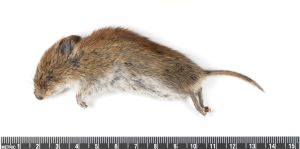 Alaska, Denali Borough
 -
 dark phase, Alaska, Denali Borough
 -
 juvenile, Alaska, Denali Borough
 -
 Alaska, Fairbanks North Star Borough
 -
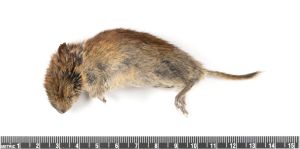 Alaska, Fairbanks North Star Borough
 -
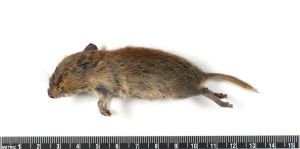 subadult, Alaska, Fairbanks North Star Borough


Skull
From Naughton (2012): "posterior loop of M3 is usually closed; m2 has 3 closed loops."
-

NEON01I3N. Dorsal view of the skull of Clethrionomys rutilus. -

NEON01I3N. Lateral view of the skull of Clethrionomys rutilus. Long scale bar is 1 cm; short scale bar is 1 mm. -

NEON01I3N. Ventral view of the skull of Clethrionomys rutilus. Long scale bar is 1 cm; short scale bar is 1 mm. -

NEON01I3N. Upper molars of Clethrionomys rutilus.


Similar species
Clethrionomys rutilus are easily distinguished from other sympatric voles by the broad, reddish mid-dorsal stripe extending from forehead to tail. However, Merritt (1981) provides the following when comparing with congeners: "Species of Clethrionomys are difficult to distinguish morphologically; no single character is sufficient... C. gapperi differs from C. rutilus as follows: tail more slender, and with sparser and less bristly hairs (Hall and Cockrum, 1953); dorsum brighter red; post palatal bridge generally a solid, truncated shelf (C. rutilus has an incomplete palatal shelf or a central notch. Bailey, 1897; Burt, 1946; Hall and Cockrum, 1953; Hall, in press).
-

Dorsal view of the Northern Red-backed Vole (Clethrionomys rutilus) showing the broad, reddish mid-dorsal stripe extending from forehead to tail. -

Dorsal view of a dark phase individual of the Northern Red-backed Vole (Clethrionomys rutilus) showing a dark dorsal band. -

Dorsal view of the Southern Red-backed Vole (Clethrionomys gapperi) showing the broad, reddish mid-dorsal stripe extending from forehead to tail. -
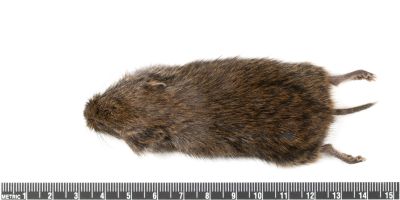
Dorsal view of the Northern Bog Lemming (Mictomys borealis), which lacks a reddish mid-dorsal stripe and has a short tail. -

Dorsal view of the Western Meadow Vole (Microtus drummondii), as an example of a sympatric vole species that lacks the broad, reddish mid-dorsal stripe.
References
Merritt JF. 1981. Clethrionomys gapperi. Mammalian species (146): 1-9. https://doi.org/10.2307/3503900
Naughton D. 2012. The natural history of Canadian mammals. Toronto (ON, CA): University of Toronto Press.
Pallas PS. 1779. Fasciculus II. Pp. 71–388 in Pallas, P.S. 1778-1779. Novae species quadrupedum e glirium ordine cum illustrationibus variis complurium ex hoc ordine animalium. Wolfgang Walther, Erlangen, 388 pp.