Geomys arenarius
| Desert Pocket Gopher
(Geomys arenarius) | |
|---|---|
| Range | |
 | |
| Taxonomic classification | |
| Order: | Rodentia |
| Suborder: | Supramyomorpha |
| Infraorder: | Castorimorphi |
| Superfamily: | Geomyoidea |
| Family: | Geomyidae |
| Subfamily: | Geomyinae |
| Tribe: | Geomyini |
| Genus: | Geomys |
| Subgenus: | Geomys (subgenus) |
| Binomial details | |
| Geomys arenarius C. H. Merriam, 1895 | |
| Other resources | |
| Full taxonomic details at MDD | |
The Desert Pocket Gopher (Geomys arenarius) is a fossorial rodent that prefers loose soil, inhabiting disturbed terrain, sandy areas along river banks, and the Tularosa Basin (Williams & Baker, 1974). It can be very difficult to distinguish from other pocket gophers. Individuals found above ground are often dispersing individuals.
Description
From Williams & Baker (1974): "Like other members of the genus, G. arenarius is a medium-sized fossorial rodent. The characteristic features are thick-set body, reduced eyes and pinnae, massive strong-clawed forelegs, nearly naked tail of medium length, and external, fur-lined cheek pouches."
From Schmidly and Bradley (2016): "A dull, pale-brown pocket gopher, with two longitudinal grooves on outer face of each incisor; feet and underparts white."


Museum specimens
-

Holotype: USNM 18117/25015. Geomys arenarius arenarius. Adult male. El Paso, El Paso County, Texas. Collected 14 December 1899. -

Holotype: USNM 18117/25015. Geomys arenarius arenarius. Adult male. El Paso, El Paso County, Texas. Collected 14 December 1899.


External measurements
Length measurements are in millimeters (mm) and weight measurements are in grams (g), unless stated otherwise. If available, the sample size (n=) is provided. If a range is not provided and n= is not given, then the listed measurement represents an average.
| Part of range | Reference | Total length | Tail length | Hindfoot length | Ear length | Mass |
|---|---|---|---|---|---|---|
| Texas | Schmidly & Bradley (2016) | males: 262; females: 243 | males: 79; females: 74 | males: 33; females: 32 | males: 198–254; females: 165–207 |
Skull
From Williams & Baker (1974): "The configuration of the zygomatic arch is the most easily recognized cranial feature that sets G. arenarius apart from other species. The occurrence of a prominent knob on the end of the squamosal arm of the zygoma is characteristic of G. arenarius and G. tropicalis... Additional salient cranial features, noted by Merriam (1895), are: posteriorly bulging occiput; jugal shorter than basioccipital; palatopterygoids normally abruptly narrowed and with parallel sides; prominent, separated, and nearly parallel temporal ridges; heavy mandible."
-

Holotype: USNM 18117/25015. Geomys arenarius arenarius. Adult male. El Paso, El Paso County, Texas. Collected 14 December 1899. Dorsal view of the skull. -

Holotype: USNM 18117/25015. Geomys arenarius arenarius. Adult male. El Paso, El Paso County, Texas. Collected 14 December 1899. Ventral view of the skull. -

Holotype: USNM 18117/25015. Geomys arenarius arenarius. Adult male. El Paso, El Paso County, Texas. Collected 14 December 1899. Lateral view of the skull. -

Holotype: USNM 18117/25015. Geomys arenarius arenarius. Adult male. El Paso, El Paso County, Texas. Collected 14 December 1899. Dorsal view of the mandible. -

Holotype: USNM 18117/25015. Geomys arenarius arenarius. Adult male. El Paso, El Paso County, Texas. Collected 14 December 1899. Lateral view of the left mandible.


Similar species
From Williams & Baker (1974): "Geomys arenarius most closely resembles G. personatus and G. tropicalis morphologically (Alvarez, 1963). These three species differ from other Geomys in having a rostrum that is wider than the length of the basioccipital. Externally, G. arenarius is a medium-sized gopher with a relatively long tail and pale coloration. The pelage is drab-brown dorsally, with finely scattered black-tipped hairs. This color pattern continues laterally and onto the venter where it may or may not blend with the white hair on the abdomen, chest, and feet. Most of the tail is covered with hair (Merriam, 1895). The configuration of the zygomatic arch is the most easily recognized cranial feature that sets G. arenarius apart from other species. The occurrence of a prominent knob on the end of the squamosal arm of the zygoma is characteristic of G. arenarius and G. tropicalis. The zygoma of G. arenarius differs from that of both G. tropicalis and G. personatus in having parallel sides in contrast to sides that converge posteriorly. Geomys arenarius also differs from these two species in having a subquadrangular interparietal and no sagittal crest (Alvarez, 1963). Additional salient cranial features, noted by Merriam (1895), are: posteriorly bulging occiput; jugal shorter than basioccipital; palatopterygoids normally abruptly narrowed and with parallel sides; prominent, separated, and nearly parallel temporal ridges; heavy mandible."
-
Holotype: USNM 18117/25015. Geomys arenarius arenarius. Adult male. El Paso, El Paso County, Texas. Collected 14 December 1899. Dorsal view of the skull. -

Holotype: USNM 32031/43845. Geomys personatus fallax. Adult male. South side of Nueces Bay, Nueces County, Texas. Collected 30 November 1891. Dorsal view of the skull. -
Holotype: USNM 18117/25015. Geomys arenarius arenarius. Adult male. El Paso, El Paso County, Texas. Collected 14 December 1899. Ventral view of the skull. -
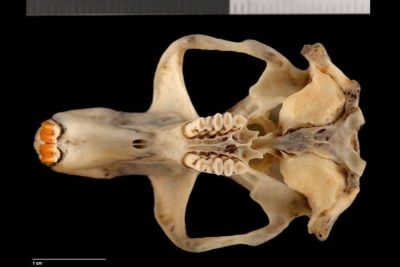
Holotype: USNM 32031/43845. Geomys personatus fallax. Adult male. South side of Nueces Bay, Nueces County, Texas. Collected 30 November 1891. Ventral view of the skull. -
Holotype: USNM 18117/25015. Geomys arenarius arenarius. Adult male. El Paso, El Paso County, Texas. Collected 14 December 1899. Lateral view of the skull. -

Holotype: USNM 32031/43845. Geomys personatus fallax. Adult male. South side of Nueces Bay, Nueces County, Texas. Collected 30 November 1891. Lateral view of the skull.
References
Alvarez T. 1963. The Recent mammals of Tamaulipas, Mexico. Lawrence (KS, USA): University of Kansas publications, Museum of Natural History 14:363-473.
Merriam CH. 1895-01-31. Revision of the pocket gophers, family Geomyidæ, exclusive of the species of Thomomys. North American Fauna 8:1-262.
Schmidly DJ, Bradley RD. 2016. The mammals of Texas. Austin (TX, USA): University of Texas Press.
Williams SL, Baker RJ. 1974. Geomys arenarius. Mammalian Species (36): 1-3. https://doi.org/10.2307/3503970