Dipodomys simulans
| Dulzura Kangaroo Rat
(Dipodomys simulans) | |
|---|---|
| Range | |
 | |
| Taxonomic classification | |
| Order: | Rodentia |
| Suborder: | Supramyomorpha |
| Infraorder: | Castorimorphi |
| Superfamily: | Geomyoidea |
| Family: | Heteromyidae |
| Subfamily: | Dipodomyinae |
| Genus: | Dipodomys |
| Binomial details | |
| Dipodomys simulans (C. H. Merriam, 1904) | |
| Other resources | |
| Full taxonomic details at MDD | |
The Dulzura Kangaroo Rat (Dipodomys simulans) is a medium-sized kangaroo rat found in southern California and the Baja California peninsula.
Description
From Ceballos (ed., 2014): "Dipodomys simulans is medium in size; its dorsal coloration is dark brown, and the ventral surface is white. The tail is hairy with a dark line in the lower surface that extends to the tip. The ears are small ... and they have 5 toes with claws on each foot (Hall, 1981; Whitaker, 1980; Williams et al., 1993)."


External measurements
Length measurements are in millimeters (mm) and weight measurements are in grams (g), unless stated otherwise. If available, the sample size (n=) is provided. If a range is not provided and n= is not given, then the listed measurement represents an average.
| Part of range | Reference | Total length | Tail length | Hindfoot length | Ear length | Mass |
|---|---|---|---|---|---|---|
| Holotype USNM 33105 (San Diego Co., CA) | Smithsonian National Museum of Natural History | 280 | 165 | 40 | ||
| not reported | Ceballos (editor, 2014) | 265–319 | 155–203 | 43–46 | 12–16 | 45–77 |
Skull
From Jameson & Peeters (2004): "It is similar to the Pacific Kangaroo Rat (D. agilis), but the skull is relatively broader and the auditory bullae are kidney shaped rather than oval."
-

Holotype: USNM 33105/45103. Dipodomys simulans simulans. Adult female. Dulzura, San Diego County, California. Collected 24 November 1891. Dorsal view of the skull. -
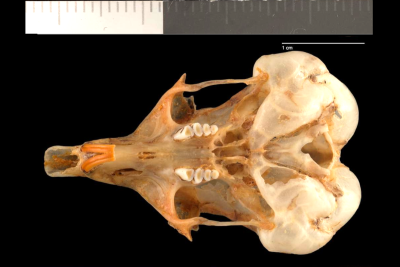
Holotype: USNM 33105/45103. Dipodomys simulans simulans. Adult female. Dulzura, San Diego County, California. Collected 24 November 1891. Ventral view of the skull. -
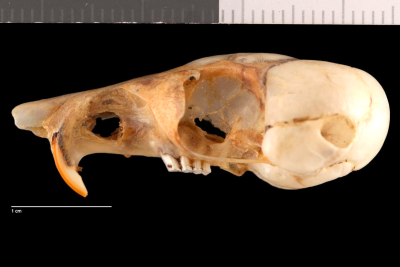
Holotype: USNM 33105/45103. Dipodomys simulans simulans. Adult female. Dulzura, San Diego County, California. Collected 24 November 1891. Lateral view of the skull. -
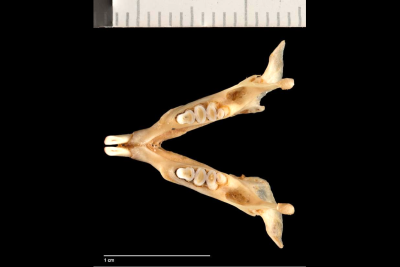
Holotype: USNM 33105/45103. Dipodomys simulans simulans. Adult female. Dulzura, San Diego County, California. Collected 24 November 1891. Dorsal view of the mandible. -
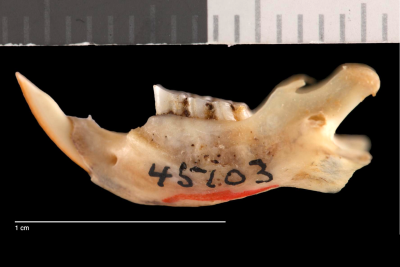
Holotype: USNM 33105/45103. Dipodomys simulans simulans. Adult female. Dulzura, San Diego County, California. Collected 24 November 1891. Lateral view of the left mandible.


Taxonomic and distribution notes
Based on chromosomal, allozymic, morphologic, and ecologic differences between two chromosomal forms of Dipodomys agilis, Sullivan & Best (1997) recommended that the northern 2n = 62 chromosomal form be referred to as Dipodomys agilis and the 2n = 60 chromosomal form be given specific status as Dipodomys simulans.
From Cui and Nunney (2025), summarizing the results of their genomic analysis of the Agile Kangaroo Rat (Dipodomys agilis) (AKR) and the Dulzura Kangaroo Rat (DKR, Dipodomys simulans): "In summary, genomic analysis provided evidence of the long term genetic separation of AKR and DKR, supporting the original division of these two taxa into two species by Sullivan and Best (1997) based primarily on their karyotype difference. Given the finding that AKR and DKR are genetically distinct, with no evidence of a history of genetic introgression, both taxa satisfy the criterion of the genetic species concept, where a species is a group of genetically compatible interbreeding natural populations that is genetically isolated from other such groups (Baker and Bradley 2006). There was also no evidence of the sympatry that had been inferred from small morphological differences in samples collected south of the mountains by Sullivan and Best (1997). Of course, this genomic evidence has no bearing on whether or not these two species have developed pre- or post-mating reproductive isolating mechanisms, only that there is no evidence of genetic mixing since the two taxa split. Similarly, the possibility of historical sympatry is not excluded (although the absence of any indication of genetic introgression makes this unlikely), but instead it is suggested that the ecological shift at the southern edge of the mountains [San Gabriel and San Bernardino Mountains] probably maintains their separation despite the absence of a clear physical barrier preventing sympatry."
Similar species
Jameson & Peeters (2004) noted that the Agile Kangaroo Rat (Dipodomys agilis) is similar to D. simulans, but when viewed from above, the auditory bullae are oval in D. agilis and kidney shaped in D. simulans.
From Sullivan & Best (1997): "Several characters reliably separate D. agilis from D. simulans, including larger size, narrower skull, and more oval-shaped auditory bullae of D. agilis as viewed from above."
| Species | Toes | Tail_tip | Size |
|---|---|---|---|
| Dipodomys agilis | 5 | dusky | medium to large |
| Dipodomys deserti | 4 | white | large |
| Dipodomys heermanni | 5 | dusky | medium to large |
| Dipodomys merriami | 4 | dusky | small to medium |
| Dipodomys microps | 5 | dusky, sometimes tip appears pale | medium |
| Dipodomys panamintinus | 5 | dusky | medium to large |
| Dipodomys simulans | 5 | dusky | medium |
| Dipodomys stephensi | 5 | dusky, sometimes tip appears pale | medium |
References
Baker RJ, Bradley RD. 2006. Speciation in mammals and the genetic species concept. Journal of Mammalogy 87:643–662.
Ceballos G, editor. 2014. Mammals of Mexico. Baltimore (MD, USA): Johns Hopkins University Press.
Cui Y, Nunney L. 2025. Genomic analysis of differentiation and demography of the formerly conspecific agile (Dipodomys agilis) and Dulzura (D. simulans) kangaroo rats. Heredity, pp.1-10. https://doi.org/10.1038/s41437-025-00789-3
Jameson EW, Peeters HJ. 2004. Mammals of California (No. 66). Berkeley (CA, USA): University of California Press.
Sullivan RM, Best TL. 1997. Systematics and Morphologic Variation in Two Chromosomal Forms of the Agile Kangaroo Rat (Dipodomys agilis). Journal of Mammalogy 78(3): 775-797.