Megascapheus connectens
| New Mexico Pocket Gopher
(Megascapheus connectens) | |
|---|---|
| Range | |
 | |
| Taxonomic classification | |
| Order: | Rodentia |
| Suborder: | Supramyomorpha |
| Infraorder: | Castorimorphi |
| Superfamily: | Geomyoidea |
| Family: | Geomyidae |
| Subfamily: | Geomyinae |
| Tribe: | Thomomyini |
| Genus: | Megascapheus |
| Binomial details | |
| Megascapheus connectens (E. R. Hall, 1936) | |
| Other resources | |
| Full taxonomic details at MDD | |

Distribution (dark green) of Megascapheus connectens is based on Sands and Finley (1959). Distribution (light green) of Megascapheus connectens is based on Bradley et al. (2023). Bradley et al. (2023) note that their distributions are approximated.
Description
The following description from Hall (1936) is for subspecies connectens which was then elevated to specific status by Bradley et al. (2023): "Size: Large. Color: in fresh summer pelage cinnamon buff (color terms after Ridgway); whitish below with plumbeous areas and with cinnamon buff extending onto pectoral region, and sometimes to other sections of the underparts and; insides of cheek pouches and usually nose, blackish; postauricular patches small. Winter pelage with a reduced amount of cinnamon buff on the upper parts producing a "gray" coat."
-
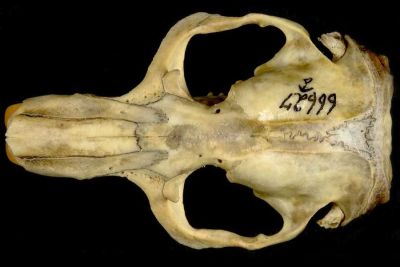
Holotype: MVZ:Mamm:66627. Megascapheus connectens. Male. Clawson Dairy, 5 mi N Albuquerque, Bernalillo County, New Mexico, United States. Collected 6 May 1935. Dorsal view of the skull. -
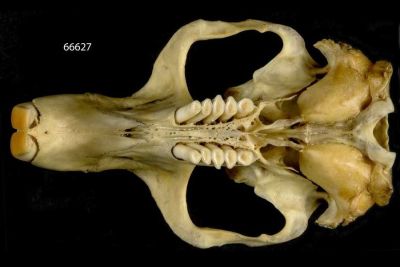
Holotype: MVZ:Mamm:66627. Megascapheus connectens. Male. Clawson Dairy, 5 mi N Albuquerque, Bernalillo County, New Mexico, United States. Collected 6 May 1935. Ventral view of the skull. -
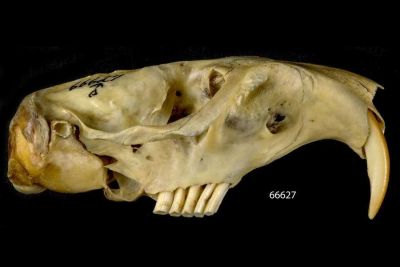
Holotype: MVZ:Mamm:66627. Megascapheus connectens. Male. Clawson Dairy, 5 mi N Albuquerque, Bernalillo County, New Mexico, United States. Collected 6 May 1935. Lateral view of the skull. -
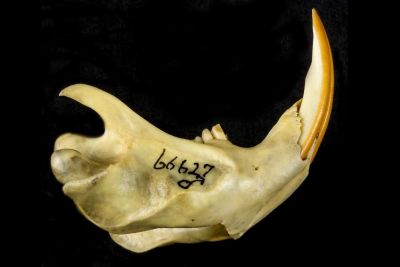
Holotype: MVZ:Mamm:66627. Megascapheus connectens. Male. Clawson Dairy, 5 mi N Albuquerque, Bernalillo County, New Mexico, United States. Collected 6 May 1935. Lateral view of the right mandible. -

Measurements of connectens from Hall (1936).


External measurements
Length measurements are in millimeters (mm) and weight measurements are in grams (g), unless stated otherwise. If available, the sample size (n=) is provided. If a range is not provided and n= is not given, then the listed measurement represents an average.
| Part of range | Reference | Total length | Tail length | Hindfoot length | Ear length | Mass |
|---|---|---|---|---|---|---|
| New Mexico | Hall (1936) | 232–270 (n=7) | 66–76 (n=7) | 31–36 (n=7) |
Taxonomic notes
Elevation of subgenera within genus Thomomys Wied-Neuwied, 1839
Genetic analyses (CytB and COI) by Álvarez-Castañeda and Segura-Trujillo (2025) found that the two subgenera within the genus Thomomys Wied-Neuwied, 1839 — Megascapheus and Thomomys — are genetically distinct. Morphological and genetic data support considering these differences sufficient at the genus level. Both subgenera Megascapheus and Thomomys were elevated to the taxonomic rank of genus by Álvarez-Castañeda and Segura-Trujillo (2025).
Skull
From Hall (1936): " Skull: Large; rostrum broad and its length amounting to more than 67 percent of zygomatic breadth; nasals posteriorly truncate; hamulus of lacrimal large; interpterygoid space V-shaped and provided with median spine."


Similar species
References
Álvarez-Castañeda ST, Segura-Trujillo CA. 2025. Genus-level review of pocket gophers in the family Geomyidae. Therya 16(1): 41-75.
Bradley RD, Pham AT, Rich KA, Roberts EK, Soniat TJ, Poehlein CM, Mills MN, Ballard M, Pitts RM, Lindsey LL, Halsey MK. 2023. Genetic identification of pocket gophers (Genera Cratogeomys, Geomys, and Thomomys) in Texas and surrounding areas. Museum of Texas Tech University. https://www.depts.ttu.edu/nsrl/publications/downloads/SP78.pdf
Hall ER. 1936. A new pocket gopher from New Mexico. Journal of the Washington Academy of Sciences 26(7):296-298.
Sands JL, Findley JS. 1959. The Relationships of Two Subspecies of Pocket Gopher in Central New Mexico. Journal of Mammalogy 40(3) 331–337. https://doi.org/10.2307/1376557