Oryzomys texensis
| Northwestern Marsh Rice Rat
(Oryzomys texensis) | |
|---|---|
| Range | |
 | |
| Taxonomic classification | |
| Order: | Rodentia |
| Suborder: | Supramyomorpha |
| Infraorder: | Myomorphi |
| Superfamily: | Muroidea |
| Family: | Cricetidae |
| Subfamily: | Sigmodontinae |
| Tribe: | Oryzomyini |
| Genus: | Oryzomys |
| Binomial details | |
| Oryzomys texensis J. A. Allen, 1894 | |
| Other resources | |
| Full taxonomic details at MDD | |
From Rose (2024): "Molecular genetic analysis (Hanson et al. 2010), supported by earlier assessments by Schmidt and Engstrom (1994) and Goldman (1918), plus its parapatric distribution with Oryzomys palustris, led Hanson et al. (2010) to conclude that “texensis” was sufficiently distinct from the other subspecies of O. palustris to be considered as a separate species."
Description
From Schmidly & Bradley (2016): "Rat-like, with long, nearly naked, scaly tail; ears short and hairy; upperparts grizzled grayish brown, heavily lined with black, especially in winter pelage; underparts whitish."

Museum type specimens
-
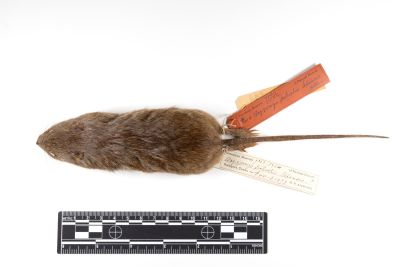
Holotype: AMNH MO-5764, AMNH MS-7166. Oryzomys texensis. Male. Rockport, Aransas County, Texas. Collected 15 November 1893. Dorsal view. -

Holotype: AMNH MO-5764, AMNH MS-7166. Oryzomys texensis. Male. Rockport, Aransas County, Texas. Collected 15 November 1893. Ventral view.


External measurements
Length measurements are in millimeters (mm) and weight measurements are in grams (g), unless stated otherwise. If available, the sample size (n=) is provided. If a range is not provided and n= is not given, then the listed measurement represents an average.
| Part of range | Reference | Total length | Tail length | Hindfoot length | Ear length | Mass |
|---|---|---|---|---|---|---|
| Texas | Schmidly & Bradley (2016) | 245 | 116 | 29 | 51 (40–68) |
Skull
-
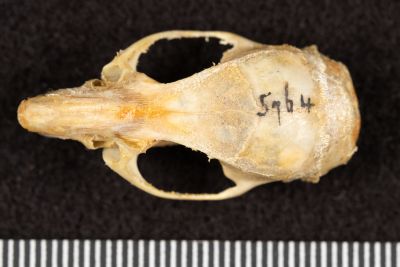
Holotype: AMNH MO-5764, AMNH MS-7166. Oryzomys texensis. Male. Rockport, Aransas County, Texas. Collected 15 November 1893. Dorsal view of the skull. -

Holotype: AMNH MO-5764, AMNH MS-7166. Oryzomys texensis. Male. Rockport, Aransas County, Texas. Collected 15 November 1893. Ventral view of the skull. -
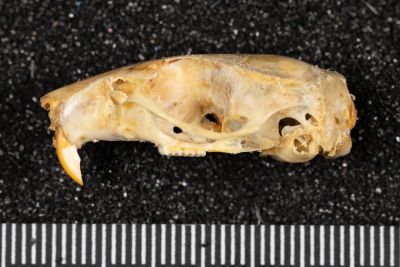
Holotype: AMNH MO-5764, AMNH MS-7166. Oryzomys texensis. Male. Rockport, Aransas County, Texas. Collected 15 November 1893. Lateral view of the skull. -

Holotype: AMNH MO-5764, AMNH MS-7166. Oryzomys texensis. Male. Rockport, Aransas County, Texas. Collected 15 November 1893. Dorsal view of the mandible. -
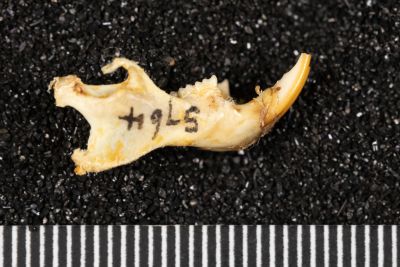
Holotype: AMNH MO-5764, AMNH MS-7166. Oryzomys texensis. Male. Rockport, Aransas County, Texas. Collected 15 November 1893. Lateral view of the right mandible. -
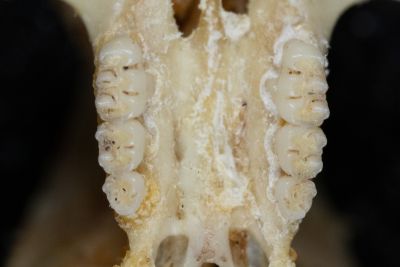
Holotype: AMNH MO-5764, AMNH MS-7166. Oryzomys texensis. Male. Rockport, Aransas County, Texas. Collected 15 November 1893. Upper molars.


Similar species
Comparison with Oryzomys palustris
From Rose (2023): "The separation of the Texas marsh rice rat (Oryzomys texensis) from O. palustris was determined by differences at the molecular genetics level (Hanson et al. 2010) when the five subspecies of O. palustris were grouped into one clade and populations of the former subspecies texensis formed another clade. Although the skulls of O. palustris and O. texensis could be separated by such morphological features as breadth at the condyles and alveolar length of the upper and lower molar toothrows (Humphrey and Setzer 1989), few variables consistently separated these taxa."
References
Goldman EA. 1918. The rice rats of North America. North American Fauna 43:1–101. https://doi.org/10.3996/nafa.43.0001
Hanson JD, Indorf JL, Swier VJ, Bradley RD. 2010. Molecular divergence within the Oryzomys palustris complex: evidence for multiple species. Journal of Mammalogy 91(2):336–347. https://doi. org/10.1644/08-MAMM-A-342.1
Rose RK. 2024. Oryzomys texensis (Rodentia: Cricetidae). Mammalian Species, 56(1036):1-12.
Schmidly DJ, Bradley RD. 2016. The mammals of Texas. Austin (TX, USA): University of Texas Press.
Schmidt CA, Engstrom MD. 1994. Genic variation and systematics of rice rats (Oryzomys palustris species group) in southern Texas and northeastern Tamaulipas, Mexico. Journal of Mammalogy 75(4):914–928. https://doi.org/10.2307/1382473