Alexandromys oeconomus
| Root Vole
(Alexandromys oeconomus) | |
|---|---|
| Range | |
 | |
| Taxonomic classification | |
| Order: | Rodentia |
| Suborder: | Supramyomorpha |
| Infraorder: | Myomorphi |
| Superfamily: | Muroidea |
| Family: | Cricetidae |
| Subfamily: | Arvicolinae |
| Tribe: | Arvicolini |
| Genus: | Alexandromys |
| Subgenus: | Oecomicrotus |
| Binomial details | |
| Alexandromys oeconomus (Pallas, 1776) | |
| Other resources | |
| Full taxonomic details at MDD | |
The Root Vole (Alexandromys oeconomus) is a medium-sized brown vole found in open, wet riparian areas of tundra and forests at northern latitudes. It ranges from northern and central Europe and Asia to Alaska and western Canada. Analyses of mitochondrial DNA gene sequences (cytb + CO1) by Liu et al. (2017) found that the former species Microtus oeconomus should be included in the genus Alexandromys and referred to as Alexandromys oeconomus.
Description
From Naughton (2012): "Body fur is golden brown, which is darker to rusty brown on the back and more golden or greyish on the sides and rump. Sometimes, especially in winter pelage, the sides are so light that the back fur stands out as a darker band. Belly fur is greyish white often with a buffy wash. Juveniles are darker overall. Ears are rounded and barely show above the long pelage. The short tail is strongly bicoloured; dark grey above and greyish white below. Feet are greyish brown. [Root voles] experience two moults annually, one in spring and the other in autumn. The winter coat is long and silky and frequently lighter than the summer pelage. Feet in the winter pelage are edged with long, stiff, silvery hairs."

Museum specimens
-

NEON01IIJ. Alexandromys oeconomus. Adult female. Toolik Field Station, North Slope Borough, Alaska. Collected 14 August 2019. -
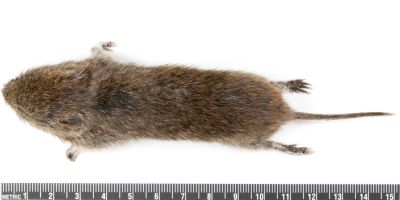
NEON01IIJ. Alexandromys oeconomus. Adult female. Toolik Field Station, North Slope Borough, Alaska. Collected 14 August 2019. -
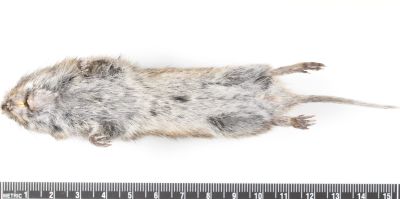
NEON01IIJ. Alexandromys oeconomus. Adult female. Toolik Field Station, North Slope Borough, Alaska. Collected 14 August 2019.


External measurements
Length measurements are in millimeters (mm) and weight measurements are in grams (g), unless stated otherwise. If available, the sample size (n=) is provided. If a range is not provided and n= is not given, then the listed measurement represents an average.
| Part of range | Reference | Total length | Tail length | Hindfoot length | Ear length | Mass |
|---|---|---|---|---|---|---|
| Canada | Naughton (2012) | 130–187 | 26–47 | 16–23 | 10–18 | 20–69 |
Variation
This section shows some of the color variation present in Alexandromys oeconomus. The location is provided for reference only. The individual shown does not necessarily represent the only color variant within the local population.
-
NEON01IIJ. Alexandromys oeconomus. Adult female. Alaska, North Slope Borough. -
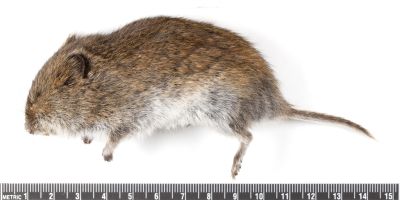
NEON01IIP. Alexandromys oeconomus. Adult male. Alaska, North Slope Borough. -
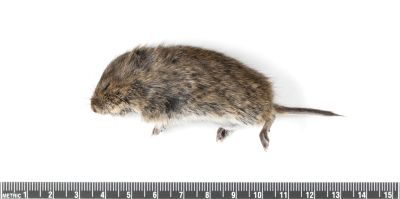
NEON01IJ4. Alexandromys oeconomus. Juvenile female. Alaska, North Slope Borough.


Skull
Incisors protrude beyond the nasals when viewed from above. From Naughton (2012): "incisive foramen gradually taper to a slit posteriorly; M2 has 3 closed triangles and an anterior loop and lacks a posterior loop; 4 closed triangles on m1, 5th triangle confluent with the anterior loop."
-

NEON01IIX. Lateral view of the skull of Alexandromys oeconomus. -

NEON01IIX. Dorsal view of the skull of Alexandromys oeconomus. -

NEON01IIX. Ventral view of the skull of Alexandromys oeconomus. -

NEON01IIX. Lower jaw of Alexandromys oeconomus. -

NEON01IIX. Upper incisors of Alexandromys oeconomus. -
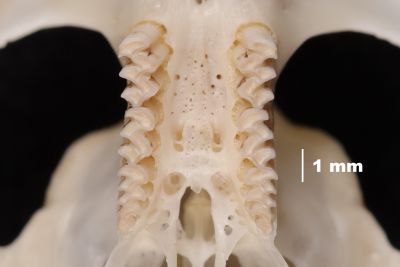
NEON01IIX. Upper molars of Alexandromys oeconomus. -

NEON01IIX. Lower molars of Alexandromys oeconomus. The first lower molar (m1) has 5 triangles (black arrows); 4 closed triangles and a fifth triangle that is confluent with the anterior loop (yellow arrow; Naughton, 2012). -

NEON01IIX. Enamel pattern of Alexandromys oeconomus. The left pair are the upper molars (top to bottom are M1, M2, M3) and right pair are the lower molars (top to bottom are m1, m2, m3).


Similar species
Comparison with Clethrionomys rutilus
The Northern Red-backed Vole (Clethrionomys rutilus) can be distinguished from Alexandromys oeconomus by its reddish to rusty colored back.
-
Root Vole (Alexandromys oeconomus) -

Northern Red-backed Vole (Clethrionomys rutilus) -
Root Vole (Alexandromys oeconomus). Notice that the back lacks a broad rufous colored band of fur. -

Northern Red-backed Vole (Clethrionomys rutilus). Notice the broad rufous colored band of fur running along the back from the forehead to tail. In dark phase individuals, a sooty gray-black dorsal band runs from the head to tail. -
Dorsal view of the skull of the Root Vole (Alexandromys oeconomus). The incisors protrude beyond the nasals when the skull is viewed from above. -

Dorsal view of the skull of the Northern Red-backed Vole (Clethrionomys rutilus). The nasals usually hide the incisors completely when viewed from above.
Comparison with Microtus abbreviatus
From Cole and Wilson (2010; note taxonomic updates have been applied to this description): "Microtus abbreviatus differs from other northern voles in combination of a buff-colored venter, a short tail, long claws, tops of the hind feet being cream colored, and an orange line on the lower sides (Kays and Wilson 2002). Other sympatric Microtus and Alexandromys oeconomus have white to gray venters, smaller claws, and longer tails."
-
Root Vole (Alexandromys oeconomus) -

Singing Vole (Microtus abbreviatus) -
Dorsal view of the skull of the Root Vole (Alexandromys oeconomus). The incisors protrude beyond the nasals when the skull is viewed from above. -

Dorsal view of the skull of the Singing Vole (Microtus abbreviatus). The nasals do not hide the incisors when viewed from above (Naughton, 2012).
Comparison with Microtus drummondii
From Naughton (2012): "Meadow Voles share much of the Tundra [Root] Voles' range and may even use the same runways. Meadow Voles are more grey-brown on the sides and rump (without the golden sheen of the Tundra [Root] Vole), they have a dull grey belly, and their tail is not strongly bicoloured."
-
Root Vole (Alexandromys oeconomus) -
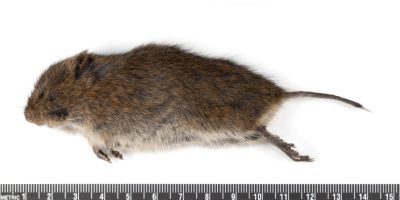
Western Meadow Vole (Microtus drummondii) from Denali Borough, Alaska. -
Dorsal view of the skull of the Root Vole (Alexandromys oeconomus). -

Dorsal view of the skull of the Western Meadow Vole (Microtus drummondii). -

Enamel pattern of the upper molars in Western Meadow Vole (Microtus drummondii). Arrows point to a rounded, closed lingual posterior loop on the second upper molar (M2), which may resemble an incipient 5th triangle in some individuals. This anterior loop is only found in the Western Meadow Vole (Microtus drummondii) and the Eastern Meadow Vole (Microtus pennsylvanicus).
Comparison with Microtus longicaudus
The relatively long tail in relation to head and body length and hindfoot length separates the Long-tailed Vole (Microtus longicaudus) from Alexandromys oeconomus.
-
Root Vole (Alexandromys oeconomus) -

Long-tailed Vole (Microtus longicaudus) -
Dorsal view of the skull of the Root Vole (Alexandromys oeconomus). The incisors protrude beyond the nasals when the skull is viewed from above. -

Dorsal view of the skull of the Long-tailed Vole (Microtus longicaudus). The nasals usually hide the incisors completely when viewed from above (Naughton, 2012). -
NEON01IIX. Ventral view of the skull of the Root Vole (Alexandromys oeconomus). The incisive foramena gradually taper to a slit posteriorly. -

Holotype: USNM 186496. Dorsal view of the skull of the Long-tailed Vole (Microtus longicaudus). The incisive foramena gradually taper, but not to a slit posteriorly as in Alexandromys oeconomous.

Comparison with Microtus xanthognathus
From Conroy & Cook (1999): "Microtus xanthognathus is one of the largest species in the genus Microtus, and adults have a conspicuous rusty-yellowish color about the whisker area."
-
Root Vole (Alexandromys oeconomus) -

Taiga Vole (Microtus xanthognathus), subadult -
Dorsal view of the skull of the Root Vole (Alexandromys oeconomus). -

Dorsal view of the skull of the Taiga Vole (Microtus xanthognathus).
References
Conroy CJ, Cook JA. 1999. Microtus xanthognathus. Mammalian Species (627): 1-5.
Liu S, Jin W, Liu Y, Murphy RW, Lv B, Hao H, Liao R, Sun Z, Tang M, Chen W, Fu J. 2017. Taxonomic position of Chinese voles of the tribe Arvicolini and the description of 2 new species from Xizang, China. Journal of Mammalogy 98(1);166-182. https://doi.org/10.1093/jmammal/gyw170.
Naughton D. 2012. The natural history of Canadian mammals. Toronto (ON, CA): University of Toronto Press.
Pallas PS. 1776. Reise durch verschiedene Provinzen des Russischen Reichs. Volume 3. Kayserlichen Academie der Wissenschaften, Saint Petersburg, 760pp.