Scapanus orarius
| Coast Mole
(Scapanus orarius) | |
|---|---|
| Range | |
 | |
| Taxonomic classification | |
| Order: | Eulipotyphla |
| Suborder: | Erinaceota |
| Superfamily: | Talpoidea |
| Family: | Talpidae |
| Subfamily: | Talpinae |
| Tribe: | Scalopini |
| Genus: | Scapanus |
| Binomial details | |
| Scapanus orarius F. W. True, 1896 | |
| Other resources | |
| Full taxonomic details at MDD | |
Description
From Hartman & Yates (1985): "Scapanus orarius displays a variety of fossorial adaptations including a robust, depressed body, conoidal and depressed head, small eyes and auditory meatus concealed in the fur , and pelage that is easily moved in any direction. The velvet-like dark grey pelage lacks a distinct underfur, and hairs are of nearly equal length. The manus is highly modified for digging; a sesamoid bone, the os falciforme, effectively widens the palmar surface of the manus. The os falciforme of S. orarius extends to the proximal end of the terminal phalange, and does not taper distally. Toes of the manus and pes are not webbed. As in all talpids, there is a humero-clavicular articulation that facilitates the lateral-thrust type of digging displayed by the animals. The snout has its apical portion naked to the level of the anterior portion of the nasals; nostrils are directed superior, are crescentic, and have their concavities turned in late rally. The tail is fleshy, scantily haired, and tapers distally; there is a slight proximal constriction. There are eight mammae: two latero-pectoral, one latero-abdominal, and one inguinal on each side."
From Jameson & Peeters (2004): "The smallest and most delicately built of the Pacific Coast moles, grayer than Townsend's Mole and sometimes brownish."

Museum specimens
-

Holotype: USNM 1381/37434. Scapanus orarius orarius. Adult female. Shoalwater (Willapa) Bay, Pacific County, Washington. Collected 30 August 1855.

External measurements
Length measurements are in millimeters (mm) and weight measurements are in grams (g), unless stated otherwise. If available, the sample size (n=) is provided. If a range is not provided and n= is not given, then the listed measurement represents an average.
| Part of range | Reference | Total length | Tail length | Hindfoot length | Ear length | Mass |
|---|---|---|---|---|---|---|
| California | Jameson & Peeters (2004) | 165–175 | 25–36 | 20–23 | 54–62 | |
| California (northern) | Hartman & Yates (1985); in Verts & Carraway (2001) | males: 136–190; females:133–168 | males: 30–45; females: 21–46 | males: 16–24; females: 15–22 | ||
| Oregon (east of Cascade Range) | Verts & Carraway (1998) | 140–166 | 28–37 | 19–23 | 43–55 | |
| Oregon (west of Cascade Range) | Verts & Carraway (1998) | 138–179 | 25–41 | 19–23 | 38–78.8 |
Skull characters
From Jameson & Peeters (2004): "The last upper unicuspid is larger than that immediately in front of it; the unicuspids are evenly spaced."
-

Holotype: USNM 1381/37434. Scapanus orarius orarius. Adult female. Shoalwater (Willapa) Bay, Pacific County, Washington. Collected 30 August 1855. Lateral view of the skull. The posterior portion of the cranium is damaged. -
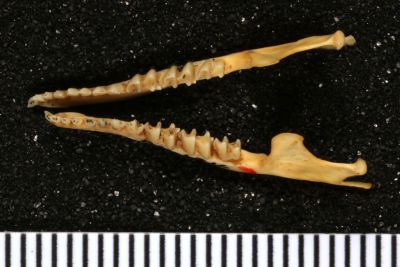
Holotype: USNM 1381/37434. Scapanus orarius orarius. Adult female. Shoalwater (Willapa) Bay, Pacific County, Washington. Collected 30 August 1855. Dorsal view of the mandible. -

Holotype: USNM 1381/37434. Scapanus orarius orarius. Adult female. Shoalwater (Willapa) Bay, Pacific County, Washington. Collected 30 August 1855. Lateral view of the left mandible.


Similar species
Key to the species of Scapanus
From Verts & Carraway (1998): "It can be distinguished from S. latimanus by its blackish or dark grayish pelage without a coppery wash and evenly spaced unicuspid teeth, and from S. towsendii by a total length <200 mm, a total length of the skull <40 mm, and a sublacrimal ridge not strongly developed (Hartman and Yates, 1985; Jackson, 1915)."
-

Coast Mole (Scapanus orarius) observed in Washington by Patricia Teague. Notice that the tail is fleshy, scantily haired, and appears almost naked. -

Northern Broad-footed Mole (Scapanus latimanus) observed by jabbott in Willits, California. Notice that the tail is nearly covered in hair to the tip. -

Townsend's Mole (Scapanus townsendii) observed by mjwood77 in Beaverton, Oregon. Scapanus townsendii is the largest species of mole in North America. Notice that the tail is similar to that of Scapanus orarius.
References
Hartman GD, Yates TL. 1985. Scapanus orarius. Mammalian Species (253): 1-5.
Jackson HHT. 1915. A review of the American moles. North American Fauna 38:1-100.
Jameson EW, Peeters HJ. 2004. Mammals of California (No. 66). Berkeley (CA, USA): University of California Press.
True FW. 1896. A Revision of the American Moles. Proceedings of the United States National Museum 19: 52.
Verts BJ, Carraway LN. 1998. Land mammals of Oregon. Berkeley (CA, USA): University of California Press.