Napaeozapus insignis
| Eastern Woodland Jumping Mouse
(Napaeozapus insignis) | |
|---|---|
| Range | |
 | |
| Taxonomic classification | |
| Order: | Rodentia |
| Suborder: | Supramyomorpha |
| Infraorder: | Myomorphi |
| Superfamily: | Dipodoidea |
| Family: | Zapodidae |
| Genus: | Napaeozapus |
| Binomial details | |
| Napaeozapus insignis (G. S. Miller, 1891) | |
| Other resources | |
| Full taxonomic details at MDD | |
Genetic analyses by Malaney et al. (2017) revealed a cryptic lineage within Napaeozapus. They proposed that populations to the north and west belong to the Western Woodland Jumping Mouse (Napaeozapus abietorum). The southern and southeastern populations belong to the Eastern Woodland Jumping Mouse (Napaeozapus insignis). The delineation of this taxon by Malaney et al. (2017) includes the following subspecies: Napaeozapus insignis insignis, Napaeozapus insignis roanensis, and part of Napaeozapus insignis abietorum. The work of Malaney et al. (2017) has importantly exposed cryptic diversity and a putative new species within Napaeozapus, but further studies will be needed to fully understand new species boundaries and morphological variation.
Description
A formal species description for this taxon as delineated by Malaney et al. (2017) does not currently exist. The following descriptions from Wrigley (1972) are provided for subspecies that Malaney et al. (2017) subsumed under this taxon.
From Wrigley (1972) describing Napaeozapus insignis insignis: "External and cranial features of medium size for the species; rostral and interorbital breadths relatively great. Lateral pelage bright yellowish orange; dorsal stripe dark brown, occasionally blackish; edging of ears brownish orange."
From Wrigley (1972) describing Napaeozapus insignis roanensis: "Size very small, with external and cranial measurements (except interorbital breadth) averaging smaller than in any other subspecies. Color characterized by reddish tint, apparent on dorsal stripe as well as sides; white tip on tail relatively short."
From Wrigley (1972) describing Napaeozapus insignis abietorum: "Size very large, with rostral breadth and maxillary toothrow averaging greater than in any other subspecies; interorbital region small. Color of sides yellowish orange with numerous dark guard hairs resulting in an undefined dorsal stripe ; ears often with white edging."
-
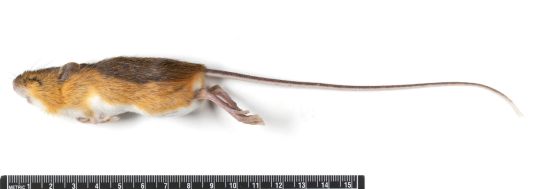
NEON054FX. Napaeozapus insignis insignis. Adult male. Harvard Forest & Quabbin Watershed, Worcester County, Massachusetts. Collected 5 August 2021. -
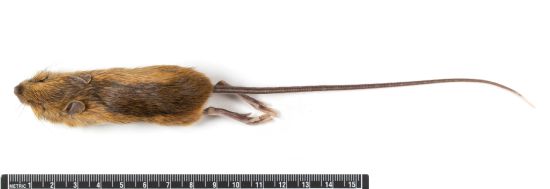
NEON054FX. Napaeozapus insignis insignis. Adult male. Harvard Forest & Quabbin Watershed, Worcester County, Massachusetts. Collected 5 August 2021. -
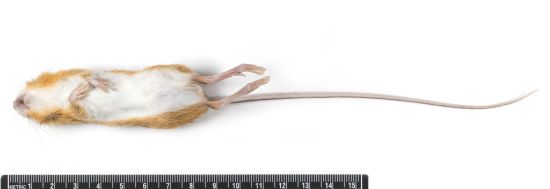
NEON054FX. Napaeozapus insignis insignis. Adult male. Harvard Forest & Quabbin Watershed, Worcester County, Massachusetts. Collected 5 August 2021.


Museum type specimens
-
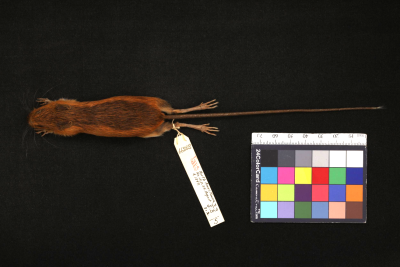
Holotype: USNM 66283. Napaeozapus insignis roanensis. Adult male. Magnetic City, foot of Roan Mountain, Mitchell County, North Carolina. Collected 22 May 1894.

External measurements
Length measurements are in millimeters (mm) and weight measurements are in grams (g), unless stated otherwise. If available, the sample size (n=) is provided. If a range is not provided and n= is not given, then the listed measurement represents an average.
| Part of range | Reference | Total length | Tail length | Hindfoot length | Ear length | Mass |
|---|---|---|---|---|---|---|
| Carolinas, Virginia, Maryland | Webster et al. (1985) | 213–230 | 130–146 | 29–31 | ||
| Virginia | Linzey (1998) | 210–250 | 125–150 | 21–28 |
Color variation
This section shows some of the color variation present in Napaeozapus insignis. The location is provided for reference only. The individual shown does not necessarily represent the only color variant within the local population.
-
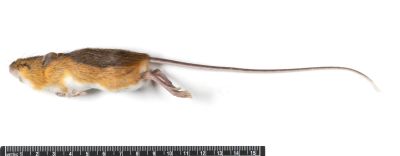 Massachusetts, Worcester County
-
 New Hampshire, Carroll County
-
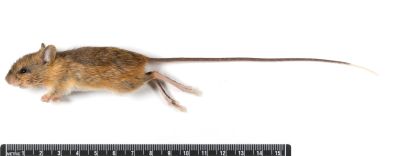 subadult, New Hampshire, Carroll County
-
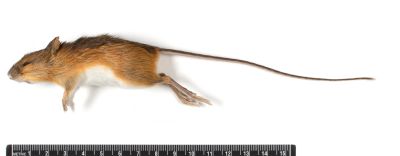 Virginia, Giles County


Skull
-

Holotype: USNM 66283. Napaeozapus insignis roanensis. Adult male. Magnetic City, foot of Roan Mountain, Mitchell County, North Carolina. Collected 22 May 1894. Dorsal view of the skull. -
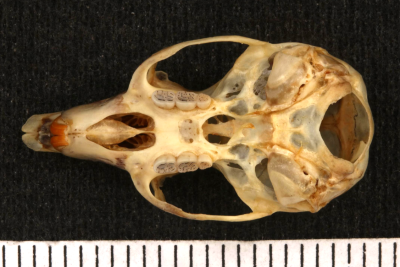
Holotype: USNM 66283. Napaeozapus insignis roanensis. Adult male. Magnetic City, foot of Roan Mountain, Mitchell County, North Carolina. Collected 22 May 1894. Ventral view of the skull. -
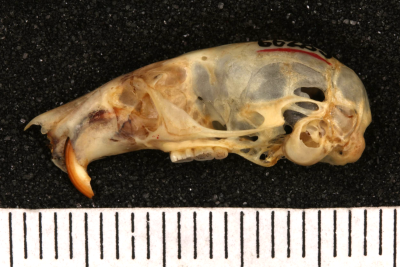
Holotype: USNM 66283. Napaeozapus insignis roanensis. Adult male. Magnetic City, foot of Roan Mountain, Mitchell County, North Carolina. Collected 22 May 1894. Lateral view of the skull. -
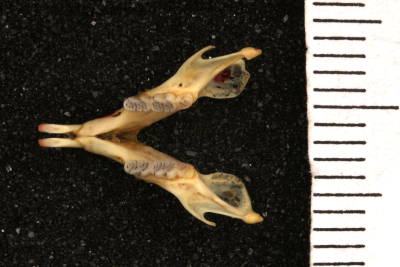
Holotype: USNM 66283. Napaeozapus insignis roanensis. Adult male. Magnetic City, foot of Roan Mountain, Mitchell County, North Carolina. Collected 22 May 1894. Dorsal view of the mandible. -
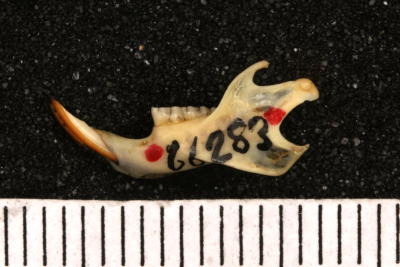
Holotype: USNM 66283. Napaeozapus insignis roanensis. Adult male. Magnetic City, foot of Roan Mountain, Mitchell County, North Carolina. Collected 22 May 1894. Lateral view of the mandible. -

Holotype: USNM 66283. Napaeozapus insignis roanensis. Adult. Upper molars. -

Holotype: USNM 66283. Napaeozapus insignis roanensis. Adult. Lower molars.


Footprint
-
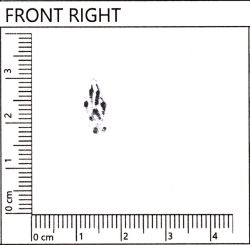
NEON03OZE. Napaeozapus insignis. Front right footprint. -
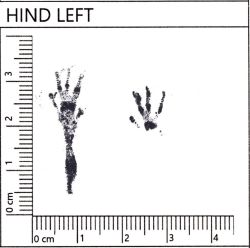
NEON03OZE. Napaeozapus insignis. Hind left footprint.


Similar species
Comparison with Zapus
From Whitaker & Wrigley (1972): "Napaeozapus differs from Zapus in having 3 rather than 4 molariform teeth. It further differs from Zapus in having the tip of the tail white."
-

Eastern Woodland Jumping Mouse (Napaeozapus insignis) -

Northern Meadow Jumping Mouse (Zapus hudsonius) -

Cheekteeth (molariform teeth) of Napaeozapus. -

Cheekteeth (molariform teeth) of Zapus.

Comparison with Napaeozapus abietorum
Currently, the boundaries of Napaeozapus insignis and Napaeozapus abietorum are not well understood. Further studies are needed to fully understand new species boundaries and morphological variation.
-
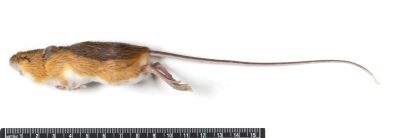
Eastern Woodland Jumping Mouse (Napaeozapus insignis) -
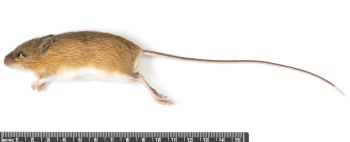
Western Woodland Jumping Mouse (Napaeozapus abietorum) -

Range of Napaeozapus insignis and Napaeozapus abietorum based on genetic analyses and niche-based distribution modeling by Malaney et al. (2017). Further studies are needed to fully understand the boundaries of these two species.

Taxonomic notes
Genetic analyses by Malaney et al. (2017) revealed a cryptic lineage within Napaeozapus. They proposed that populations to the north and west belong to the Western Woodland Jumping Mouse (Napaeozapus abietorum). The southern and southeastern populations belong to Napaeozapus insignis. The delineation of this taxon by Malaney et al. (2017) includes the following subspecies: Napaeozapus insignis insignis, Napaeozapus insignis roanensis, and part of Napaeozapus insignis abietorum. The work of Malaney et al. (2017) has importantly exposed cryptic diversity and a putative new species within Napaeozapus, but further studies will be needed to fully understand new species boundaries and morphological variation.
-

Subspecies boundaries of Napaeozapus insignis as defined by Wrigley (1972), before the species was split by Malaney et al. (2017). -

Range of Napaeozapus insignis based on molecular analyses and niche-based distribution modeling by Malaney et al. (2017).

References
Linzey DW. 1998. The mammals of Virginia. McDonald & Woodward Publishing.
Malaney JL, Demboski JR, Cook JA. 2017. Integrative species delimitation of the widespread North American jumping mice (Zapodinae). Molecular Phylogenetics and Evolution 114: 137-152.
Miller Jr GS. 1891. Description of a new jumping mouse from Nova Scotia and New Brunswick. The American Naturalist 25(296):742-743.
Webster WD, Parnell JF, Biggs WC. 1985. Mammals of the Carolinas, Virginia, and Maryland. Chapel Hill (NC, USA): University of North Carolina Press.
Whitaker JO, Wrigley RE. 1972. Napaeozapus insignis. Mammalian species (14):1-6.
Wrigley RE. 1972. Systematics and biology of the woodland jumping mouse, Napaeozapus insignis. Illinois biological monographs; v. 47.