Dipodomys microps
| Chisel-toothed Kangaroo Rat
(Dipodomys microps) | |
|---|---|
| Range | |
 | |
| Taxonomic classification | |
| Order: | Rodentia |
| Suborder: | Supramyomorpha |
| Infraorder: | Castorimorphi |
| Superfamily: | Geomyoidea |
| Family: | Heteromyidae |
| Subfamily: | Dipodomyinae |
| Genus: | Dipodomys |
| Binomial details | |
| Dipodomys microps (C. H. Merriam, 1904) | |
| Other resources | |
| Full taxonomic details at MDD | |
The Chisel-toothed Kangaroo Rat (Dipodomys microps) is found in the arid regions of the western United States where there is sufficient shrub cover and soils suitable for digging.
Description
From Hayssen (1991): "The chisel-toothed kangaroo rat is a medium-sized, narrow-faced, small-eared, five-toed kangaroo rat with incisors that are flattened anteriorly and not strongly incurved, and ever-growing cheek teeth (Nader, 1966). The skull is narrow and constricted and the maxillary arches are weakly angled. The pelage is slightly darker than average for the genus (Grinnell, 1922; Hall and Dale, 1939)."
From Hoffmeister (1986): "A medium-sized, five-toed (hind foot) species of Dipodomys with lower incisors flat on front face and broad, thus appearing chisel-like; longer-tailed and -bodied than other "small" Arizona species (merriami and ordii); lining of cheek pouches dusky; maxillary arms of zygomata not sharply angled but narrow; dorsal tail stripe blackish and broad."

Museum specimens
-

Holotype: USNM 25288/32701. Dipodomys microps microps. Adult male. Lone Pine, Owens Valley, Inyo County, California. Collected 22 December 1890. -

Holotype: USNM 25288/32701. Dipodomys microps microps. Adult male. Lone Pine, Owens Valley, Inyo County, California. Collected 22 December 1890. -

NEON06I8Y. Chisel-toothed Kangaroo Rat (Dipodomys microps). Adult female. Tooele County, Utah. Collected 28 June 2022. -
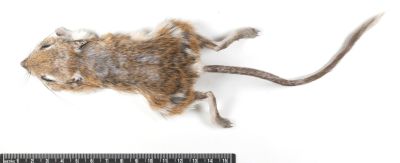
NEON06I8Y. Chisel-toothed Kangaroo Rat (Dipodomys microps). Adult female. Tooele County, Utah. Collected 28 June 2022. -

NEON06I8Y. Chisel-toothed Kangaroo Rat (Dipodomys microps). Adult female. Tooele County, Utah. Collected 28 June 2022.


External measurements
Length measurements are in millimeters (mm) and weight measurements are in grams (g), unless stated otherwise. If available, the sample size (n=) is provided. If a range is not provided and n= is not given, then the listed measurement represents an average.
| Part of range | Reference | Total length | Tail length | Hindfoot length | Ear length | Mass |
|---|---|---|---|---|---|---|
| California | Jameson & Peeters (2004) | 244–290 | 140–173 | 38–44 | 55–75 |
Skull
-

Holotype: USNM 25288/32701. Dipodomys microps microps. Adult male. Lone Pine, Owens Valley, Inyo County, California. Collected 22 December 1890. Dorsal view of the skull. -

Holotype: USNM 25288/32701. Dipodomys microps microps. Adult male. Lone Pine, Owens Valley, Inyo County, California. Collected 22 December 1890. Ventral view of the skull. -

Holotype: USNM 25288/32701. Dipodomys microps microps. Adult male. Lone Pine, Owens Valley, Inyo County, California. Collected 22 December 1890. Lateral view of the skull. -

Holotype: USNM 25288/32701. Dipodomys microps microps. Adult male. Lone Pine, Owens Valley, Inyo County, California. Collected 22 December 1890. Dorsal view of the mandible. -

Holotype: USNM 25288/32701. Dipodomys microps microps. Adult male. Lone Pine, Owens Valley, Inyo County, California. Collected 22 December 1890. Lateral view of the left mandible. -

NEON01IM5. Dipodomys microps. Adult male. Tooele County, Utah. Collected 5 May 2019. Chisel-shaped lower incisors shown.


Similar species
From Hayssen (1991): "D. microps shares it range with two other five-toed kangaroo rats, D. panamintinus and D. ordii. D. microps has a hind foot <44 mm in length in the part of its range shared with D. panamintinus (length of hind foot is 42-48 mm for D. panamintinus) and has flatter, more chisel-shaped incisors than either D. panamintinus or D. ordii (Hall, 1981). D. microps also can be distinguished from D. ordii by its more prominent face-mask and dark tail-stripes as well as its coat color, which has a gun-metal hue (Hatch et al., 1971)."
From Hoffmeister (1986): "D. microps differs from D. merriami as follows: five toes on hind foot instead of four; lower incisors flat on front face rather than curved and narrow; larger on the average in all external measurements; least interorbital breadth less than one-half the basal length rather than usually more; maxillary arches narrow and rounded rather than sharply angled; lining of cheek pouches appears dusky rather than whitish." "D. ordii differs from D. microps as follows: lower incisors rounded on the front face rather than flat and broad; dark, ventral tail stripe usually terminates short of the tip rather than extending to tip; dark stripes on tail usually narrower, rather than wider, than white stripes; lining of cheek pouches white rather than dusky; hind feet and body averaging shorter; skull relatively broader interorbitally.
Dipodomys microps has chisel-shaped (anteriorly flattened and broad) lower incisors, whereas D. merriami, D. agilis, D. panamintinus, and D. ordii have awl-shaped lower incisors. The chisel shape of the incisors is unique to this species.
-
Chisel-shaped lower incisors of the Chisel-toothed Kangaroo Rat (Dipodomys microps). -

Awl-shaped lower incisors of the Merriam's Kangaroo Rat (Dipodomys merriami). -

Awl-shaped lower incisors of the Ord's Kangaroo Rat (Dipodomys ordii).
References
Grinnell J. 1922. A geographical study of the kangaroo rats of California (Vol. 24). Berkeley (CA, USA): University of California Press.
Hall ER. 1981. The mammals of North America. 2 vols. John Wiley and Sons, New York.
Hall ER, Dale FH. 1939. Geographic races of the kangaroo rat, Dipodomys microps. Occasional Papers of the Museum of Zoology, Louisiana State University 4:47-62.
Hatch FT, Ridley EJ, Mazrimas JA. 1971. Some Dipodomys species: ecological and taxonomic features, estrous cycle, and breeding attempts. (No. UCRL-51140). California University, Livermore. Lawrence Livermore Lab.
Hayssen V. 1991. Dipodomys microps. Mammalian Species (389):pp.1-9. https://doi.org/10.2307/3504107
Hoffmeister DF. 1986. Mammals of Arizona. Tucson (AZ, USA): University of Arizona Press.
Merriam CH. 1904-07-14. New and little known kangaroo rats of the genus Perodipus. Proceedings of the Biological Society of Washington 17:139-145.
Nader IA. 1966. Roots of teeth as a generic character in the kangaroo rats, Dipodomys. Bulletin of the Biological Research Centre 2:62-69.