Dipodomys ordii
| Ord's Kangaroo Rat
(Dipodomys ordii) | |
|---|---|
| Range | |
 | |
| Taxonomic classification | |
| Order: | Rodentia |
| Suborder: | Supramyomorpha |
| Infraorder: | Castorimorphi |
| Superfamily: | Geomyoidea |
| Family: | Heteromyidae |
| Subfamily: | Dipodomyinae |
| Genus: | Dipodomys |
| Binomial details | |
| Dipodomys ordii S. W. Woodhouse, 1853 | |
| Other resources | |
| Full taxonomic details at MDD | |
The Ord's Kangaroo Rat (Dipodomys ordii) is a large kangaroo rat that inhabits grasslands, scrublands, and woodlands.
Description
From Armstrong et al. (2010): "Ord's kangaroo rat is a rather large heteromyid with a long, tufted tail; short forelimbs and elongate hindfeet with 5 toes and densely haired soles. The upper parts are brownish yellow washed with black. The venter, legs, flanks, upper lips, and facial patterns are white. Black facial lines are present on the sides of the nose. The fur is sleek and silky. The tail is dark on its dorsal and ventral surfaces and white laterally."
From Hoffmeister (1986): "A five-toed, medium-sized Dipodomys relatively short-tailed (usually about 125 percent of body); hind feet usually less than 42 mm."
Seabloom et al. (2011): "Dorsal pelage coloration is cinnamon-buff, while the underparts, including feet, are white. There are also white patches above the eyes and below the ears."


External measurements
Length measurements are in millimeters (mm) and weight measurements are in grams (g), unless stated otherwise. If available, the sample size (n=) is provided. If a range is not provided and n= is not given, then the listed measurement represents an average.
| Part of range | Reference | Total length | Tail length | Hindfoot length | Ear length | Mass |
|---|---|---|---|---|---|---|
| California | Jameson & Peeters (2004) | 208–281 | 100–163 | 33–41 | 50–61 | |
| Colorado | Armstrong et al. (2010) | 240–280 | 133–163 | 39–43 | 12–15 | 55–85 |
| Nebraska | Johnsgard (2020) | 249–280 | 138–163 | 45–100 | ||
| North Dakota | Seabloom et al. (2020) | 258 | 140 | 38 | 12 | males: 66; females: 64 |
| Texas | Schmidly & Bradley (2016) | 253 | 159 | 41 | 60–70 |
Museum specimens
-

NEON05194. Dipodomys ordii. Adult female. Collected in San Juan County, Utah on 30 June 2021. -

NEON05194. Dipodomys ordii. Adult female. Collected in San Juan County, Utah on 30 June 2021. -
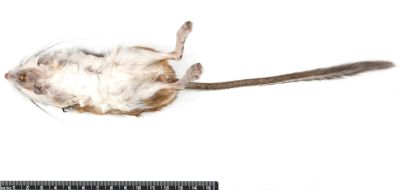
NEON05194. Dipodomys ordii. Adult female. Collected in San Juan County, Utah on 30 June 2021.


Skull
From Armstrong et al. (2010): "The skull has greatly inflated auditory bullae, and the zygomatic arches are fragile. The upper incisors are grooved." Dipodomys microps has chisel-shaped (anteriorly flattened and broad) lower incisors, whereas D. merriami, D. agilis, D. panamintinus, and D. ordii have awl-shaped lower incisors.
-

NEON06I91. Lateral view of the skull of Dipodomys ordii. -

NEON06I91. Dorsal view of the skull of Dipodomys ordii. -

NEON06I91. Ventral view of the skull of Dipodomys ordii. -

NEON06I91. Lower jaw of Dipodomys ordii. -

NEON06I91. Upper incisors of Dipodomys ordii. -

NEON06I91. Upper molars of Dipodomys ordii -

NEON06I91. Lower molars of Dipodomys ordii -

NEON06I8X. Awl-shaped lower incisors of Dipodomys ordii.


Similar species
Comparison with Dipodomys merriami
From Hoffmeister (1986): "D. ordii differs from D. merriami as follows: five rather than four toes on hind foot; tail relatively shorter, about 125 percent of body rather than 143 percent; rostrum broader; skull averaging larger but maxillary wing of zygomatic arch averaging narrower."
-
Ord's Kangaroo Rat (Dipodomys ordii). Compared to D. merriami, this species has five toes, rather than four, and a relatively shorter tail. -

Merriam's Kangaroo Rat (Dipodomys merriami). Compared to D. ordii, this species has four toes, rather than five, and a relatively longer tail.
Comparison with Dipodomys microps
From Hoffmeister (1986): "D. ordii differs from D. microps as follows: lower incisors rounded on the front face rather than flat and broad; dark, ventral tail stripe usually terminates short of the tip rather than extending to tip; dark stripes on tail usually narrower, rather than wider, than white stripes; lining of cheek pouches white rather than dusky; hind feet and body averaging shorter; skull relatively broader interorbitally."
From Hayssen (1991): "D. microps also can be distinguished from D. ordii by its more prominent face-mask and dark tail-stripes as well as its coat color, which has a gun-metal hue (Hatch et al., 1971)."
-
Ord's Kangaroo Rat (Dipodomys ordii) -

Chisel-toothed Kangaroo Rat (Dipodomys microps). Haysen (1991) noted that the gun-metal hue of this species coat color helps distinguish it from D. ordii. -
Awl-shaped lower incisors of the Ord's Kangaroo Rat (Dipodomys ordii). -

Chisel-shaped lower incisors of the Chisel-toothed Kangaroo Rat (Dipodomys microps).

Comparison with Dipodomys spectabilis
From Armstrong et al. (2010): "The banner-tailed kangaroo rat Dipodomys spectabilis differs from Ord's kangaroo rat in having 4 toes on the hindfeet and a striking white-tipped tail with a solid black band proximal to the white tip."
-

Ord's Kangaroo Rat (Dipodomys ordii) observed by Nick Cairns in Carbon County, Montana. -

Banner-tailed Kangaroo Rat (Dipodomys spectabilis) photographed by Randy Babb. © Randy Babb -

Holotype: 243093. Dipodomys ordii cupidineus. Adult male. Kanab Wash, Mohave County, Arizona. Collected 12 October 1922. Dorsal view of the skull. -

Holotype: 17886/24823. Dipodomys spectabilis spectabilis. Adult male. Dos Cabezos (Cabezas), Cochise County, Arizona. Collected 22 November 1889. Dorsal view of the skull.

References
Armstrong DM, Fitzgerald JP, Meaney CA. 2010. Mammals of Colorado, Second Edition. Denver (CO, USA): University Press of Colorado.
Hatch FT, Ridley EJ, Mazrimas JA. 1971. Some Dipodomys species: ecological and taxonomic features, estrous cycle, and breeding attempts. (No. UCRL-51140). California University, Livermore. Lawrence Livermore Lab.
Hayssen V. 1991. Dipodomys microps. Mammalian Species (389):pp.1-9.
Hoffmeister DF. 1986. Mammals of Arizona. Tucson (AZ, USA): University of Arizona Press.
Jameson EW, Peeters HJ. 2004. Mammals of California (No. 66). Berkeley (CA, USA): University of California Press.
Johnsgard PA. 2020. Wildlife of Nebraska: a natural history. Lincoln (NE, USA): University of Nebraska Press.
Schmidly DJ, Bradley RD. 2016. The mammals of Texas. Austin (TX, USA): University of Texas Press.
Seabloom R, Hoganson JW, Jensen WF. 2020. The mammals of North Dakota. Fargo (ND, USA): North Dakota State University Press.