Dipodomys deserti
| Desert Kangaroo Rat
(Dipodomys deserti) | |
|---|---|
| Range | |
 | |
| Taxonomic classification | |
| Order: | Rodentia |
| Suborder: | Supramyomorpha |
| Infraorder: | Castorimorphi |
| Superfamily: | Geomyoidea |
| Family: | Heteromyidae |
| Subfamily: | Dipodomyinae |
| Genus: | Dipodomys |
| Binomial details | |
| Dipodomys deserti Stephens, 1887 | |
| Other resources | |
| Full taxonomic details at MDD | |
The Desert Kangaroo Rat (Dipodomys deserti) is a large kangaroo rat that inhabitats sandy habitats in the Sonoran, Mojave, and Great Basin Deserts of the west.
Description
From Hoffmeister (1986): "A large species of Dipodomys; tail with white tip; hind feet long and four-toed; skull large with interparietal usually absent or not visible and supraoccipital greatly reduced; auditory bullae greatly inflated; maxillary wings of zygomata relatively weak; external auditory meatus large and oval shaped; ventral tail stripe absent or narrow and pale in color."
From Jameson & Peeters (2004): "A very large kangaroo rat, very pale buff in color. The tail has a white tip and usually also lacks a ventral dark stripe. The hind foot has four toes."
-

Holotype: USNM 15629/22522. Dipodomys deserti deserti. Adult female. Mohave River, opposite Hesperia, San Bernardino County, California. Collected 29 June 1886. -

Holotype: USNM 15629/22522. Dipodomys deserti deserti. Adult female. Mohave River, opposite Hesperia, San Bernardino County, California. Collected 29 June 1886. -

Holotype: USNM 15629/22522. Dipodomys deserti deserti. Adult female. Mohave River, San Bernardino County, California. Collected 29 June 1886. Dorsal view of the skull. -

Holotype: USNM 15629/22522. Dipodomys deserti deserti. Adult female. Mohave River, San Bernardino County, California. Collected 29 June 1886. Ventral view of the skull. -

Holotype: USNM 15629/22522. Dipodomys deserti deserti. Adult female. Mohave River, San Bernardino County, California. Collected 29 June 1886. Lateral view of the skull. -

Holotype: USNM 15629/22522. Dipodomys deserti deserti. Adult female. Mohave River, San Bernardino County, California. Collected 29 June 1886. Dorsal view of the mandible. -

Holotype: USNM 15629/22522. Dipodomys deserti deserti. Adult female. Mohave River, San Bernardino County, California. Collected 29 June 1886. Lateral view of the left mandible. Note that the lower incisors are worn down. -

Holotype: USNM 15629/22522. Dipodomys deserti deserti. Adult. Upper molars shown. -

Holotype: USNM 15629/22522. Dipodomys deserti deserti. Adult. Lower molars shown. -
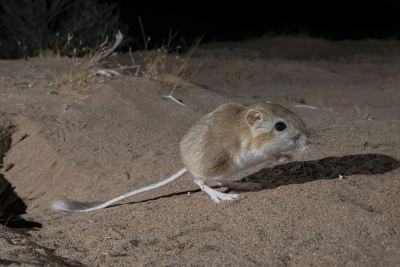
Desert Kangaroo Rat (Dipodomys deserti) photographed by Randy Babb. © Randy Babb -

Merriam's Kangaroo Rat (Dipodomys merriami) photographed by Randy Babb. © Randy Babb -
Holotype: USNM 15629/22522. Dipodomys deserti deserti. Adult female. Mohave River, [San Bernardino County], California. Collected 29 June 1886. Dorsal view of the skull. From Best et al. (1989): "The mastoids meet immediately behind the parietals, having at most an inconspicuous spicule between them; this character distinguishes D. deserti from all other species of Dipodomys. -

Holotype: USNM 54552. Dipodomys merriami merriami. Adult female. Pyramid Lake, Washoe County, Nevada. Collected 26 June 1893. Dorsal view of the skull. -
Holotype: USNM 15629/22522. Dipodomys deserti deserti. Adult female. Mohave River, [San Bernardino County], California. Collected 29 June 1886. Dorsal view of the skull. From Best et al. (1989): "The mastoids meet immediately behind the parietals, having at most an inconspicuous spicule between them; this character distinguishes D. deserti from all other species of Dipodomys. -

Holotype: 25288/32701. Dipodomys microps microps. Adult male. Lone Pine, Owens Valley, Inyo County, California. Collected 22 December 1890. Dorsal view of the skull. -
Desert Kangaroo Rat (Dipodomys deserti) photographed by Randy Babb. © Randy Babb -

Ord's Kangaroo Rat (Dipodomys ordii) observed by Nick Cairns in Carbon County, Montana. -
Holotype: USNM 15629/22522. Dipodomys deserti deserti. Adult female. Mohave River, [San Bernardino County], California. Collected 29 June 1886. Dorsal view of the skull. From Best et al. (1989): "The mastoids meet immediately behind the parietals, having at most an inconspicuous spicule between them; this character distinguishes D. deserti from all other species of Dipodomys. -

Holotype: USNM 243093. Dipodomys ordii cupidineus. Adult male. Kanab Wash, Mohave County, Arizona. Collected 12 October 1922. Dorsal view of the skull. -
Desert Kangaroo Rat (Dipodomys deserti) photographed by Randy Babb. © Randy Babb -

Banner-tailed Kangaroo Rat (Dipodomys spectabilis) photographed by Randy Babb. © Randy Babb -
Holotype: USNM 15629/22522. Dipodomys deserti deserti. Adult female. Mohave River, [San Bernardino County], California. Collected 29 June 1886. Dorsal view of the skull. From Best et al. (1989): "The mastoids meet immediately behind the parietals, having at most an inconspicuous spicule between them; this character distinguishes D. deserti from all other species of Dipodomys. -

Holotype: USNM 17886/24823. Dipodomys spectabilis spectabilis. Adult male. Dos Cabezos (Cabezas), Cochise County, Arizona. Collected 22 November 1889. Dorsal view of the skull.


Museum specimens


External measurements
Length measurements are in millimeters (mm) and weight measurements are in grams (g), unless stated otherwise. If available, the sample size (n=) is provided. If a range is not provided and n= is not given, then the listed measurement represents an average.
| Part of range | Reference | Total length | Tail length | Hindfoot length | Ear length | Mass |
|---|---|---|---|---|---|---|
| Arizona (Mohave Co., vicinity of Beaver Dam and Pakoon) | Hoffmeister (1986) | males: 324–354 (n=6); females: 315–348 (n=10) | males: 184–209 (n=6); females:175–203 (n=10) | males: 51–54 (n=6); females: 50–54 (n=10) | ||
| Arizona (Pinal Co., vicinity of Picacho) | Hoffmeister (1986) | males: 332–358 (n=9); females: 341–353 (n=6) | males: 193–212 (n=9); females: 196–210 (n=6) | males: 52–56 (n=9); females: 49–54 (n=6) | ||
| Arizona (Yuma Co., vicinty of Somerton) | Hoffmeister (1986) | males: 315–360 (n=7); females: 318–347 (n=7) | males: 181–212 (n=7); females: 177–205 (n=7) | males: 52–58 (n=7); females: 51–56 (n=7) | ||
| California | Jameson & Peeters (2004) | 305–377 | 180–215 | 50–58 | 83–138 | |
| not reported | Ceballos (editor, 2014) | 305–377 | 180–215 | 50–58 | 15–18 | 83–138 |
Skull
From Best et al. (1989): "The mastoids meet immediately behind the parietals, having at most an inconspicuous spicule between them; this character distinguishes D. deserti from all other species of Dipodomys. In addition, D. deserti has the flattest skull of any member of the genus (Merriam, 1890)."


Habitat
From Hoffmeister (1986): "Desert kangaroo rats are inhabitants of loose, easily diggable sands. Such sands may be in the bottoms of washes or they may be in wind-drifted sands partially stabilized by creosote bush." Hoffmeister (1986) notes an exception to this is a record of two individuals captured in gravelly soil near Florence, Arizona.
Similar species
Comparison with Dipodomys merriami
Dipodomys deserti differs from Merriam's Kangaroo Rat (Dipodomys merriami) in having a white-tipped tail.

Comparison with Dipodomys microps
The Chisel-toothed Kangaroo Rat (Dipodomys microps) differs from D. deserti in having five hind toes (instead of four).
Comparison with Dipodomys ordii
Dipodomys deserti differs from Ord's Kangaroo Rat (Dipodomys ordii) in having a white-tipped tail and four hind toes, instead of five.


Comparison with Dipodomys spectabilis
From Hoffmeister (1986): "D. spectabilis differs from D. deserti as follows: terminal white tip on tail more conspicuous; dorsal and ventral dark stripes on tail unite to form a nearly solid subterminal area of black or dark gray; interparietal present and supraoccipital narrow, but usually 1.0 mm wide or greater at narrowest constriction; suture between frontal and maxillary arm of zygomatic arch longer; rostrum heavier; external auditory meatus rounder and smaller; ventral stripe on tail darker and broader."

References
Best TL, Hildreth NJ, Jones C. 1989. Dipodomys deserti. Mammalian Species (339): 1-8.
Ceballos G, editor. 2014. Mammals of Mexico. Baltimore (MD, USA): Johns Hopkins University Press.
Hoffmeister DF. 1986. Mammals of Arizona. Tucson (AZ, USA): University of Arizona Press.
Jameson EW, Peeters HJ. 2004. Mammals of California (No. 66). Berkeley (CA, USA): University of California Press.
Stephens F. 1887. Description of a New Species of Dipodomys, with Some Account of Its Habits. American Naturalist 21, 42.