Peromyscus maniculatus
| Eastern Deermouse
(Peromyscus maniculatus) | |
|---|---|
| Range | |
 | |
| Taxonomic classification | |
| Order: | Rodentia |
| Suborder: | Supramyomorpha |
| Infraorder: | Myomorphi |
| Superfamily: | Muroidea |
| Family: | Cricetidae |
| Subfamily: | Neotominae |
| Tribe: | Peromyscini |
| Genus: | Peromyscus |
| Binomial details | |
| Peromyscus maniculatus (J. A. Wagner, 1844) | |
| Other resources | |
| Full taxonomic details at MDD | |
Molecular studies by Bradley et al. (2019) and Greenbaum et. al (2019) indicate that Peromyscus maniculatus is a complex of multiple species. Both studies elevate some lineages within maniculatus to species status. Greenbaum et al. (2019) increased the number of species in the Peromyscus maniculatus group to nine (P. melanotis, P. polionotus, P. keeni, P. arcticus, P. gambelii, P. sejugis, P. sonoriensis, P. labecula, and P. maniculatus). According to both Bradley (2019) and Greenbaum (2019), Peromyscus maniculatus is restricted to the northeastern United States and south-central Canada.
Description
From Bradley et al. (2019): "Size is large for species group; measurements obtained from Osgood (1909), for several of the subspecies now assigned to P. maniculatus, indicated a total length averaging 187 mm; (range 174–200 mm) and tail length averaging 91.5 mm (range 79–104 mm). Coloration is based on synopsis of Osgood’s (1909) observations of several subspecies - back and sides are dark brown and tinged with fawn (varies among subspecies); venter is white; ears are dusky with pale edges; and tail is bicolored (brownish black above and white underneath)."


External measurements
Length measurements are in millimeters (mm) and weight measurements are in grams (g), unless stated otherwise. If available, the sample size (n=) is provided. If a range is not provided and n= is not given, then the listed measurement represents an average.
| Part of range | Reference | Total length | Tail length | Hindfoot length | Ear length | Mass |
|---|---|---|---|---|---|---|
| Kentucky | Best & Dusi (2014) | 178 (164–198) (n=18) | 89 (77–97) (n=18) | 20 (19–22) (n=18) | 16–24 (n=18) | |
| Maryland (Prince Georges Co.) (short-tailed race) | Webster et al. (1985) | 149–152 | 59–63 | seldom reaches 18 | ||
| Maryland, Virginia, and North and South Carolina (western mountainous regions) (long-tailed race) | Webster et al. (1985) | 152–200 | 72–102 | 18–23 | ||
| Minnesota (ssp. bairdii) | Hazard (1982) | 138–168 | 56–69 | 16–19.5 | 14–18? | 19.4–24.8 |
| Minnesota (ssp. gracilis) | Hazard (1982) | 162–200 | 80–104 | 20–22 | 17–22 | 14.9?–25.1 |
| Virginia (northern counties and near Harrisonburg) (short-tailed race) | Webster et al. (1985) | 149–152 | 59–63 | seldom reaches 18 | ||
| Virginia (subspecies maniculatus) | Linzey (1998) | 155–220 | 80–110 | |||
| Virigina (subspecies bairdii) | Linzey (1998) | 116–154 | 40–58 |
Variation
This section shows some of the color variation present in Peromyscus maniculatus. The location is provided for reference only. The individual shown does not necessarily represent the only color variant within the local population.
-

NEON0BKLJ. Peromyscus maniculatus. Adult. Carroll County, New Hampshire. -

NEON06RUU. Peromyscus maniculatus. Adult. Giles County, Virginia. -

NEON092XE. Peromyscus maniculatus. Adult. Giles County, Virginia. -
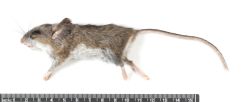
NEON09K25. Peromyscus maniculatus. Adult. Price County, Wisconsin. -
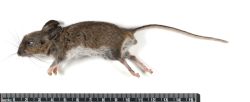
NEON01J0C. Peromyscus maniculatus. Adult. Vilas County, Wisconsin. -

NEON0DL0Y. Peromyscus maniculatus. Juvenile transitioning to subadult. Price County, Wisconsin.


Skull and skeleton
-

NEON0DL23. Peromyscus maniculatus. Subadult female. University of Notre Dame Environmental Research Center, Vilas County, Wisconsin. Collected 20 August 2025. Dorsal view of the skull. -

NEON0DL23. Peromyscus maniculatus. Subadult female. University of Notre Dame Environmental Research Center, Vilas County, Wisconsin. Collected 20 August 2025. Ventral view of the skull. -
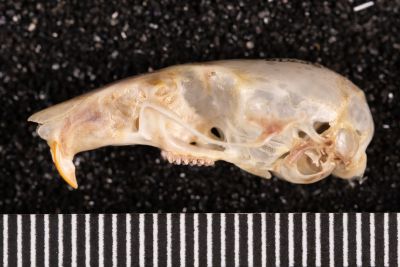
NEON0DL23. Peromyscus maniculatus. Subadult female. University of Notre Dame Environmental Research Center, Vilas County, Wisconsin. Collected 20 August 2025. Lateral view of the skull. -

NEON0DL23. Peromyscus maniculatus. Subadult female. University of Notre Dame Environmental Research Center, Vilas County, Wisconsin. Collected 20 August 2025. Dorsal view of the mandible. -

NEON0DL23. Peromyscus maniculatus. Subadult female. University of Notre Dame Environmental Research Center, Vilas County, Wisconsin. Collected 20 August 2025. Lateral view of the left mandible. -

NEON0DL23. Peromyscus maniculatus. Subadult female. University of Notre Dame Environmental Research Center, Vilas County, Wisconsin. Collected 20 August 2025. Upper incisors. -

NEON0DL23. Peromyscus maniculatus. Subadult female. University of Notre Dame Environmental Research Center, Vilas County, Wisconsin. Collected 20 August 2025. Upper molars. -
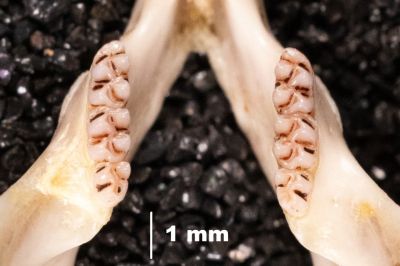
NEON0DL23. Peromyscus maniculatus. Subadult female. University of Notre Dame Environmental Research Center, Vilas County, Wisconsin. Collected 20 August 2025. Lower molars. -

NEON0DL23. Peromyscus maniculatus. Subadult female. University of Notre Dame Environmental Research Center, Vilas County, Wisconsin. Collected 20 August 2025. Skeleton.


Taxonomic notes
In 2019, based on mitochondrial DNA, Bradley et al. (2019) and Greenbaum et al. (2019) proposed elevating some of the monophyletic (descended from a common evolutionary ancestor or ancestral group) lineages within the Peromyscus maniculatus species group to distinct species, in addition to those species already recognized, resulting in at least 9 species within the P. maniculatus species complex. In 2023, Boria & Blois published their analyses using 28,000 genome wide SNPs, showing P. m. sonoriensis and P. m. gambelii are either very recently diverged or in the process of diversification and should not yet be elevated to distinct species.
From Bradley et al. (2019): "Although we were not able to examine all of the recognized subspecies that potentially are referable to P. maniculatus, we tentatively assign the following nine subspecies recognized in Hall (1981) to P. maniculatus: abietorium, anticostiensis, argentatus, bairdi, eremus, gracilis, maniculatus, nubiterrae, and plumbeus."
-

Peromyscus maniculatus range prior to molecular analyses published by Greenbaum et al. (2019) and Bradley et al. (2019). -

Peromyscus maniculatus range based on molecular analyses published by Greenbaum et al. (2019) and Bradley et al. (2019).

Similar species
Comparison with Peromyscus leucopus
Peromyscus maniculatus and the White-footed Deermouse (Peromyscus leucopus) are a pair of often co-occurring species that is notoriously difficult to differentiate in the field in certain regions of North America. Generally, but not always, Peromyscus maniculatus has a strongly/sharply bicolored tail and a duller gray-brown appearance, whereas Peromyscus leucopus has a less distinctly bicolored tail and a brighter and richer brown appearance. However, these characters should be used with caution. Confidently differentiating these two species may require genetic testing. Peromyscus maniculatus and P. leucopus can be differentiated in the lab using an AFLP-PCR (genetic) method developed by Tessier et al. (2004). A modified version that is fairly quick and inexpensive is available in the Genetic resources section.
-

Eastern Deermouse (Peromyscus maniculatus) -

White-footed Deermouse (Peromyscus leucopus)
Comaprison with Peromyscus sonoriensis

References
Armstrong DM, Fitzgerald JP, Meaney CA. 2010. Mammals of Colorado, Second Edition. Denver (CO, USA): University Press of Colorado.
Best TL, Dusi JL. 2014. Mammals of Alabama (Vol. 4). Tuscaloosa (AL, USA): University Alabama Press.
Best TL, Hunt JL. 2020. Mammals of the southeastern United States. Tuscaloosa (AL, USA): University Alabama Press.
Boria RA, Blois JL. 2023. Phylogeography within the Peromyscus maniculatus species group: Understanding past distribution of genetic diversity and areas of refugia in western North America. Molecular Phylogenetics and Evolution 180: 107701.
Bradley R, Francis JQ, Platt II RN, Soniat TJ, Alvarez D, Lindsey L. 2019. Mitochondrial DNA sequence data indicate evidence for multiple species within Peromyscus maniculatus. Special Publications, Museum of Texas Tech University.
Greenbaum IF, Honeycutt RL, Chirhart SE. 2019. Taxonomy and phylogenetics of the Peromyscus maniculatus species group. From field to laboratory: a memorial volume in honor to Robert J. Baker 71: 559-575.
Hall ER. 1981. The mammals of North America. 2nd ed. John Wiley & Sons, Inc. New York 1181 pp.
Hazard EB. 1982. The mammals of Minnesota. Minneapolis (MN, USA): University of Minnesota Press.
Linzey DW. 1998. The mammals of Virginia. McDonald & Woodward Publishing.
Wagner JA. 1845. Diagnosen einiger neuen Arten von Nagern und Handflüglern. Archiv für Naturgeschichte 11:145-149.
Webster WD, Parnell JF, Biggs WC. 1985. Mammals of the Carolinas, Virginia, and Maryland. Chapel Hill (NC, USA): University of North Carolina Press.