Neotoma floridana
| Eastern Woodrat
(Neotoma floridana) | |
|---|---|
| Range | |
 | |
| Taxonomic classification | |
| Order: | Rodentia |
| Suborder: | Supramyomorpha |
| Infraorder: | Myomorphi |
| Superfamily: | Muroidea |
| Family: | Cricetidae |
| Subfamily: | Neotominae |
| Tribe: | Neotomini |
| Genus: | Neotoma |
| Binomial details | |
| Neotoma floridana (Ord, 1818) | |
| Other resources | |
| Full taxonomic details at MDD | |
The Eastern Woodrat (Neotoma floridana) is a large woodrat (also called packrat) found in wooded and riparian habitats.
Description
From Best & Hunt (2020): "A medium-sized rodent with a long tail covered with short hairs. They look like very large deermice. Dorsal pelage is soft and brownish-gray sprinkled with black hairs. Ventral pelage is white, but during the breeding season yellowish discoloration on the ventrum may be caused be secretions from an abdominal musk gland. In adults, the worn pelage appears cinnamon-orange in late summer. The tail is sharply bicolored. Eyes are dark and bulging. Ears are large, rounded, and short-haired. Vibrissae are long and conspicuous. The front feet have four toes, the hind feet have five toes, and all bear well-developed claws."
From Webster et al. (1985): "The pelage is rather long and soft. The upper body is colored brownish gray with numerous black-tipped hairs, which produce a grizzled appearance; the fur is darkest at the midline, grading to buff on the sides. The underside and feet are white, there being a distinct line separating the white belly from the darker upper body. The tail is distinctly bicolored, dark brown above and white below. Adults in the summer are more brightly colored above, tending toward cinnamon. Vibrissae are long and conspicuous; the eyes are black, large, and somewhat bulging; and the ears are prominent and sparsely haired."
From Armstrong et al. (2010): "The eastern woodrat is a rather large rat with a relatively short, sparsely haired tail that is not scaly. The fur is relatively long, soft, and fine. The color is brownish gray washed lightly with black, paler on the sides. Hairs of the belly are whitish with lead gray roots. The throat and chest are white with individual hairs white to their bases. The tail is bicolored, white below and blackish brown above."


Museum type specimens
-

Holotype: USNM 186483. Neotoma floridana baileyi. Adult female. Clarks Canyon near Valentine, Cherry County, Nebraska. Collected 16 June 1888. -

Holotype: USNM 186483. Neotoma floridana baileyi. Adult female. Clarks Canyon near Valentine, Cherry County, Nebraska. Collected 16 June 1888.


External measurements
Length measurements are in millimeters (mm) and weight measurements are in grams (g), unless stated otherwise. If available, the sample size (n=) is provided. If a range is not provided and n= is not given, then the listed measurement represents an average.
| Part of range | Reference | Total length | Tail length | Hindfoot length | Ear length | Mass |
|---|---|---|---|---|---|---|
| Alabama | Best & Dusi (2014) | 331 (230–392) (n=12) | 158 (108–184) (n=12) | 36 (33–39) (n=12) | 27 (24–29) (n=9) | 208.8 (149.3–251.2) (n=5) |
| Carolinas, Virginia, Maryland | Webster et al. (1985) | 340–430 | 160–200 | 217–333 | ||
| Colorado | Armstrong et al. (2010) | 340–380 | 139–159 | 38–43 | 18–28 | 275–400 |
| Nebraska | Johnsgard (2020) | 350–400 | 135–180 | 300–400 | ||
| Texas | Schmidly & Bradley (2016) | 369 | 160 | 40 | 200–350 |
Color variation
This section shows some of the color variation present in Neotoma floridana. The location is provided for reference only. The individual shown does not necessarily represent the only color variant within the local population.
-

NEON09YPW. Neotoma floridana. Adult female. Putnam County, Florida. -
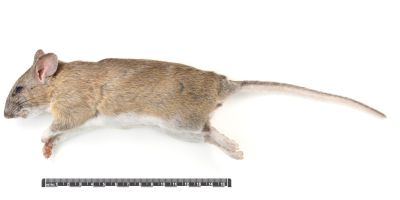
NEON07QPS. Neotoma floridana. Adult male. Geary County, Kansas. -

NEON09G1K. Neotoma floridana. Adult male. Geary County, Kansas. -

NEON0BKNB. Neotoma floridana. Adult female. Jefferson County, Kansas. -

NEON03JR2. Neotoma floridana. Adult male. Riley County, Kansas.


Skull
From Armstrong et al. (2010): "The skull is relatively long with a condylobasal length greater than 43 mm. The nasals are also long, usually more than 19 mm. The interorbital region is not strongly arched. The nasal septum is intact, lacking a maxillo-vomerine notch. The posterior margin of the palate is notched or concave."
-

Holotype: USNM 186483. Neotoma floridana baileyi. Adult female. Clarks Canyon near Valentine, Cherry County, Nebraska. Collected 16 June 1888. Dorsal view of the skull. -

Holotype: USNM 186483. Neotoma floridana baileyi. Adult female. Clarks Canyon near Valentine, Cherry County, Nebraska. Collected 16 June 1888. Ventral view of the skull. -

Holotype: USNM 186483. Neotoma floridana baileyi. Adult female. Clarks Canyon near Valentine, Cherry County, Nebraska. Collected 16 June 1888. Lateral view of the skull. -

Holotype: USNM 186483. Neotoma floridana baileyi. Adult female. Clarks Canyon near Valentine, Cherry County, Nebraska. Collected 16 June 1888. Dorsal view of the mandible. -

Holotype: USNM 186483. Neotoma floridana baileyi. Adult female. Clarks Canyon near Valentine, Cherry County, Nebraska. Collected 16 June 1888. Lateral view of the left mandible. -

Holotype: USNM 186483. Neotoma floridana baileyi. Adult female. Clarks Canyon near Valentine, Cherry County, Nebraska. Collected 16 June 1888. Upper molars. Arrows point to the anteromedial flexus of the anteroloph of each upper molar (M1). -

Holotype: USNM 186483. Neotoma floridana baileyi. Adult female. Clarks Canyon near Valentine, Cherry County, Nebraska. Collected 16 June 1888. Lower molars.


Footprint
-

NEON0BKN9. Neotoma floridana. Right front footprint. -

NEON0BKN9. Neotoma floridana. Right hind footprint.


Similar species
Comparison with Neotoma albigula
From Wiley (1980): Neotoma floridana differs "from N. albigula in larger size, skull more robust and arched, interorbital ridges straighter, and septum intact (maxillovomerine notch absent)."
Comparison with Neotoma magister
From Best & Hunt (2020): "Compared to the Allegheny woodrat [Neotoma magister], the eastern woodrat usually has a forked anterior spine on its palate and no maxillovomerine notch. The most reliable way to tell the two species apart is by genetic analyses or by anatomical details of the skull because measurements overlap. Skulls of Allegheny woodrats posses a maxillovomerine notch on the posterior palate, and this notch rarely is present in eastern woodrats."
Comparison with Neotoma mexicanus
From Wiley (1980): Neotoma floridana differs "from N. mexicana in larger size, throat and breast white to base of fur, skull more robust and arched, interorbital region wider and more ridged, maxillovomerine notch absent, posterior margin of palatal bridge concave or notched, sphenopalatine vacuities narrower, teeth larger, and anterior median fold of M1 shallow (Finley, 1958)."
-
Holotype: USNM 186483. Neotoma floridana baileyi. Adult female. Clarks Canyon near Valentine, Cherry County, Nebraska. Collected 16 June 1888. Upper molars. Arrows point to the anteromedial flexus of the anteroloph of each upper molar (M1), which is notched. -

Holotype: USNM 17692/24628. Neotoma mexicana pinetorum. Adult. Upper molars. Arrows point to the anteromedial flexus of the anteroloph of each upper molar (M1), which is very deeply notched.

Comparison with Neotoma micropus
From Wiley (1980): Neotoma floridana differs "from ''N. micropus in less gray color, interorbital ridges straight, posterior margin of bony palate concave or notched, and sphenopalatine vacuities narrower."
Comparison with Rattus rattus
From Webster et al. (1985): "This rat bears superficial resemblance to the Norway rat [Rattus norvegicus], but the eastern woodrat has larger and more prominent eyes, a blunter snout, less coarse fur, and a more densely haired tail that lacks obvious scales."
References
Armstrong DM, Fitzgerald JP, Meaney CA. 2010. Mammals of Colorado, Second Edition. Denver (CO, USA): University Press of Colorado.
Best TL, Dusi JL. 2014. Mammals of Alabama (Vol. 4). Tuscaloosa (AL, USA): University Alabama Press.
Best TL, Hunt JL. 2020. Mammals of the southeastern United States. Tuscaloosa (AL, USA): University Alabama Press.
Johnsgard PA. 2020. Wildlife of Nebraska: a natural history. Lincoln (NE, USA): University of Nebraska Press.
Schmidly DJ, Bradley RD. 2016. The mammals of Texas. Austin (TX, USA): University of Texas Press.
Webster WD, Parnell JF, Biggs WC. 1985. Mammals of the Carolinas, Virginia, and Maryland. Chapel Hill (NC, USA): University of North Carolina Press.