Neotoma micropus
| Southern Plains Woodrat
(Neotoma micropus) | |
|---|---|
| Range | |
 | |
| Taxonomic classification | |
| Order: | Rodentia |
| Suborder: | Supramyomorpha |
| Infraorder: | Myomorphi |
| Superfamily: | Muroidea |
| Family: | Cricetidae |
| Subfamily: | Neotominae |
| Tribe: | Neotomini |
| Genus: | Neotoma |
| Binomial details | |
| Neotoma micropus S. F. Baird, 1855 | |
| Other resources | |
| Full taxonomic details at MDD | |
The Southern Plains Woodrat (Neotoma micropus) is a medium-sized, gray woodrat (also called packrat) found in a variety of arid and semi-arid habitats.
Description
From Armstrong et al. (2010): "Formerly called the gray woodrat, the Southern Plains woodrat is of medium size with a dense, soft slate to ash gray pelage. The tail is relatively short and sparsely haired, dusky gray above and paler whitish gray below. The venter is gray and the throat and chest are white. The feet are white. As with other woodrats the vibrissae are long and conspicuous."
From Schmidly & Bradley (2016): "A large, gray-colored woodrat with large ears and relatively short, heavy, sparsely haired tail. Differs from N. floridana, to which it is most closely related and which may occur in the same area, in gray, often bluish-gray, dorsal coloration. Upperparts pale drab, mixed with blackish hairs along the back; tail blackish above, grayish below; underparts and feet white."

Museum specimens
-

Holotype: USNM 251057. Neotoma micropus leucophaea. Adult male. White Sands National Monument, Otero (Doña Ana) County, New Mexico. Collected 6 May 1933. -
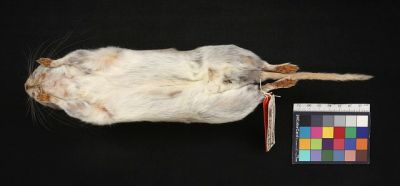
Holotype: USNM 251057. Neotoma micropus leucophaea. Adult male. White Sands National Monument, Otero (Doña Ana) County, New Mexico. Collected 6 May 1933.


External measurements
Length measurements are in millimeters (mm) and weight measurements are in grams (g), unless stated otherwise. If available, the sample size (n=) is provided. If a range is not provided and n= is not given, then the listed measurement represents an average.
| Part of range | Reference | Total length | Tail length | Hindfoot length | Ear length | Mass |
|---|---|---|---|---|---|---|
| Colorado | Armstrong et al. (2010) | 310–411 | 130–175 | 30–45 | 25–30 | 180–320 |
| Texas | Schmidly & Bradley (2016) | 351 | 163 | 41 | males: 272–310; females: 204–243 |
Skull
From Armstrong et al. (2010): "The skull has a strongly arched interorbital region, no maxillo-vomerine notch, and a short palatal bridge (usually with a posterior median spine)."
From Braun and Mares (1989): "skull robust; supraorbital region strongly arched; maxillovomerine notch absent; interpterygoid fossa broad; palatal bridge relatively short, usually with a posterior median spine, but occasionally concave or square; sphenopalatine vacuities large; incisive foramina relatively long; interparietal length almost equal to width between temporal ridges; temporal ridges prominent, present over the orbits, widest on the parietals, converging gradually toward the interparietal; anterointernal re-entrant angle of M1 shallow; upper incisors wide, heavy (Finley, 1958; Hall, 1981)."
-
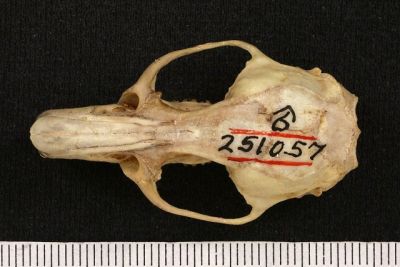
Holotype: USNM 251057. Neotoma micropus leucophaea. Adult male. White Sands National Monument, Otero (Doña Ana) County, New Mexico. Collected 6 May 1933. Dorsal view of the skull. -

Holotype: USNM 251057. Neotoma micropus leucophaea. Adult male. White Sands National Monument, Otero (Doña Ana) County, New Mexico. Collected 6 May 1933. Ventral view of the skull. -

Holotype: USNM 251057. Neotoma micropus leucophaea. Adult male. White Sands National Monument, Otero (Doña Ana) County, New Mexico. Collected 6 May 1933. Lateral view of the skull. -

Holotype: USNM 251057. Neotoma micropus leucophaea. Adult male. White Sands National Monument, Otero (Doña Ana) County, New Mexico. Collected 6 May 1933. Dorsal view of the mandible. -
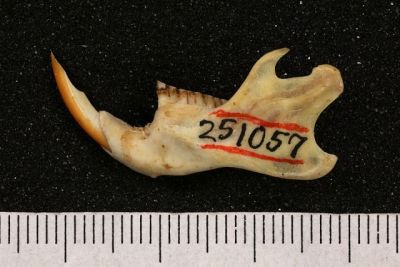
Holotype: USNM 251057. Neotoma micropus leucophaea. Adult male. White Sands National Monument, Otero (Doña Ana) County, New Mexico. Collected 6 May 1933. Lateral view of the left mandible. -

Holotype: USNM 251057. Neotoma micropus leucophaea. Adult male. Upper molars. Arrows point to the anteromedial flexus of the anteroloph of each upper molar (M1), which is shallow. -

Holotype: USNM 251057. Neotoma micropus leucophaea. Adult male. Lower molars.


Species comparisons
Comparison with Neotoma albigula
The White-throated Woodrat (Neotoma albigula) is a medium-sized brownish rat, whereas Neotoma micropus is a medium-sized slate to ash gray woodrat (Armstrong et al., 2010).
-

White-throated Woodrat (Neotoma albigula) -

Southern Plains Woodrat (Neotoma micropus) observed in Texas by Greg Lasley. The pelage if soft slate to ash gray.
Comparison with Neotoma floridana
From Schmidly and Bradley (2016): "Differs from N. floridana, to which it is most closely related and which may occur in the same area, in gray, often bluish-gray, dorsal coloration. Upperparts pale drab, mixed with blackish hairs along the back; tail blackish above, grayish below; underparts and feet white."
-
Southern Plains Woodrat (Neotoma micropus) -

Eastern Woodrat (Neotoma floridana)
Comparison with Neotoma leucodon

Comparison with Neotoma stephensi
-
Southern Plains Woodrat (Neotoma micropus) -

Stephens's Woodrat (Neotoma stephensi) photographed in Arizona by Rick Overson and Laura Steger. N. stephensi is ochraceous or yellowish dorsally.
References
Armstrong DM, Fitzgerald JP, Meaney CA. 2010. Mammals of Colorado, Second Edition. Denver (CO, USA): University Press of Colorado.
Braun JK, Mares MA. 1989. Neotoma micropus. Mammalian Species (330): 1–9. https://doi.org/10.2307/3504233
Finley, RB Jr. 1958. The wood rats of Colorado: distribution and ecology. Misc. Publ. Mus. Nat. Hist., University of Kansas, 10: 213-552.
Hall ER. 1981. The mammals of North America. Second ed. John Wiley and Sons, New York, 2:601-1181 + 90.
Schmidly DJ, Bradley RD. 2016. The mammals of Texas. Austin (TX, USA): University of Texas Press.