Marmota caligata
| Hoary Marmot
(Marmota caligata) | |
|---|---|
| Range | |
 | |
| Taxonomic classification | |
| Order: | Rodentia |
| Suborder: | Sciuromorpha |
| Family: | Sciuridae |
| Subfamily: | Xerinae |
| Tribe: | Marmotini |
| Genus: | Marmota |
| Subgenus: | Petromarmota |
| Binomial details | |
| Marmota caligata (von Eschscholtz, 1829) | |
| Sound | |
| Sound recordings at xeno-canto | |
| Other resources | |
| Full taxonomic details at MDD | |
The Hoary Marmot (Marmota caligata) is a large ground squirrel that occupies open rocky talus slopes and alpine tundra naturally fragmented and disjunct in parts of northwestern North America.
Description
From Braun et al. (2011): "Marmota caligata is a large marmot with a thick body, short and broad head, and short and stout legs (Hoffmann et al. 1979; Howell 1915). The length of the tail ranges from 30% to 51% of the length of the head and body and is densely haired and slightly flattened. The nose is broad, blunt, and covered with hair to the edge of the nostrils. The ears are small, broad, rounded, and well haired. Tufts of long, black bristles are present behind the nose, underneath and between the eye and ear, and over the eye; small, scattered bristles are present under the chin. The feet are robust; the claws are slightly curved and those on the forefeet are slightly stouter than those on the hind feet. The overall color is black and white (Hoffmann et al. 1979; Howell 1915), with cinnamon buff on the posterior body; dorsal coloration may also be brownish drab, russet, or Vandyke brown (Ridgway, 1912).The dorsum of the head is covered with short, unicolored black hairs; a white patch extends between the eyes and across the rostrum, which is sometimes interrupted by a small black spot or band; the tip of the nose is white; the black of the cap extends posteriorly as a dark patch behind the ear or as an indistinct dark band down the neck to the shoulder. The ears are black and white. The sides of the face are grizzled black to brown, but abruptly whitish near the mouth; the lips and throat are whitish. The feet are covered with short, unicolored, black or blackish brown hairs; whitish markings often are present on the forefeet. Males and females are similar in coloration."


Museum images
-
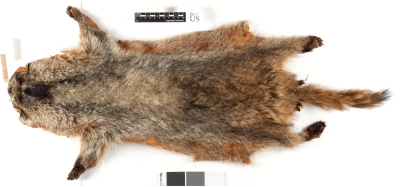
Holotype: USNM 137319. Marmota caligata caligata. Adult male. Montague Island, Alaska. Collected 24 May 1905. Dorsal view of skin.

External measurements
Length measurements are in millimeters (mm) and weight measurements are in grams (g), unless stated otherwise. If available, the sample size (n=) is provided. If a range is not provided and n= is not given, then the listed measurement represents an average.
| Part of range | Reference | Total length | Tail length | Hindfoot length | Ear length | Mass |
|---|---|---|---|---|---|---|
| rangewide | compiled by Braun et al. (2011) from Howell (1915) | males: 630- 785; females: 620-820 | males: 197-252; females: 170-247 | males: 92-112; females: 90-113 |
Skull
-

Holotype: USNM 137319. Marmota caligata caligata. Adult male. Montague Island, Alaska. Collected 24 May 1905. Dorsal view of skull. -
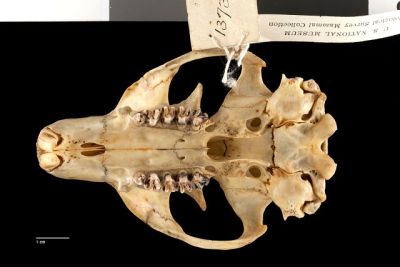
Holotype: USNM 137319. Marmota caligata caligata. Adult male. Montague Island, Alaska. Collected 24 May 1905. Ventral view of skull. -

Holotype: USNM 137319. Marmota caligata caligata. Adult male. Montague Island, Alaska. Collected 24 May 1905. Lateral view of skull. -
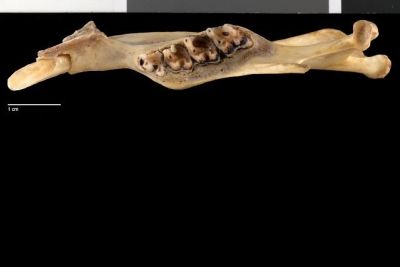
Holotype: USNM 137319. Marmota caligata caligata. Adult male. Montague Island, Alaska. Collected 24 May 1905. Dorsal view of left mandible. -
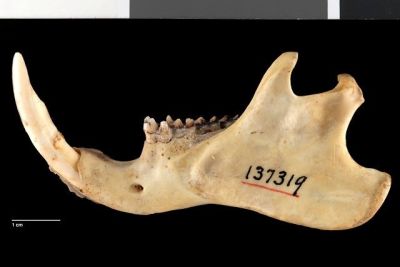
Holotype: USNM 137319. Marmota caligata caligata. Adult male. Montague Island, Alaska. Collected 24 May 1905. Lateral view of left mandible.


Similar species
Key to North American species of Marmota
Comparison with Marmota broweri
The Alaska Marmot (Marmota broweri) was considered a subspecies of the Marmota caligata. In Marmota broweri, the face is all black rather than marked by an extensize white area between and in front of the eyes and the feet are mostly white rather an black or blackish brown (Hall and Gilmore, 1934). Additionally, Braun et al. (2011) provide the following: "M. caligata differs from M. broweri (Alaska marmot) by coarse rather than soft dorsal pelage, uniformly colored or lightly tipped dorsal guard hairs, black cap extending from nose to neck interrupted with a white patch between the eyes and nose, black lips, a longer angular process of the mandible (52.79 mm versus 47.83 mm, males), longer rostrum (27.85 mm versus 25.06 mm, males), smaller postorbital width (16.32 mm versus 16.84 mm, males), more welldeveloped sagittal and lambdoidal crests, gradually tapering nasals with a slightly convex or straight margin, larger mastoid width (45.12 mm versus 39.51 mm, males), and rectangular-shaped lachrymal bones (Hoffmann et al. 1979; Rausch 1953)."
-

Hoary Marmot (Marmota caligata) photographed by Eemeli Haverinen in Denali National Park, Alaska. -

Alaska Marmot (Marmota broweri) photographed by Robert Weeden near Toolik Field Station, Brooks Range, Alaska. -

Borrowed from Hall and Gilmore (1934). Views corresponding to those shown of Marmota broweri are shown in figures 1-3 and those of Marmota caligata are shown in figures 4-6. "Note especially as between broweri and caligata, difference in shape of the nasal bone; difference in shape of the anterior palatine foramina; longer palate, and smaller angular process of the lower mandible and more nearly straight inferior margin of lower mandible in broweri."

Comparison with Marmota flaviventris
The Yellow-bellied Marmot (Marmota flaviventris) is closely related to Marmota caligata and the ranges of the two species overlap in western Montana, northern Idaho, Washington, and southern British Columbia, Canada. Frase and Hoffman (1980) provide the following for the Yellow-bellied Marmot (Marmota flaviventris): "Sides of neck buffy to yellowish; feet hazel-brown to buffy; rarely dark brown and never black (except in melanistic specimens); pad in middle of sole of hind foot oval (see also Howell, 1915; Hoffmann et al., 1979). Fronto-nasal and fronto-premaxillary sutures usually forming distinct arch across rostrum," compared to "sides of neck whitish to gray or cream; never buffy; feet black to dark brown; pad on hind foot near edge of sole, subcircular. Fronto-nasal and fronto-premaxillary sutures usually forming a fairly straight line across rostrum" in Marmota caligata.
-
Hoary Marmot (Marmota caligata) photographed by Eemeli Haverinen in Denali National Park, Alaska. -

Yellow-bellied Marmot (Marmota flaviventris) photographed by Rick Overson in Custer Gallatin National Forest, Montana. -

Ventral surface of sole of hind foot of Marmota flaviventris, showing oval shape of posterior pad. Borrowed from Frase and Hoffman (1980).

Comparison with Marmota olympus
From Braun et al. (2011): "M. caligata differs from M. olympus (Olympic marmot) by having black and white pelage, black feet, smaller cranium, narrower interorbital region (24.13 mm versus 27.53 mm, males), narrower postorbital width (16.32 mm versus 16.56 mm, males), wider zygomatic width (64.24 mm versus 64.22 mm, males), anteriorly divergent upper molar toothrows and rectangular-shaped lachrymal bones (Hoffmann et al. 1979; Howell 1915)."
-
Hoary Marmot (Marmota caligata) photographed by Eemeli Haverinen in Denali National Park, Alaska. -

Olympic Marmot (Marmota olympus) photographed by Mike Merchant in Clallam County, Washington.
Comparison with Marmota vancouverensis
The ranges of Marmota caligata and Marmota vancouverensis do not overlap. Marmota vancouverensis is only found on Vancouver Island, off Canada’s Pacific Coast. From Braun et al. (2011): "M. caligata differs from M. vancouverensis (Vancouver Island marmot) by having black and white pelage, deeply V-shaped posterior border of nasals, anteriorly divergent upper molar toothrows and rectangularshaped lachrymal bones (Howell 1915).
-
Hoary Marmot (Marmota caligata) photographed by Eemeli Haverinen in Denali National Park, Alaska. -
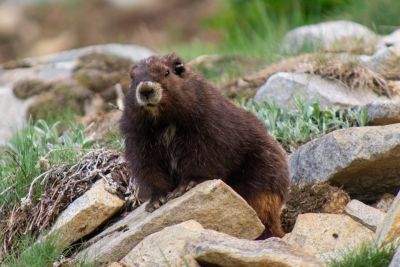
Marmota vancouverensis photographed by Adam Taylor on Vancouver Island, Canada. This species is only found on Vancouver Island, off Canada’s Pacific Coast.

References
Braun JK, Eaton Jr TS, Mares MA. 2011. Marmota caligata (Rodentia: Sciuridae). Mammalian Species 43(884):155-171. https://doi-org.ezproxy1.lib.asu.edu/10.1644/884.1
Hall ER, Gilmore RM. 1934. Marmota caligata broweri, a new marmot from northern Alaska. Canadian Field Naturalist 48:57–59. https://www.biodiversitylibrary.org/page/28103713#page/77/mode/1up