Dipodomys merriami
| Merriam's Kangaroo Rat
(Dipodomys merriami) | |
|---|---|
| Range | |
 | |
| Taxonomic classification | |
| Order: | Rodentia |
| Suborder: | Supramyomorpha |
| Infraorder: | Castorimorphi |
| Superfamily: | Geomyoidea |
| Family: | Heteromyidae |
| Subfamily: | Dipodomyinae |
| Genus: | Dipodomys |
| Binomial details | |
| Dipodomys merriami Mearns, 1890 | |
| Other resources | |
| Full taxonomic details at MDD | |
The Merriam's Kangaroo Rat (Dipodomys merriami) is a small to medium-sized kangaroo rat found in a variety of habitats in the Sonoran, Mojave, Chihuahuan, and Great Basin Deserts of the west.
Description
From Hoffmeister (1986): "A small to medium-sized, four-toed (hind foot) species of Dipodomys; tail relatively long, about 140 to 150 percent of body length... dorsal coloration variable geographically."

Museum specimens
-

Holotype: USNM 54552. Dipodomys merriami merriami. Adult female. Pyramid Lake, Washoe County, Nevada. Collected 26 June 1893. -
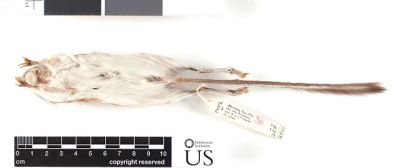
Holotype: USNM 54552. Dipodomys merriami merriami. Adult female. Pyramid Lake, Washoe County, Nevada. Collected 26 June 1893. -

NEON05G5R. Dipodomys merriami. Adult male. Dona Ana County, New Mexico. Collected 9 November 2021. -
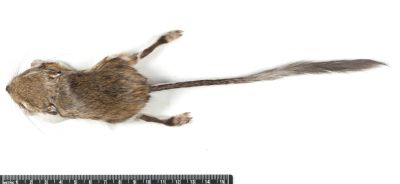
NEON05G5R. Dipodomys merriami. Adult male. Dona Ana County, New Mexico. Collected 9 November 2021. -
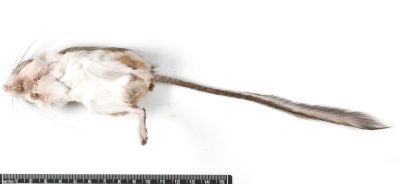
NEON05G5R. Dipodomys merriami. Adult male. Dona Ana County, New Mexico. Collected 9 November 2021. -
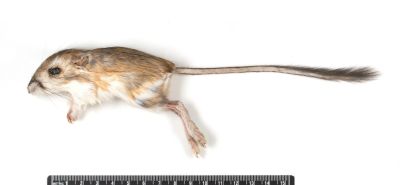
NEON08SOC. Dipodomys merriami. Subadult female. Santa Rita Experimental Range, Pima County, Arizona. Collected 10 July 2023.


External measurements
Length measurements are in millimeters (mm) and weight measurements are in grams (g), unless stated otherwise. If available, the sample size (n=) is provided. If a range is not provided and n= is not given, then the listed measurement represents an average.
| Part of range | Reference | Total length | Tail length | Hindfoot length | Ear length | Mass |
|---|---|---|---|---|---|---|
| Arizona (Maricopa Co., vic. New River) | Hoffmeister (1986) | 224–265 (n=31) | 128–161 (n=31) | 36–41 (n=31) | ||
| California | Jameson & Peeters (2004) | 220–260 | 123–160 | 34–39 | 39–52 | |
| Texas | Schmidly & Bradley (2016) | 247 | 144 | 39 | 40–50 |
Skull
From Hoffmeister (1986): "skull small but bullae well-inflated; least interobital breadth usually more than one-half the basal length; interparietal narrow; narrow, sharply angular maxillary arches;...skull with relatively widely divergent maxillary arms of the zygomata; relatively short rostrum; lower incisors not flattened on anterior face."
-

Holotype: USNM 54552. Dipodomys merriami merriami. Adult female. Pyramid Lake, Washoe County, Nevada. Collected 26 June 1893. Dorsal view of the skull. -
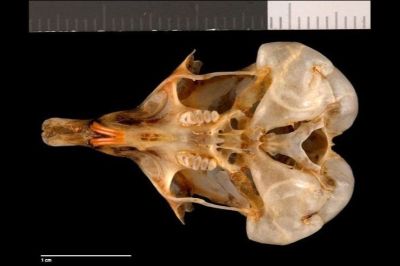
Holotype: USNM 54552. Dipodomys merriami merriami. Adult female. Pyramid Lake, Washoe County, Nevada. Collected 26 June 1893. Ventral view of the skull. -
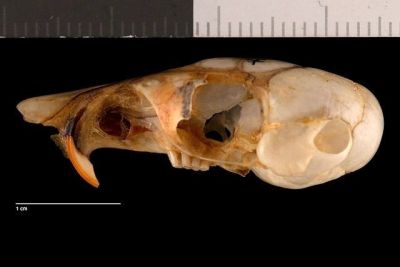
Holotype: USNM 54552. Dipodomys merriami merriami. Adult female. Pyramid Lake, Washoe County, Nevada. Collected 26 June 1893. Lateral view of the skull. -
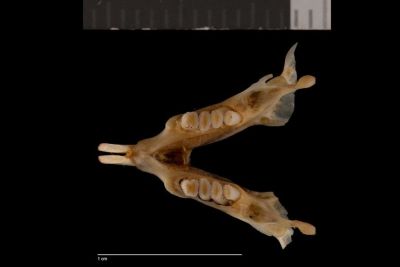
Holotype: USNM 54552. Dipodomys merriami merriami. Adult female. Pyramid Lake, Washoe County, Nevada. Collected 26 June 1893. Dorsal view of the mandible. -

Holotype: USNM 54552. Dipodomys merriami merriami. Adult female. Pyramid Lake, Washoe County, Nevada. Collected 26 June 1893. Lateral view of the left mandible. -

Awl-shaped lower incisors of Dipodomys merriami. -
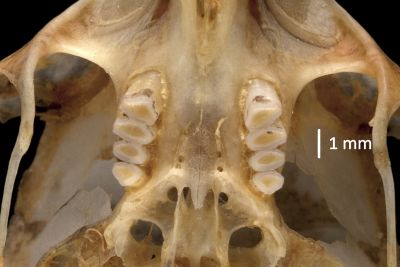
Holotype: USNM 54552. Dipodomys merriami merriami. Adult. Upper molars. -
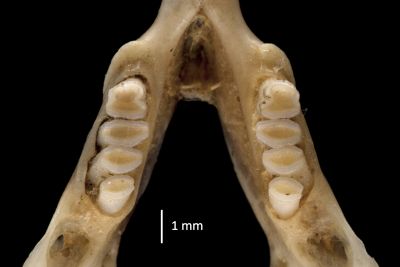
Holotype: USNM 54552. Dipodomys merriami merriami. Adult. Lower molars.


Similar species
Comparison with Dipodomys deserti
Desert Kangaroo Rat (Dipodomys deserti) differs from Dipodomys merriami in having a white-tipped tail.
-
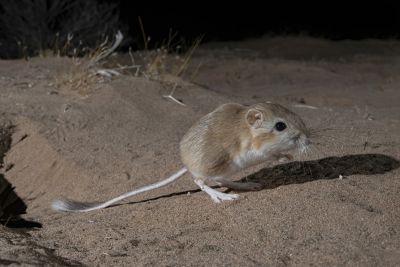
Desert Kangaroo Rat (Dipodomys deserti) photographed by Randy Babb. © Randy Babb -

Merriam's Kangaroo Rat (Dipodomys merriami) photographed by Randy Babb. © Randy Babb -

Holotype: USNM 15629/22522. Dipodomys deserti deserti. Adult female. Mohave River, [San Bernardino County], California. Collected 29 June 1886. Dorsal view of the skull. From Best et al. (1989): "The mastoids meet immediately behind the parietals, having at most an inconspicuous spicule between them; this character distinguishes D. deserti from all other species of Dipodomys. -
Holotype: USNM 54552. Dipodomys merriami merriami. Adult female. Pyramid Lake, Washoe County, Nevada. Collected 26 June 1893. Dorsal view of the skull.
Comparison with Dipodomys ordii
From Hoffmeister (1986): "D. ordii differs from D. merriami as follows: five rather than four toes on hind foot; tail relatively shorter, about 125 percent of body rather than 143 percent; rostrum broader; skull averaging larger but maxillary wing of zygomatic arch averaging narrower."
-
The Merriam's Kangaroo Rat (Dipodomys merriami) has four toes, rather than five, and a relatively long tail. -

The Ord's Kangaroo Rat (Dipodomys ordii) has five toes, rather than four, and a relatively short tail. -
Holotype: USNM 54552. Dipodomys merriami merriami. Adult female. Pyramid Lake, Washoe County, Nevada. Collected 26 June 1893. Dorsal view of the skull. -

Holotype: USNM 243093. Dipodomys ordii cupidineus. Adult male. Kanab Wash, Mohave County, Arizona. Collected 12 October 1922. Dorsal view of the skull. -
Awl-shaped lower incisors of the Merriam's Kangaroo Rat (Dipodomys merriami). -

Awl-shaped lower incisors of the Ord's Kangaroo Rat (Dipodomys ordii).
Comparison with Dipodomys microps
From Hoffmeister (1986): "D. microps differs from D. merriami as follows: five toes on hind foot instead of four; lower incisors flat on front face rather than curved and narrow; larger on the average in all external measurements; least interorbital breadth less than one-half the basal length rather than usually more; maxillary arches narrow and rounded rather than sharply angled; lining of cheek pouches appears dusky rather than whitish."
-
The Merriam's Kangaroo Rat (Dipodomys merriami) has four toes, rather than five. -

The Chisel-toothed Kangaroo Rat (Dipodomys microps) has five toes, rather than four. The tail crest and tuft in D. microps is less pronounced than in D. merriami, at least in some populations. The dark tuft in D. microps can also appear faded. However, these tail characters should be used with caution as they are not mentioned in published species descriptions. -
Awl-shaped lower incisors of the Merriam's Kangaroo Rat (Dipodomys merriami). -

Chisel-shaped lower incisors of the Chisel-toothed Kangaroo Rat (Dipodomys microps). -
Holotype: USNM 54552. Dipodomys merriami merriami. Adult female. Pyramid Lake, Washoe County, Nevada. Collected 26 June 1893. Dorsal view of the skull. -

Holotype: USNM 25288/32701. Dipodomys microps microps. Adult male. Lone Pine, Owens Valley, Inyo County, California. Collected 22 December 1890. Dorsal view of the skull. .
-
Holotype: USNM 54552. Dipodomys merriami merriami. Adult female. Pyramid Lake, Washoe County, Nevada. Collected 26 June 1893. Ventral view of the skull. -

Holotype: USNM 25288/32701. Dipodomys microps microps. Adult male. Lone Pine, Owens Valley, Inyo County, California. Collected 22 December 1890. Ventral view of the skull.


Comparison with Dipodomys panamintinus
-
Merriam's Kangaroo Rat (Dipodomys merriami) photographed by Randy Babb. © Randy Babb -

Panamint Kangaroo Rat (Dipodomys panamintinus) observed by markc666 in Mono County, California. -
Holotype: USNM 54552. Dipodomys merriami merriami. Adult female. Pyramid Lake, Washoe County, Nevada. Collected 26 June 1893. Dorsal view of the skull. -

Holotype: USNM 28566/40670. Dipodomys panamintinus panamintinus. Adult male. On head of Willow Creek, Panamint Mountains, Inyo County, California. Collected 12 May 1891. Dorsal view of the skull.
Comparison with Dipodomys spectabilis
The Banner-tailed Kangaroo Rat (Dipodomys spectabilis) differs from Dipodomys merriami in having a striking white-tipped tail with a solid black band proximal to the white tip.
-

Banner-tailed Kangaroo Rat (Dipodomys spectabilis) photographed by Randy Babb. © Randy Babb -
Merriam's Kangaroo Rat (Dipodomys merriami) photographed by Randy Babb. © Randy Babb -

Holotype: 17886/24823. Dipodomys spectabilis spectabilis. Adult male. Dos Cabezos (Cabezas), Cochise County, Arizona. Collected 22 November 1889. Dorsal view of the skull. -
Holotype: 54552. Dipodomys merriami merriami. Adult female. Pyramid Lake, Washoe County, Nevada. Collected 26 June 1893. Dorsal view of the skull.
References
Hoffmeister DF. 1986. Mammals of Arizona. Tucson (AZ, USA): University of Arizona Press.
Jameson EW, Peeters HJ. 2004. Mammals of California (No. 66). Berkeley (CA, USA): University of California Press.
Mearns EA. 1890-02-21. Description of supposed new species and subspecies of mammals, from Arizona. Bulletin of the American Museum of Natural History 2(20):277-307.
Schmidly DJ, Bradley RD. 2016. The mammals of Texas. Austin (TX, USA): University of Texas Press.