Microtus pinetorum
| Woodland Vole
(Microtus pinetorum) | |
|---|---|
| Range | |
 | |
| Taxonomic classification | |
| Order: | Rodentia |
| Suborder: | Supramyomorpha |
| Infraorder: | Myomorphi |
| Superfamily: | Muroidea |
| Family: | Cricetidae |
| Subfamily: | Arvicolinae |
| Tribe: | Arvicolini |
| Genus: | Microtus |
| Subgenus: | Mynomes |
| Binomial details | |
| Microtus pinetorum (Le Conte, 1830) | |
| Other resources | |
| Full taxonomic details at MDD | |
The Woodland Vole (Microtus pinetorum) is a small, reddish-brown vole that occupies wooded and forested areas with loose soils for burrowing.
Description
From Smolen (1981): "The body is cylindrical, slender, and modified for semi-fossorial life. Fur is soft and dense; ears, eyes, and tail are reduced; facial vibrissae are well developed; the mouth is small and the upper lips are closely appressed beneath the upper incisors. The feet have five plantar pads. Females bear two pairs of inguinal mammae (Miller, 1896; Bailey, 1900; Hall and Cockrum, 1953)."
From Best & Hunt (2020): "Woodland voles are small, and the tail is slightly longer than the hind feet. Eyes, ears, and mouth are small, and ears are hidden partially by fur. Pelage is thick and soft. Fur is dark reddish-brown dorsally, paler on the sides, and gray washed with brown ventrally. The tail is indistinctly bicolored."


Museum type specimens
-

Holotype: USNM 191204. Microtus pinetorum carbonarius. Old adult female. Eubank, Pulaski County, Kentucky. Collected 14 February 1888. -

Holotype: USNM 191204. Microtus pinetorum carbonarius. Old adult female. Eubank, Pulaski County, Kentucky. Collected 14 February 1888.


External measurements
Length measurements are in millimeters (mm) and weight measurements are in grams (g), unless stated otherwise. If available, the sample size (n=) is provided. If a range is not provided and n= is not given, then the listed measurement represents an average.
| Part of range | Reference | Total length | Tail length | Hindfoot length | Ear length | Mass |
|---|---|---|---|---|---|---|
| Alabama | Best & Dusi (2014) | 120 (105–142) (n=25) | 20 (16–26) (n=25) | 15 (13–18) (n=25) | 8 (5–10) (n=25) | 26.6 (17.6–38.9) (n=22) |
| Carolinas, Virginia, Maryland | Webster et al. (1985) | 97–131 | 18–30 | 17–30 | ||
| Texas | Schmidly & Bradley (2016) | 135 | 25 | 18 | 25–45 | |
| Virginia | Linzey (1998) | 100–145 | 18–20 | 21–56 |
Skull
-
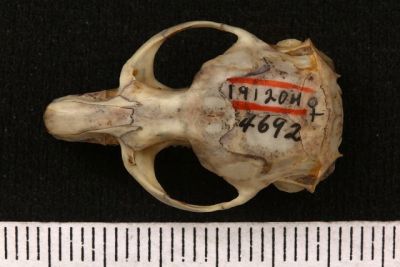
Holotype: USNM 191204. Microtus pinetorum carbonarius. Old adult female. Eubank, Pulaski County, Kentucky. Collected 14 February 1888. Dorsal view of the skull. -

Holotype: USNM 191204. Microtus pinetorum carbonarius. Old adult female. Eubank, Pulaski County, Kentucky. Collected 14 February 1888. Ventral view of the skull. -

Holotype: USNM 191204. Microtus pinetorum carbonarius. Old adult female. Eubank, Pulaski County, Kentucky. Collected 14 February 1888. Lateral view of the skull. -

Holotype: USNM 191204. Microtus pinetorum carbonarius. Old adult female. Eubank, Pulaski County, Kentucky. Collected 14 February 1888. Dorsal view of the mandible. -

Holotype: USNM 191204. Microtus pinetorum carbonarius. Old adult female. Eubank, Pulaski County, Kentucky. Collected 14 February 1888. Lateral view of the left mandible.


Similar species
Comparison with Clethrionomys gapperi
-

Woodland Vole (Microtus pinetorum) -

Lateral view of the Southern Red-backed Vole (Clethrionomys gapperi). Collected in Giles County, Virginia.
Comparison with Microtus chrotorrhinus

Comparison with Microtus ochrogaster
Microtus pinetorum can be distinguished from the Prairie Vole (Microtus ochrogaster) by its shorter tail (Best and Hunt, 2020).
-
Woodland Vole (Microtus pinetorum) -

Prairie Vole (Microtus ochrogaster)
Comparison with Synaptomys cooperi
Microtus pinetorum can be distinguished from the Southern Bog Lemming (Synaptomys cooperi) by its lack of grooved incisors (Best and Hunt, 2020).
-
Woodland Vole (Microtus pinetorum) -

Southern Bog Lemming (Synaptomys cooperi) -

Skull of the Southern Bog Lemming (Synaptomys cooperi) showing the grooved upper incisors. A single groove is located near the outside edge of each upper incisor.

Comparison with Microtus pennsylvanicus
-
Woodland Vole (Microtus pinetorum) -

Eastern Meadow Vole (Microtus pennsylvanicus)
References
Bailey V. 1900. Revision of American voles of the genus Microtus. North American Fauna 17:1-88
Best TL, Hunt JL. 2020. Mammals of the southeastern United States. Tuscaloosa (AL, USA): University Alabama Press.
Hall ER, Cockrum EL. 1953. A synopsis of the North American microtine rodents. University of Kansas publications, Museum of Natural History 5:375-499.
Miller Jr GS. 1896. Genera and subgenera of voles and lemmings. North American Fauna, 1.
Smolen MJ. 1981. Microtus pinetorum. Mammalian Species (147): 1-7.