Sorex albibarbis
| Eastern Water Shrew
(Sorex albibarbis) | |
|---|---|
| Range | |
 | |
| Taxonomic classification | |
| Order: | Eulipotyphla |
| Suborder: | Erinaceota |
| Superfamily: | Soricoidea |
| Family: | Soricidae |
| Subfamily: | Soricinae |
| Tribe: | Soricini |
| Genus: | Sorex |
| Subgenus: | Otisorex |
| Species group: | Sorex palustris group |
| Binomial details | |
| Sorex albibarbis (Cope, 1862) | |
| Other resources | |
| Full taxonomic details at MDD | |
The Eastern Water Shrew (Sorex albibarbis) is found along streams, ponds, marshes, and bogs where vegetation provides sufficient cover from predators.
Description
From Best & Hunt (2020)'s description of Sorex palustris for the southeastern US, where they also note "Recent assessments of genetic variation in water shrews indicate that most populations beyond the eastern United States actually represent species other than Sorex palustris: "A relatively large shrew whose color is seasonally and geographically variable, but usually blackish or gray frosted with white on the dorsum and white with a tinge of brownish or grayish on the underside. The chin is paler than the rest of the body. Pelage is paler in winter. The tail is long and is usually distinctly bicolored, brownish-black dorsally, and paler ventrally. Eyes and ears are inconspicuous. Toes are fimbriated and partially webbed."


External measurements
Length measurements are in millimeters (mm) and weight measurements are in grams (g), unless stated otherwise. If available, the sample size (n=) is provided. If a range is not provided and n= is not given, then the listed measurement represents an average.
| Part of range | Reference | Total length | Tail length | Hindfoot length | Ear length | Mass |
|---|---|---|---|---|---|---|
| not reported | Whitaker Jr. & Hamilton Jr. (1998) | 138–164 | 63–72 | 19–21 | 12–18 |
Skull
| Sorex albibarbis skull characters | |
|---|---|
| units in mm | |
| Skull | |
| Condylobasal length: | 19.1–21.7 (Beneski & Stinson, 1987); 18.4–19.2 (Álvarez-Castañeda, 2024) |
| Postmandibular canal: | Absent |
| Dental | |
| Upper unicuspids: | 5 |
| Unicuspid notes: | U3<U4 |
| Tines present: | Yes |
| Tine size: | Small |
From Fisher and Ludwig (2015) regarding the specimen shown below: "No type was designated in original description. Cope (1862) had two specimens, both from the locality given above [Profile Lake, Franconia Mountains, Grafton County, New Hampshire]. The whereabouts of the second specimen is unknown. The alcoholic part of this specimen was destroyed and its skeleton preserved on 6 Sep 1956, so it is now a skull and skeleton."
-

Syntype: USNM 11239/38743. Sorex albibarbis albibarbis. Adult female. Profile Lake, Franconia Mountains, Grafton County, New Hampshire. Collected September 1859. Dorsal view of the skull. -

Syntype: USNM 11239/38743. Sorex albibarbis albibarbis. Adult female. Profile Lake, Franconia Mountains, Grafton County, New Hampshire. Collected September 1859. Ventral view of the skull. The individual's right side of the skull is damaged. -

Syntype: USNM 11239/38743. Sorex albibarbis albibarbis. Adult female. Profile Lake, Franconia Mountains, Grafton County, New Hampshire. Collected September 1859. Lateral view of the skull. -
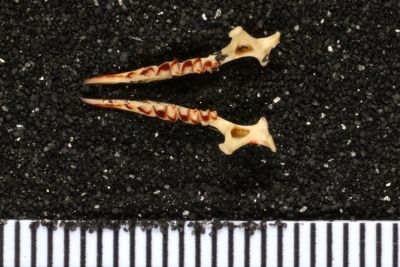
Syntype: USNM 11239/38743. Sorex albibarbis albibarbis. Adult female. Profile Lake, Franconia Mountains, Grafton County, New Hampshire. Collected September 1859. Dorsal view of the mandible. -

Syntype: USNM 11239/38743. Sorex albibarbis albibarbis. Adult female. Profile Lake, Franconia Mountains, Grafton County, New Hampshire. Collected September 1859. Lateral view of the mandible.


Taxonomic notes
This species was split from Sorex palustris by Hope et al. (2014). From Woodman (2018): "Hope et al.’s (2014) investigation of the molecular phylogenetics of North American water shrews revealed three species-level clades among the subspecies formerly united as Sorex palustris: eastern Sorex albibarbis, western cordilleran Sorex navigator, and boreal Sorex palustris (sensu stricto). Nagorsen et al. (2017) demonstrated that parapatric S. navigator and S. palustris can be distinguished morphometrically."
Similar species
This is a relatively large shrew with fimbriated toes that is not easily confused with other shrews, except for the American Water Shrew (Sorex palustris) from which is was recently split by Hope et al. (2014). Differentiating Sorex albibarbis from the Sorex palustris may be difficult in the field. Further studies will be needed to fully understand new species boundaries and morphological variation.
-

Range of the Eastern Water Shrew (Sorex albibarbis). -

Range of the American Water Shrew (Sorex palustris).
References
Álvarez-Castañeda ST. 2024. Order Eulipotyphla. In Mammals of North America-Volume 1: Systematics and Taxonomy (pp. 397-513). Cham (Switzerland): Springer Nature Switzerland.
Beneski JT, Stinson DW. 1987. Sorex palustris. Mammalian Species (296): 1-6.
Best TL, Hunt JL. 2020. Mammals of the southeastern United States. Tuscaloosa (AL, USA): University Alabama Press.
Cope ED. 1862-08-01. On Neosorex albibarbis. Proceedings of the Academy of Natural Sciences of Philadelphia 14(5):188-189.
Fisher RD, Ludwig CA. 2015. Catalog of type specimens of recent mammals : orders Didelphimorphia through Chiroptera (excluding Rodentia) in the National Museum of Natural History, Smithsonian Institution. Washington, D.C.: Smithsonian Institution Scholarly Press.
Hope AG, Panter N, Cook JA, Talbot SL, Nagorsen DW. 2014. Multilocus phylogeography and systematic revision of North American water shrews (genus: Sorex). Journal of Mammalogy 95(4): 722-738.
Whitaker JO, Hamilton WJ. 1998. Mammals of the eastern United States. Ithaca, (NY, USA): Cornell University Press.
Woodman N. 2018. American Recent Eulipotyphla: Nesophontids, Solenodons, Moles, and Shrews in the New World. Smithsonian Contributions to Zoology. https://doi.org/10.5479/si.1943-6696.650