Neotoma fuscipes
| Dusky-footed Woodrat
(Neotoma fuscipes) | |
|---|---|
| Range | |
 | |
| Taxonomic classification | |
| Order: | Rodentia |
| Suborder: | Supramyomorpha |
| Infraorder: | Myomorphi |
| Superfamily: | Muroidea |
| Family: | Cricetidae |
| Subfamily: | Neotominae |
| Tribe: | Neotomini |
| Genus: | Neotoma |
| Binomial details | |
| Neotoma fuscipes S. F. Baird, 1857 | |
| Other resources | |
| Full taxonomic details at MDD | |
The Dusky-footed Woodrat (Neotoma fuscipes) is a large woodrat that occupies a variety of habitats in coastal and inner-coastal montane regions of western California and western Oregon.
Description
From Jameson & Peeters (2004): "A large wood rat with a grayish brown dorsum and a pale or white venter. The feet are brown at the base, with the distal half white. The tail is faintly bicolored and scantily haired. The ear pinnae are broad and moderately hairy."


Museum specimens
-

Holotype: USNM 19693. Neotoma fuscipes fuscipes. Adult male. Nicasio, Marin County, California. Collected 25 November 1887. -
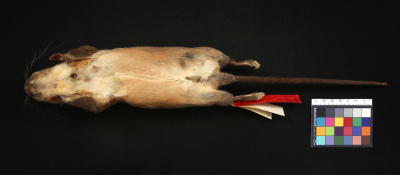
Holotype: USNM 19693. Neotoma fuscipes fuscipes. Adult male. Nicasio, Marin County, California. Collected 25 November 1887.


External measurements
Length measurements are in millimeters (mm) and weight measurements are in grams (g), unless stated otherwise. If available, the sample size (n=) is provided. If a range is not provided and n= is not given, then the listed measurement represents an average.
| Part of range | Reference | Total length | Tail length | Hindfoot length | Ear length | Mass |
|---|---|---|---|---|---|---|
| California | Jameson & Peeters (2004) | 260–439 | 130–212 | 37–44 | 31–34 | 184–358 |
| rangewide | see Carraway & Verts (1991) | 335–468 | 160–227 | 34–47 | 24–36 | 200–250 (Kofoid et al., 1935); 311.8 (Bailey, 1936); 186.7 (Lee, 1963) |
Skull
-
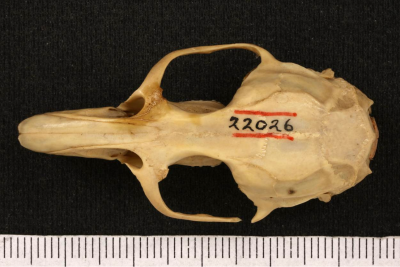
Holotype: USNM 22026. Neotoma fuscipes fuscipes. Adult male. Petaluma, Sonoma County, California. Collected February 1856. Dorsal view of the skull. -

Holotype: USNM 22026. Neotoma fuscipes fuscipes. Adult male. Petaluma, Sonoma County, California. Collected February 1856. Ventral view of the skull. -

Holotype: USNM 22026. Neotoma fuscipes fuscipes. Adult male. Petaluma, Sonoma County, California. Collected February 1856. Lateral view of the skull. -

Holotype: USNM 22026. Neotoma fuscipes fuscipes. Adult male. Petaluma, Sonoma County, California. Collected February 1856. Dorsal view of the mandible. -
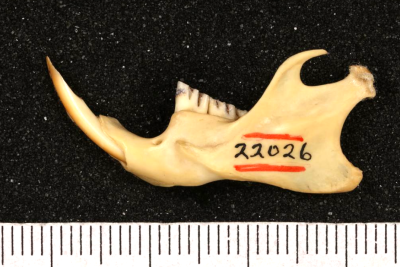
Holotype: USNM 22026. Neotoma fuscipes fuscipes. Adult male. Petaluma, Sonoma County, California. Collected February 1856. Lateral view of the left mandible. -

Holotype: USNM 22026. Neotoma fuscipes fuscipes. Adult male. Upper molars. Arrows point to the anteromedial flexus of the anteroloph of each upper molar (M1), which is deeply notched.


Skeleton
-
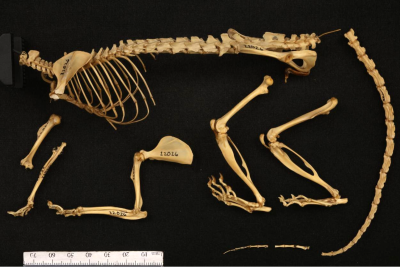
Holotype: USNM 22026. Neotoma fuscipes fuscipes. Adult male. Petaluma, Sonoma County, California. Collected February 1856.

Similar species
Comparison with Neotoma macrotis
From Coyner et al. (2014): "We found clear genetic evidence of hybridization between N. fuscipes and N. macrotis where they come into contact along the Nacimiento River of central California. The spatial extent of sympatry between pure forms is limited to less than 1 km within a narrow strip of riparian habitat. The vast majority of admixed individuals are limited to the zone of sympatry and areas immediately adjacent, but a few can be detected along the entire 7 km study area."
Comparison with other Neotoma species
From Carraway & Verts (1991), which at the time N. fuscipes included N. macrotis: "N. fuscipes can be separated from Neotoma with which it is sympatric or parapatric by its grayish-brown dorsum, usually pale or white venter, sooty-colored pelage on top of the hind feet, and the faintly bicolored, scantly haired, terete tail covered with short, dark-sooty colored hairs (Howell, 1926; Jameson and Peeters, 1988). N. lepida has a ventral pelage composed of hairs gray at the base and white at the tip and a distinctly bicolored tail; N. cinerea has a pale gray dorsum and a long bushy tail; N. albigula has throat hairs white to the base and a bicolored tail (Jameson and Peeters, 1988). Neotoma fuscipes has a longer tail, hind foot, and ear than N. lepida, and a longer ear than N. albigula (Jameson and Peeters, 1988)."
References
Baird SF. 1857. Mammals. In Reports of Explorations and Surveys to Ascertain the Most Practicable and Economical Route for a Railroad from the Mississippi River to the Pacific Ocean. Part 1. General Report upon the Zoology of the Several Pacific Railroad Routes, Volume 8, bk. 1. Washington, D.C., Beverly Tucker, 495.
Carraway LN, Verts BJ. 1991. Neotoma fuscipes. Mammalian Species (386): 1-10.
Howell AB. 1926. Anatomy of the woodrat: comparative anatomy of the subgenera of the American wood rat (genus Neotoma). Monographs of the American Society of Mammalogists 1:1-2.
Jameson EW, Peeters HJ. 2004. Mammals of California (No. 66). Berkeley (CA, USA): University of California Press.
Jameson EW, Peeters HJ. 1988. California mammals. Berkeley (CA, USA): University of California Press.