Peromyscus fraterculus
| Northern Baja Deermouse
(Peromyscus fraterculus) | |
|---|---|
| Range | |
 | |
| Taxonomic classification | |
| Order: | Rodentia |
| Suborder: | Supramyomorpha |
| Infraorder: | Myomorphi |
| Superfamily: | Muroidea |
| Family: | Cricetidae |
| Subfamily: | Neotominae |
| Tribe: | Peromyscini |
| Genus: | Peromyscus |
| Binomial details | |
| Peromyscus fraterculus (G. S. Miller, 1892) | |
| Other resources | |
| Full taxonomic details at MDD | |
Peromyscus fraterculus was considered a subspecies of Peromyscus eremicus until a phylogenetic analysis (based on mitochondrial cytochrome-c oxidase subunit III) of the eremicus species complex by Riddle et al. (2000) formally classified it as separate species. Populations west of the Colorado River were assigned to the Northern Baja Deermouse (Peromyscus fraterculus) and populations east side of the river to the Cactus Deermouse (Peromyscus eremicus).
Description
From Cornejo-Latorre et al. (2021): "P. fraterculus has dorsal pelage cinnamon rufous and richly sprinkled with black, middle of dorsum darker, including flanks, never with orange shades; lateral line when present thin and light yellow (Álvarez-Castañeda et al. 2017). The pelage of P. fraterculus is reddish brown and much darker than that of P. eremicus... On the lower sides and the ventral region, P. fraterculus is whitish with one yellowish reddish pectoral spot..."
However, it appears that in some populations of Peromyscus fraterculus, individuals are not darker than P. eremicus and lack a pectoral spot. The individual shown below is a male that was captured in the Arizona Strip, north of the Grand Canyon, on dark substrate.


External measurements
Length measurements are in millimeters (mm) and weight measurements are in grams (g), unless stated otherwise. If available, the sample size (n=) is provided. If a range is not provided and n= is not given, then the listed measurement represents an average.
| Part of range | Reference | Total length | Tail length | Hindfoot length | Ear length | Mass |
|---|---|---|---|---|---|---|
| California | Carleton and Lawlor (2005) | 177–204 (n=23) | 93–119 (n=23) | 17–21 (n=23) | ||
| not reported | Ceballos (editor, 2014) | 169–218 | 92–118 | 18–22 | 13–18 | 13–18 |
Skull
-

ASUMAC009069. Peromyscus fraterculus. Adult male. Arizona Strip, Mohave County, Arizona. Collected 28 April 2025. Dorsal view of the skull. -

ASUMAC009069. Peromyscus fraterculus. Adult male. Arizona Strip, Mohave County, Arizona. Collected 28 April 2025. Ventral view of the skull. -
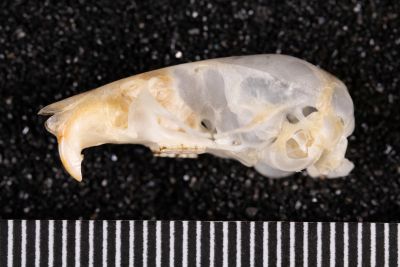
ASUMAC009069. Peromyscus fraterculus. Adult male. Arizona Strip, Mohave County, Arizona. Collected 28 April 2025. Lateral view of the skull. -

ASUMAC009069. Peromyscus fraterculus. Adult male. Arizona Strip, Mohave County, Arizona. Collected 28 April 2025. Dorsal view of the mandible. -

ASUMAC009069. Peromyscus fraterculus. Adult male. Arizona Strip, Mohave County, Arizona. Collected 28 April 2025. Lateral view of the left mandible. -

ASUMAC009069. Peromyscus fraterculus. Adult male. Arizona Strip, Mohave County, Arizona. Collected 28 April 2025. Upper molars.


Color variation
From Cornejo-Latorre et al. (2021): "Peromyscus fraterculus shows a seasonal variation in fur coloration, being reddish brown in summer and more blackish in winter, while the ventral part of the body maintains a creamy or buff shade (Osgood 1909). There is also a slight variation in the coloration of P. fraterculus in relation to the type of substrate present and the sex of the individual (females are slightly paler in pelage color than males—Dice 1939; Hall 1981), and environmental factors such as humidity and altitude can influence pelage color (Dice 1939). Usually, the tone of the pelage in P. fraterculus matches the color of the soil in its habitat (Dice and Blossom 1937; Dice 1939). In the highlands, the pelage of P. fraterculus is darker owing to a greater admixture of brown and black pigment in the hair (Lawlor 1971a). Leucism has been reported in individuals of P. fraterculus in the San Quintín area, Baja California, México, likely associated with a low genetic diversity within this population due to habitat fragmentation (Camargo et al. 2016)."
-

Peromyscus fraterculus captured in late April in the Arizona Strip of northern Mohave County, Arizona. -

Peromyscus fraterculus photographed in late May by Patricia Simpson in San Diego County, California.

Similar species
Comparison with Peromyscus boylii
Peromyscus fraterculus differs from the Brush Deermouse (Peromyscus boylii) in less heavily haired and less bicolored tail, generally smaller ears, and upper molars 1-2 without mesolophs.
-
Northern Baja Deermouse (Peromyscus fraterculus) -

Brush Deermouse (Peromyscus boylii) -

Arrows point to the accessory lophs on the upper molars of Peromyscus boylii.

Comparison with Peromyscus californicus
From Cornejo-Latorre et al. (2021): "Peromyscus fraterculus is noticeably smaller than P. californicus; the cranial length is generally less than 23.0 mm (22.3–25.0 mm), and the total length ranges from 185.0 to 218.0 mm in P. fraterculus (Álvarez-Castañeda et al. 2015). In P. californicus the cranial length may be greater than 28.0 mm (28.1–32.1 mm), and the total length ranges from 220 to 285 mm (Merrit 1978; Álvarez-Castañeda et al. 2015)."
Comparison with Peromyscus crinitus
The Canyon Deermouse (Peromyscus crinitus) can be differentiated from P. fraterculus by its dorsal coloration and relatively long tail that has a pronounced terminal tuft. The tail of P. fraterculus is also long, but is nearly naked and lacks a pronounced terminal tuft.
-
Northern Baja Deermouse (Peromyscus fraterculus) -

Canyon Deermouse (Peromyscus crinitus)
Comparison with Peromyscus eremicus
From Cornejo-Latorre et al. (2021): "Based on external morphology, Peromyscus fraterculus is most similar to P. eremicus (cactus mouse—Lawlor 1971a); however, both taxa have an allopatric distribution (Riddle et al. 2000). P. fraterculus can be distinguished from P. eremicus by its smaller skull (greatest length of skull, 24.53 mm, range 22.3–25.0 mm; basilar length, 19.83 mm; nasal length, 8.50 mm; length of palatal bridge, 3.55 mm [mean of 161 adults with sexes combined]—Legg 1978; Álvarez-Castañeda et al. 2015) compared to P. eremicus (greatest length of skull, 25.23 mm, range 24.0–26.5 mm; basilar length, 20.36 mm; nasal length, 8.63 mm; length of palatal bridge, 3.65 mm [mean of 216 adults with sexes combined]—Osgood 1909; Legg 1978; Álvarez-Castañeda et al. 2015)."
-
Northern Baja Deermouse (Peromyscus fraterculus) -

Cactus Deermouse (Peromyscus eremicus) -

Range of the Northern Baja Deermouse (Peromyscus fraterculus). -

Range of the Cactus Deermouse (Peromyscus eremicus).

Comparison with Peromyscus gambelii
Peromyscus fraterculus can be distinguished from the Gambel's Deermouse (Peromyscus gambelii) by its dorsal coloration and long tail that is sparsely haired and not strongly bicolored. Peromyscus gambelii has a tail that is short to medium in length and strongly bicolored.
-
Northern Baja Deermouse (Peromyscus fraterculus) -

Gambel's Deermouse (Peromyscus gambelii)
Comparison with Peromyscus truei
Peromyscus fraterculus can be distinguished from Pinyon Deermouse (Peromyscus truei) by its shorter ears (shorter than the length of the hind foot). In P. truei, a mesoloph is present in the upper molars M1 and M2 (Hoffmeister, 1981)." In P. fraterculus, the upper molars M1 and M2 lack accessory lophs.
-
Northern Baja Deermouse (Peromyscus fraterculus) -

Pinyon Deermouse (Peromyscus truei) -

Arrows point to the mesolophs present on both the first and second upper molars (M1 and M2) in the Pinyon Deermouse (Peromyscus truei).

Field observations
-

Peromyscus fraterculus observed in California by M. Stepek. -

Peromyscus fraterculus observed in California by M. Stepek.


References
Álvarez-Castañeda ST, Álvarez T, González-Ruiz N. 2015. Keys for identifying Mexican mammals. Centro de Investigaciones Biológicas del Noroeste, S. C. Asociación Mexicana de Mastozoología A. C. Guadalajara, Jalisco, Mexico.
Álvarez-Castañeda ST, Álvarez T, González-Ruiz N. 2017. Keys for identifying Mexican Mammals. Baltimore (MD, USA): The Johns Hopkins University Press.
Dice LR, Blossom PM. 1937. Studies of mammalian ecology in southwestern North America, with special attention to the colors of deserts mammals. Washington D.C. (USA): Carnegie Institution of Washington.
Camargo I, Rios E, Cornejo-Latorre C, ÁlvarezCastañeda ST. 2016. First record of leucism in the genus Peromyscus (Mammalia: Rodentia). Western North American Naturalist 74:366–368.
Ceballos G, editor. 2014. Mammals of Mexico. Baltimore (MD, USA): Johns Hopkins University Press.
Cornejo-Latorre C, Cortés-Calva P, Álvarez-Castañeda ST. 2021. Peromyscus fraterculus (Rodentia: Cricetidae). Mammalian Species 53(1008): 112-124. https://doi.org/10.1093/mspecies/seab010
Hall ER. 1981. The mammals of North America. 2 vols. John Wiley and Sons, New York.
Lawlor TE. 1971. Distribution and relationships of six species of Peromyscus in Baja California and Sonora, Mexico. Occasional Papers of the Museum of Zoology, University of Michigan 661:1–22.
Merrit JF. 1978. Peromyscus californicus. Mammalian Species 78:1–6.
Osgood WH. 1909. Revision of the mice of the American genus Peromyscus. North American Fauna 28:1–285.
Riddle BR, Hafner DJ, Alexander LF. 2000. Phylogeography and systematics of the Peromyscus eremicus species group and the historical biogeography of North American warm regional deserts. Molecular Phylogenetics and Evolution 17:145–160.