Peromyscus eremicus
| Cactus Deermouse
(Peromyscus eremicus) | |
|---|---|
| Range | |
 | |
| Taxonomic classification | |
| Order: | Rodentia |
| Suborder: | Supramyomorpha |
| Infraorder: | Myomorphi |
| Superfamily: | Muroidea |
| Family: | Cricetidae |
| Subfamily: | Neotominae |
| Tribe: | Peromyscini |
| Genus: | Peromyscus |
| Binomial details | |
| Peromyscus eremicus (S. F. Baird, 1857) | |
| Other resources | |
| Full taxonomic details at MDD | |
Peromyscus eremicus was separated into two species by Riddle et al. (2000), assigning Peromyscus fraterculus to populations west of the Colorado River and Peromyscus eremicus to populations east side of the river.
Description
From Veal & Caire (1979): "Externally Peromyscus eremicus is characterized by naked soles on the hind feet; a finely annulated, nearly naked tail which is equal to or usually longer than the head and body; relatively large, sparsely haired and membranous ears; and long, soft, silky pelage. The coloration of the pelage varies among the subspecies and even among different populations. Dark populations are known to occur in the lava areas of Arizona (Benson, 1933), New Mexico (Findley et al., 1975; Koschmann, 1974), and Sonora (Caire, 1978). In general, P. eremicus can be described as having upper parts of ochraceous-buff to cinnamon-buff washed with dusk; a lateral line of pure ochraceous-buff extending from along the sides to the outer surface of the front legs; a slightly bicolored tail, dusky on top and whitish below: sides and a buffy pectoral spot sometimes present. Dice (1939) found the pelage color of female cactus mice to be slightly paler than that of males, and noted that juvenile pelage was usually duller (grayer) and less buffy than the adult pelage."
From Hoffmeister (1986) for Arizona: "A small to medium-sized species of Peromyscus, tail longer than body (in about 90 percent of our specimens, but perhaps in all if measurements more accurately taken), tail sparsely haired so as to appear almost naked, except for more hairs near the tip, tail only slightly bicolor, with the dark color on dorsum grading into color of venter, ears small and not rimmed with white."


Museum type specimens
-

Holotype: USNM 20018/35413. Peromyscus eremicus eremicus. Adult male. Rio Grande, about 6 mi (10 km) from El Paso, El Paso County, Texas. Collected 25 February 1892. -

Holotype: USNM 20018/35413. Peromyscus eremicus eremicus. Adult male. Rio Grande, about 6 mi (10 km) from El Paso, El Paso County, Texas. Collected 25 February 1892.


External measurements
Length measurements are in millimeters (mm) and weight measurements are in grams (g), unless stated otherwise. If available, the sample size (n=) is provided. If a range is not provided and n= is not given, then the listed measurement represents an average.
| Part of range | Reference | Total length | Tail length | Hindfoot length | Ear length | Mass |
|---|---|---|---|---|---|---|
| Arizona (Cochise Co., vic. San Simon) | Hoffmeister (1986) | 184.1 (n=21) | 95.9 (n=21) | 20.6 (n=21) | ||
| Arizona (Coconino Co., Supai) | Hoffmeister (1986) | 193.5 (n=18) | 104.7 (n=18) | 20.9 (n=18) | ||
| Arizona (Maricopa Co., vic. Buckeye) | Hoffmeister (1986) | 184.7 (n=22) | 103.0 (n=22) | 20.4 (n=22) | ||
| Arizona (Mohave Co., Beaver Dam to Pakoon Spg.) | Hoffmeister (1986) | 190.9 (n=18) | 97.3 (n=18) | 20.4 (n=18) | ||
| Arizona (Yuma Co., Yuma to Gadsen) | Hoffmeister (1986) | 192.8 (n=24) | 103.2 (n=24) | 19.5 (n=24) | ||
| California | Jameson & Peeters (2004) | 160–200 | 84–120 | 18–22 | 13–20 | 18–30 |
| Texas | Schmidly & Bradley (2016) | 185 | 102 | 20 | 20 | 18–40 |
Color variation
From Veal & Caire (1979): "The coloration of the pelage varies among the subspecies and even among different populations. Dark populations are known to occur in the lava areas of Arizona (Benson, 1933), New Mexico (Findley et al., 1975; Koschmann, 1974), and Sonora (Caire, 1978)."
-

Peromyscus eremicus photographed by Rick Overson and Laura Steger in the Peloncillo Mountains, Cochise County, Arizona. -

Peromyscus eremicus photographed by Rick Overson and Laura Steger in the Peloncillo Mountains, Cochise County, Arizona. -
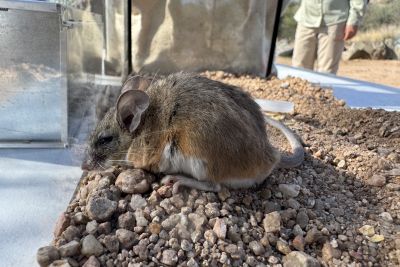
Peromyscus eremicus photographed by Laura Steger near Four Peaks, Maricopa County, Arizona. -

Peromyscus eremicus photographed by Laura Steger near Four Peaks, Maricopa County, Arizona.


Habitat
From Veal & Caire (1979): "Peromyscus eremicus is common in desert shrub and riparian habitats throughout the southwestern United States, north central Mexico, and Baja California."
Skull
From Hoffmeister (1986): "upper molars 1-2 usually without a mesoloph, zygomatic arches weak and not flared out, auditory bullae not greatly inflated, nasal branches of premaxillaries extend posteriorly beyond nasals."
-
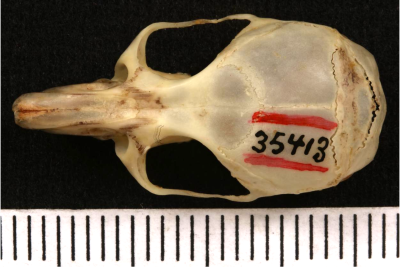
Holotype: USNM 20018/35413. Peromyscus eremicus eremicus. Adult male. Rio Grande, about 6 mi (10 km) from El Paso, El Paso County, Texas. Collected 25 February 1892. Dorsal view of the skull. -

Holotype: USNM 20018/35413. Peromyscus eremicus eremicus. Adult male. Rio Grande, about 6 mi (10 km) from El Paso, El Paso County, Texas. Collected 25 February 1892. Ventral view of the skul. -
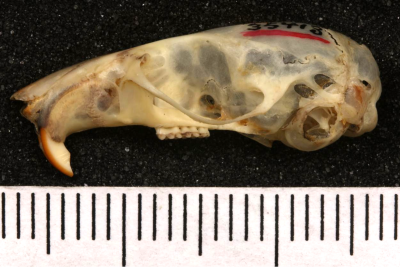
Holotype: USNM 20018/35413. Peromyscus eremicus eremicus. Adult male. Rio Grande, about 6 mi (10 km) from El Paso, El Paso County, Texas. Collected 25 February 1892. Lateral view of the skull. -
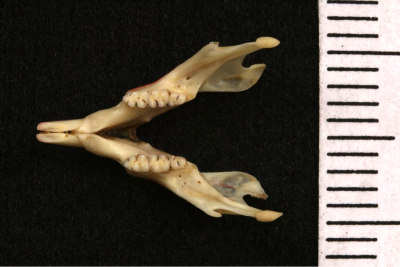
Holotype: USNM 20018/35413. Peromyscus eremicus eremicus. Adult male. Rio Grande, about 6 mi (10 km) from El Paso, El Paso County, Texas. Collected 25 February 1892. Dorsal view of the mandible. -

Holotype: USNM 20018/35413. Peromyscus eremicus eremicus. Adult male. Rio Grande, about 6 mi (10 km) from El Paso, El Paso County, Texas. Collected 25 February 1892. Lateral view of the left mandible. -

Holotype: USNM 20018/35413. Peromyscus eremicus eremicus. Adult male. Rio Grande, about 6 mi (10 km) from El Paso, El Paso County, Texas. Collected 25 February 1892. Upper molars. -

Holotype: USNM 20018/35413. Peromyscus eremicus eremicus. Adult male. Rio Grande, about 6 mi (10 km) from El Paso, El Paso County, Texas. Collected 25 February 1892. Lower molars.


Similar species
Peromyscus eremicus occurs sympatrically with many species of Peromyscus. Because of broad overlap of species ranges and extensive geographic variation in most characters of P. eremicus and other species of Peromyscus, the diagnostic characters at one locality may not be diagnostic at another locality. To insure proper identification a combination of characters are needed.
Comparison with Peromyscus attwateri
The Cactus Deermouse (Peromyscus eremicus) differs from P. attwateri in less heavily haired tail and upper molars 1-2 without mesolophs. The coloration of the pelage for P. eremicus varies among the subspecies and even among different populations and is not always a reliable character (Veal & Caire, 1979). Pelage color for P. eremicus at one locality may not be diagnostic at another locality.
-

Texas Deermouse (Peromyscus attwateri) -

Cactus Deermouse (Peromyscus eremicus) 
NEON01IGI. Texas Deermouse (Peromyscus attwateri). Arrows point to the accessory lophs on the first and second upper molars. -
Holotype: USNM 20018/35413. Cactus Deermouse (Peromyscus eremicus). Upper molars. Upper molars 1-2 usually without a mesoloph (Hoffmeister, 1986). 
NEON01IGI. Texas Deermouse (Peromyscus attwateri). Arrows point to the accessory lophs on the first and second lower molars. -
Holotype: USNM 20018/35413. Cactus Deermouse (Peromyscus eremicus). Lower molars lack accessory lophs, unlike in Peromyscus attwateri.
Comparison with Peromyscus boylii
From Hoffmeister (1986): "Peromyscus eremicus differs from P. boylii in less heavily haired and less bicolored tail, smaller ears, upper molars 1-2 without mesolophs."
-
Cactus Deermouse (Peromyscus eremicus) -

Brush Deermouse (Peromyscus boylii) -
Holotype: USNM 20018/35413. Cactus Deermouse (Peromyscus eremicus). Upper molars. Upper molars 1-2 usually without a mesoloph (Hoffmeister, 1986). -

Holotype: USNM 356/1270. Brush Deermouse (Peromyscus boylii). Upper molars. Arrows point to the accessory lophs on the first and second upper molars.
Comparison with Peromyscus crinitus
From Hoffmeister (1986): "P. crinitus is similar to and often confused with P. eremicus from which it differs as follows: tail with a covering of hairs so that annulations are less conspicuous and with a noticeable tuft of hairs at the tips."
From Johnson & Armstrong (1987) describing the dental pattern of the Canyon Deermouse (Peromyscus crinitus): "Dental pattern simple, much like P. eremicus; accessory lophs typically absent; presence of accessory styles geographically variable; when present, unattached to neighboring cusps or lophs; no mesoloph; lower teeth simpler than upper teeth, no meso- or ectolophids, and stylids small and present in one-third of sample."
-
Cactus Deermouse (Peromyscus eremicus) -

Canyon Deermouse (Peromyscus crinitus)
Comparison with Peromyscus gambelii and P. sonoriensis
Peromyscus eremicus differs from P. gambelii and P. sonoriensis in actually and relatively longer tail, less heavily haired and less biocolored tail, body shorter rather than longer than tail, ears not fringed with white, and upper molars 1-2 without mesolophs (Hoffmeister, 1986).
-
Cactus Deermouse (Peromyscus eremicus) -

Gambel's Deermouse (Peromyscus gambelii) -

Western Deermouse (Peromyscus sonoriensis) from North Dakota.
Comparison with Peromyscus fraterculus
From Cornejo-Latorre et al. (2021): "Based on external morphology, Peromyscus fraterculus is most similar to P. eremicus (cactus mouse—Lawlor 1971a); however, both taxa have an allopatric distribution (Riddle et al. 2000). P. fraterculus can be distinguished from P. eremicus by its smaller skull (greatest length of skull, 24.53 mm, range 22.3–25.0 mm; basilar length, 19.83 mm; nasal length, 8.50 mm; length of palatal bridge, 3.55 mm [mean of 161 adults with sexes combined]—Legg 1978; Álvarez-Castañeda et al. 2015) compared to P. eremicus (greatest length of skull, 25.23 mm, range 24.0–26.5 mm; basilar length, 20.36 mm; nasal length, 8.63 mm; length of palatal bridge, 3.65 mm [mean of 216 adults with sexes combined]—Osgood 1909; Legg 1978; Álvarez-Castañeda et al. 2015)."
-
Cactus Deermouse (Peromyscus eremicus) -

Northern Baja Deermouse (Peromyscus fraterculus) -

Range of Cactus Deermouse (Peromyscus eremicus). -

Range of Northern Baja Deermouse (Peromyscus fraterculus).

Comparison with Peromyscus gratus
Comparison with Peromyscus labecula
Comparison with Peromyscus leucopus
-
Cactus Deermouse (Peromyscus eremicus) -

White-footed Deermouse (Peromyscus leucopus)
Comparison with Peromyscus merriami
From Hoffmeister (1986): "P. merriami is most similar to P. eremicus and differs from it usually in these features: mastoidal breadth more than 11.55 mm rather than less, greatest length of skull more than 25.75 mm rather than less, baculum curves ventrally rather than dorsally, length of baculum more than 8.5 mm rather than less. Other features include longer hind foot, usually 21.6 mm or more rather than less, total length greater, pectoral spot frequently present, underparts frequently cream-colored rather than whitish."
-

Comparison of the baculum of Peromyscus merriami and Peromyscus eremicus from Hoffmeister and Lee (1963). -

Comparison of the skulls of Peromyscus merriami and Peromyscus eremicus as shown by Commissaris (1960). Hoffmeister and Lee (1963) found that "no single cranial character was found to be always diagnostic. Even the presence or absence of the exposed mastoid process, regarded by Commissaris as a qualitative character, was found to be unreliable in a great many cases."


Comparison with Peromyscus nasutus
The upper parts of the Northern Rock Deermouse (Peromyscus nasutus) are grayish brown or grayish buff.
-
Cactus Deermouse (Peromyscus eremicus) -

Northern Rock Deermouse (Peromyscus nasutus)
References
Benson SB. 1933. Concealing coloration among some desert rodents of the southwestern United States. Univ. California Publ. Zool. 40:1-70.
Caire W. 1978. Distribution and zoogeography of the mammals of Sonora, Mexico. Ph.D. dissertation, University of New Mexico, Albuquerque.
Commissaris LR. 1960. Morphological and ecological differentiation of Peromyscus merriami from southern Arizona. Journal of Mammalogy 41(3):305-310.
Dice LR, Blossom PM. 1937. Studies of mammalian ecology in southwestern North America, with special attention to the colors of desert animals. Washington D.C. (USA): Carnegie Institution of Washington.
Hoffmeister DF. 1986. Mammals of Arizona. Tucson (AZ, USA): University of Arizona Press.
Hoffmeister DF, Lee MR. 1963. The status of the sibling species Peromyscus merriami and Peromyscus eremicus. Journal of Mammalogy 44(2):201-213.
Johnson DW, Armstrong DM. 1987. Peromyscus crinitus. Mammalian species (287):1-8.
Findley JS, Harris AH, Wilson DE, Jones C. 1975. Mammals of New Mexico. Albuquerque (NM, USA): University of New Mexico Press.
Koschmann JR. 1974. Melanism in rodents of the Afton lava flows, Dona Ana County. M.S. thesis, University of Texas at El Paso.
Ridde BR, Hafner DJ, Alexander LF. 2000. Phylogeography and systematics of the Peromyscus eremicus species group and the historical biogeography of North American warm regional deserts. Molecular Phylogenetics and Evolution 17:145–160.
Veal R, Caire W. 1979. Peromyscus eremicus. Mammalian species (118): pp.1-6. https://doi.org/10.2307/3503858