Sorex obscurus
| Northern Montane Shrew
(Sorex obscurus) | |
|---|---|
| Range | |
 | |
| Taxonomic classification | |
| Order: | Eulipotyphla |
| Suborder: | Erinaceota |
| Superfamily: | Soricoidea |
| Family: | Soricidae |
| Subfamily: | Soricinae |
| Tribe: | Soricini |
| Genus: | Sorex |
| Subgenus: | Otisorex |
| Species group: | Sorex monticolus group |
| Binomial details | |
| Sorex obscurus C. H. Merriam, 1895 | |
| Other resources | |
| Full taxonomic details at MDD | |
From Woodman (2018): "Phylogenetic analysis of the mitochondrial cytochrome b gene indicated that S. monticola, as considered by Alexander (1996), is not monophyletic but includes three genetically divergent clades (Demboski and Cook, 2001; Shafer and Stewart, 2007)." According to Demboski & Cook (2001), the “northern continental clade" belongs to Sorex obscurus, and the “southern continental clade” belongs to the Southern Montane Shrew (Sorex monticolus), and the "coastal clade" belongs to the Pacific Shrew (Sorex pacificus). Androski et al. (2025) add: "We recovered the same backbone topology as Demboski and Cook (2001) but with higher support for all 3 clades....we identify significant niche divergence between the 3 major clades of S. monticola that lends support to their status as distinct species—S. monticola, S. pacificus, and S. obscurus (Woodman, 2018) representing the Southern, Coastal, and Northern clades, respectively." Further studies will be needed to fully understand new species boundaries and morphological variation.
Description
A formal species description for this taxon as delineated by Demboski & Cook (2001) does not currently exist. The following descriptions are provided for portions of the range of Sorex monticolus that Demboski & Cook (2001) subsumed under this taxon.
From Verts & Carraway (1998), describing two geographic variants that were described under S. monticolus, but are now presumed to be S. obscurus based on molecular studies by Demboski & Cook (2001): "[in northwestern Oregon] is blackish brown on the dorsum and light brown on the venter; the bases of the hairs are neutral very dark-gray. The tail is distinctly bicolored, blackish brown above, pinkish gray below; the flank glands are covered with pale brown bristles. The dorsal pelage of S. m. obscurus [northeastern part of the state] has yellow overtones—medium brown to medium yellowish-brown; the venter is white. The tail is indistinctly bicolored, medium brown above grading to white below; the flank glands have white bristles (Carraway, 1990)."
From Naughton (2012) for Canada: "very dark grey or greyish brown to brown (often with reddish or yellowish overtones) on their back and sides (sides may be slightly paler), with a somewhat lighter belly of silver to smoky grey to buffy brown. Interior populations in British Columbia tend to be brownish, but coastal populations may be almost black on the upper surfaces, especially in winter when the pelage is darker and greyer than in summer. Their long tail is bicoloured, dark brown above with a pinkish-grey or pale brown underside, and does not have a black tip. The upper surfaces of the feet are pale brown or grey brown."


Museum type specimens
-

Holotype: USNM 23525/30943. Sorex obscurus. Adult female. Salmon River (Lemhi) Mountains, 10 mi (16 km) west of Junction, Lemhi County, Idaho. Collected 26 August 1890. -

Holotype: USNM 23525/30943. Sorex obscurus. Adult female. Salmon River (Lemhi) Mountains, 10 mi (16 km) west of Junction, Lemhi County, Idaho. Collected 26 August 1890.


External measurements
Length measurements are in millimeters (mm) and weight measurements are in grams (g), unless stated otherwise. If available, the sample size (n=) is provided. If a range is not provided and n= is not given, then the listed measurement represents an average.
| Part of range | Reference | Total length | Tail length | Hindfoot length | Ear length | Mass |
|---|---|---|---|---|---|---|
| California | Jameson & Peeters (2004) | 111–120 | 46–55 | 13–15 | 6–7 | 2.8–5.2 |
| California and Idaho | Woodman (2012) | head and body: 55–77 (n=28) | 37–55 (n=28) | 12–16 (n=28) | ||
| Canada | Naughton (2012) | 93–140 | 35–68 | 10–18 | 4–10 | 3.7–13.0 (avg 6–7) |
| Canada | Wilson & Ruff (editors, 1999) | 95–139 | 30–62 | 4.4–10.2 | ||
| Oregon (eastern) | Verts & Carraway (1998) | 85–127 | 35–45 | 10–13 | 2.4–6.1 | |
| Oregon (Hood River Co.) | Verts & Carraway (1998) | 105–127 | 41–55 | 12–16 | 3.6–9.4 |
Color variation
This section shows some of the color variation present in Sorex obscurus. The location is provided for reference only. The individual shown does not necessarily represent the only color variant within the local population.
-

NEON0D0YK. Sorex obscurus. Subadult female. Denali Borough, Alaska. Collected 14 August 2024. -

NEON05JUG. Sorex obscurus. Adult female. Clark County, Washington. Collected 2 August 2018. -

NEON05JT2. Sorex obscurus. Adult male. Clark County, Washington. Collected 5 September 2018. -

NEON01IUE. Sorex obscurus. Subadult female. Skamania County, Washington. Partial molt. Collected on 1 October 2019. -
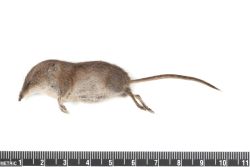
NEON01IMC. Sorex obscurus. Subadult. Park County, Wyoming. Collected on 3 September 2019. -

NEON0D0Z9. Sorex obscurus. Adult female. Fresno County, California. Collected 26 September 2024.


Skull and skeleton
| Sorex obscurus skull characters | |
|---|---|
| units in mm | |
| Skull | |
| Condylobasal length: | 16.1–17.7 (Hennings & Hoffman, 1977); 16.1–19.2 (Junge & Hoffman, 1981) |
| Postmandibular canal: | Absent |
| Shape: | Skull somewhat slightly flattened |
| Dental | |
| Upper unicuspids: | 5 |
| Unicuspid notes: | U3<U4 |
| Tines present: | Yes |
| Tine size: | Small-medium |
| Tine position: | Below upper limit of pigment on upper incisors |
| Shape upper incisors: | Diverging |
-

Holotype: USNM 23525/30943. Sorex obscurus. Adult female. Salmon River (Lemhi) Mountains, 10 mi (16 km) west of Junction, Lemhi County, Idaho. Collected 26 August 1890. Dorsal view of the skull. The back of the skull is damaged. -

Holotype: USNM 23525/30943. Sorex obscurus. Adult female. Salmon River (Lemhi) Mountains, 10 mi (16 km) west of Junction, Lemhi County, Idaho. Collected 26 August 1890. Ventral view of the skull. The back of the skull is damaged. -

Holotype: USNM 23525/30943. Sorex obscurus. Adult female. Salmon River (Lemhi) Mountains, 10 mi (16 km) west of Junction, Lemhi County, Idaho. Collected 26 August 1890. Lateral view of the skull. The back of the skull is damaged and missing. -

Holotype: USNM 23525/30943. Sorex obscurus. Adult female. Salmon River (Lemhi) Mountains, 10 mi (16 km) west of Junction, Lemhi County, Idaho. Collected 26 August 1890. Dorsal view of the mandible. The outer sides of the mandible are facing inwards. -

Holotype: USNM 23525/30943. Sorex obscurus. Adult female. Salmon River (Lemhi) Mountains, 10 mi (16 km) west of Junction, Lemhi County, Idaho. Collected 26 August 1890. Lateral view of the inner right mandible. -

NEON03P7V. Sorex obscurus. Denali Borough, Alaska. Collected 21 August 2020. Lateral view of the skull. Lower jaw is not shown. Long scale bar represents 1 cm; short scale bar represents 1 mm. -

NEON05JT3. Sorex obscurus. Clark County, Washington. Collected 5 September 2018. Lateral view of the skull. Lower jaw is not shown. Long scale bar represents 1 cm; short scale bar represents 1 mm. -

NEON01IX8. Lateral view of the skull of Sorex obscurus. Long scale bar is 1 cm; short scale bar is 1 mm. -

NEON03P7V. Sorex obscurus. Denali Borough, Alaska. Collected 21 August 2020. Unicuspids, scale is 1 mm. -

NEON05NNR. Sorex obscurus. Denali Borough, Alaska. Upper incisors. Scale is 1 mm. -

NEON03P7V. Sorex obscurus. Denali Borough, Alaska. Upper incisors. Scale is 1 mm. -

NEON05JT3. Sorex obscurus. Clark County, Washington. Upper incisors. Scale is 1 mm. -

NEON06SGJ. Sorex obscurus. Fresno County, California. Upper incisors. Scale is 1 mm. -

NEON01IX3. Upper incisors of Sorex obscurus, Fresno County, California, scale is 1 mm. -

MVZ201248. Upper incisors of Sorex obscurus, Mariposa County, California, scale is 1 mm. -
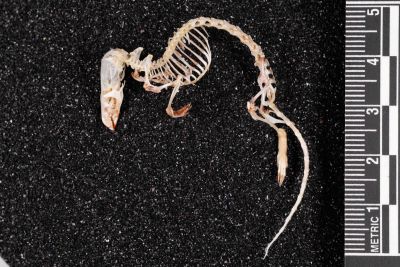
NEON0D0Z9. Sorex obscurus. Skeleton of an adult female.


Similar species
Comparison with Sorex monticolus
Distinguishing between the Southern Montane Shrew (Sorex monticolus) and Sorex obscurus in the field may require genetic testing. Currently, the boundaries of Sorex monticolus and Sorex obscurus are not well understood in eastern Idaho, southeastern Wyoming, and northwestern Colorado. Further studies are needed to fully understand species boundaries and morphological variation.
-

Southern Montane Shrew (Sorex monticolus) -

Northern Montane Shrew (Sorex obscurus) -
Unicuspids of the Northern Montane Shrew (Sorex obscurus). -

Upper incisors (I1s) of the Southern Montane Shrew (Sorex monticolus) from Boulder County, Colorado. Scale is 1 mm. -
Upper incisors (I1s) of the Northern Montane Shrew (Sorex obscurus) from Denali Borough, Alaska. Scale is 1 mm.

Comparison with Sorex trowbridgii
Distinguishing between the Trowbridge's Shrew (Sorex trowbridgii) and Sorex obscurus in the field may be easy or challenging depending on the locality, season, and age of the individual. The pelage of Sorex obscurus ranges from dark grayish brown to brown and that of Sorex trowbridgii ranges from dark gray pelage in winter to slightly more brownish in summer (George, 1989; Naughton, 2012). Careful examination of the skull may be required in order to be certain of identification. In Sorex trowbridgii, the inside of the lower mandible contains a postmandibular canal; the inferior dentary foramen and postmandibular foramen are confluent and large (Naughton, 2012); and the medial edge of the upper incisors are curved. Whereas in Sorex obscurus the lower mandible lacks a postmandibular canal and the medial edges of the upper incisors are not curved.
-
NEON01IUE. Northern Montane Shrew (Sorex obscurus). Early October in Skamania County, Washington. -

NEON05JT2. Northern Montane Shrew (Sorex obscurus). Early September in Clark County, Washington. -

NEON01IHK. Trowbridge's Shrew (Sorex trowbridgii). Mid-September in Fresno County, California. -

NEON05G3C. Trowbridge's Shrew (Sorex trowbridgii). Early June in Clark County, Washington. -
NEON03P7V. Unicuspids of the Northern Montane Shrew (Sorex obscurus). Similar to Sorex trowbridgii, the third unicuspid is smaller than the fourth. -

NEON01IYG. Unicuspids of the Trowbridge's Shrew (Sorex trowbridgii). Similar to Sorex obscurus, the third unicuspid is smaller than the fourth. -
Upper incisors (I1s) of the Northern Montane Shrew (Sorex obscurus) from Denali Borough, Alaska. Scale is 1 mm. The medial edge of the upper incisors are straight (not curved). -

MVZ:Mamm:219772. Upper incisors (I1s) of the Trowbridge's Shrew (Sorex trowbridgii) from California, scale is 1 mm. The medial edge of the upper incisors are curved.
References
Alexander LF. 1996. A morphometric analysis of geographic variation within Sorex monticolus. University of Kansas Natural History Museum Miscellaneous Publication (88): 1-54.
Androski A, Malaney JL, Demboski JR, Liphardt SW, Fernández JA, Cook JA. 2025. Range-wide mitochondrial phylogeography of Sorex monticola: evolutionarily distinct clades occupy divergent abiotic niches. Journal of Mammalogy 106(4):898–932. https://doi.org/10.1093/jmammal/gyaf019
Carraway LN. 1990. A morphologic and morphometric analysis of the "Sorex vagrans species complex" in the Pacific Coast region. Special Publications, The Museum, Texas Tech University 32:1-76.
Demboski JR, Cook JA. 2001. Phylogeography of the dusky shrew, Sorex monticolus (Insectivora, Soricidae): insight into deep and shallow history in northwestern North America. Molecular Ecology 10(5): 1227-1240.
Hennings D. 1970. Systematics of the Sorex vagrans-obscurus complex revisited. Graduate Student Theses, Dissertations, & Professional Papers. 6564. https://scholarworks.umt.edu/etd/656
Hennings D, Hoffmann RS. 1977. A review of the taxonomy of the Sorex vagrans species complex from western North America. Occasional Papers of the Museum of Natural History, University of Kansas 68:1-35.
Junge, J.A. and Hoffman, R.S., 1981. An annotated key to the long-tailed shrews (Genus Sorex) of the United States and Canada with notes on middle American Sorex. Occasional Papers of the Museum of Natural History, The University of Kansas, Lawrence Kansas. Number 94; Pages 1-48. Link
Naughton D. 2012. The natural history of Canadian mammals. Toronto (ON, CA): University of Toronto Press.
Verts BJ, Carraway LN. 1998. Land mammals of Oregon. Berkeley (CA, USA): University of California Press.
Wilson DE, Ruff S, editors. 1999. The Smithsonian Book of North American Mammals. Washington D.C. (USA): Smithsonian Institution Scholarly Press.
Woodman N. 2012. Taxonomic status and relationships of Sorex obscurus parvidens, from California. Journal of Mammalogy 93(3): 826-838.
Woodman N. 2018. American Recent Eulipotyphla: nesophontids, solenodons, moles, and shrews in the New World. Washington D.C. (USA): Smithsonian Institution Scholarly Press. https://doi.org/10.5479/si.1943-6696.650.