Sorex pacificus
| Pacific Shrew
(Sorex pacificus) | |
|---|---|
| Range | |
 | |
| Taxonomic classification | |
| Order: | Eulipotyphla |
| Suborder: | Erinaceota |
| Superfamily: | Soricoidea |
| Family: | Soricidae |
| Subfamily: | Soricinae |
| Tribe: | Soricini |
| Genus: | Sorex |
| Subgenus: | Otisorex |
| Species group: | Sorex sonomae group |
| Binomial details | |
| Sorex pacificus Coues, 1877 | |
| Other resources | |
| Full taxonomic details at MDD | |
From Woodman (2018): "Within the Sorex sonomae group, S. pacificus is sister to S. sonomae (Demboski and Cook, 2001; Hope et al., 2014). Phylogenetic analysis of the mitochondrial cytochrome b gene indicated that S. monticola as conceived by Alexander (1996) is not monophyletic but is composed of three genetic clades (Demboski and Cook, 2001; Shafer and Stewart, 2007)." According to Demboski & Cook (2001), the “northern continental clade" belongs to the Northern Montane Shrew (Sorex obscurus), and the “southern continental clade” belongs to the Southern Montane Shrew (Sorex monticolus), and the "coastal clade" belongs to the Sorex pacificus. Further studies will be needed to fully understand new species boundaries and morphological variation.
Description
From Mittermeier & Wilson (2018): "The Pacific Shrew is relatively large. Dorsum is rich reddish brown to dark brown, and venter is orangish brown and slightly paler than dorsum. Feet are pale brown. Tail is long, narrow, nearly naked, and slightly bicolored, being pale brown above and slightly lighter below. [Upper incisors] lack tines and have no medial tines but do have small protuberances, unlike in the Fog Shrew (S. sonomae). Teeth are pigmented dark red. There are five unicuspids, third is smaller than fourth, and fifth is minute."


External measurements
Length measurements are in millimeters (mm) and weight measurements are in grams (g), unless stated otherwise. If available, the sample size (n=) is provided. If a range is not provided and n= is not given, then the listed measurement represents an average.
| Part of range | Reference | Total length | Tail length | Hindfoot length | Ear length | Mass |
|---|---|---|---|---|---|---|
| Oregon (Cascade Range) | Verts & Carraway (1998) | 103–130 | 44–58 | 13–15 | 4.7–7.4 | |
| Oregon (Coast Range) | Verts & Carraway (1998) | 118–141 | 52–69 | 15–18 | 4.7–12.8 | |
| Oregon (ssp bairdi) | Wilson & Ruff (editors, 1999) | 100–143 | 32–64 | 5.5–11.2 | ||
| rangewide | Wilson & Ruff (editors, 1999) | 134–154 | 59–72 | 10–18 |
Skull
| Sorex pacificus skull characters | |
|---|---|
| units in mm | |
| Skull | |
| Condylobasal length: | 19.0–22.8 (Junge & Hoffman, 1981); 21.4–23.0 (Álvarez-Castañeda, 2024) |
| Postmandibular canal: | Absent |
| Dental | |
| Upper unicuspids: | 5 |
| Unicuspid notes: | U3<U4 |
| Tines present: | No; but may have a median ridge |
| Shape upper incisors: | Slightly diverging (based on illustration in Carraway, 1985) |
| Dental characters: | In ventral view, the unicuspids are wider than long |
Sorex pacificus has no medial tines on the upper incisors (Smith & Belk, 1996), but may have a median ridge (Carraway, 1985). From Carraway (1985): "In lateral view, the third unicuspid tooth is distinctly smaller than the fourth (Junge and Hoffmann, 1981), and the fifth is distinctly smaller than the third (Coues, 1877); in ventral view, the unicuspids are wider than long."
-

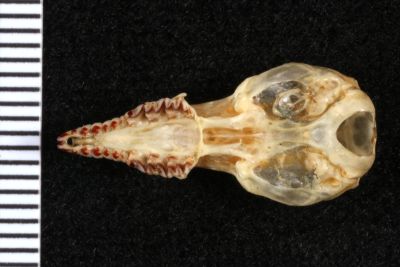
Holotype: USNM 73051. Sorex pacificus pacificus . Adult female. Yaquina Bay, Lincoln County, Oregon. Collected 18 July 1895. Dorsal view of the skull. -
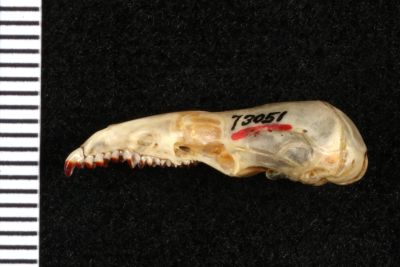
Holotype: USNM 73051. Sorex pacificus pacificus . Adult female. Yaquina Bay, Lincoln County, Oregon. Collected 18 July 1895. Ventral view of the skull. -
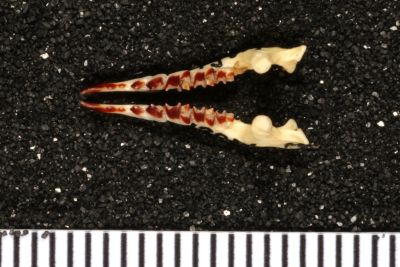
Holotype: USNM 73051. Sorex pacificus pacificus . Adult female. Yaquina Bay, Lincoln County, Oregon. Collected 18 July 1895. Lateral view of the skull. -
Holotype: USNM 73051. Sorex pacificus pacificus . Adult female. Yaquina Bay, Lincoln County, Oregon. Collected 18 July 1895. Dorsal view of the mandible. -

Holotype: USNM 73051. Sorex pacificus pacificus . Adult female. Yaquina Bay, Lincoln County, Oregon. Collected 18 July 1895. Lateral view of the left mandible. -
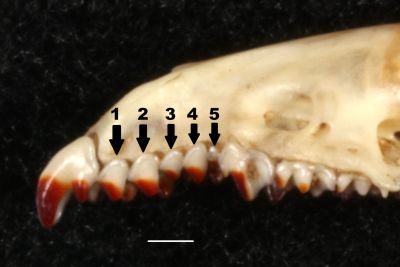
Holotype: USNM 73051. Sorex pacificus pacificus . Adult female. Yaquina Bay, Lincoln County, Oregon. Collected 18 July 1895. Arrows point to the unicuspids. -

Upper incisors of Sorex pacificus. Illustration by G.L. Milton. Borrowed from Carraway (1985).


Taxonomy
From Woodman (2018): "Within the Sorex sonomae group, S. pacificus is sister to S. sonomae (Demboski and Cook, 2001; Hope et al., 2014). Phylogenetic analysis of the mitochondrial cytochrome b gene indicated that S. monticola as conceived by Alexander (1996) is not monophyletic but is composed of three genetic clades (Demboski and Cook, 2001; Shafer and Stewart, 2007)." According to Demboski & Cook (2001), the “northern continental clade" belongs to the Northern Montane Shrew (Sorex obscurus), and the “southern continental clade” belongs to the Southern Montane Shrew (Sorex monticolus), and the "coastal clade" belongs to the Sorex pacificus.
Species comparisons

References
Álvarez-Castañeda ST. 2024. Order Eulipotyphla. In Mammals of North America-Volume 1: Systematics and Taxonomy (pp. 397-513). Cham (Switzerland): Springer Nature Switzerland.
Carraway LN. 1985. Sorex pacificus. Mammalian Species (231): 1-5.
Coues E. 1877-05-15. Precursory notes on American insectivorous mammals, with descriptions of new species. Bulletin of the United States Geological and Geographical Survey of the Territories 3(3):631-653.
Demboski JR, Cook JA. 2001. Phylogeography of the dusky shrew, Sorex monticolus (Insectivora, Soricidae): insight into deep and shallow history in northwestern North America. Molecular Ecology 10(5): 1227-1240.
Junge JA, Hoffman RS. 1981. An annotated key to the long-tailed shrews (Genus Sorex) of the United States and Canada with notes on middle American Sorex. Occasional Papers of the Museum of Natural History, The University of Kansas, Lawrence Kansas. Number 94; Pages 1-48. Link
Mittermeier RA, Wilson DE. 2018. Soricidae. In: Handbook of the Mammals of the World – Volume 8 Insectivores, Sloths and Colugos. Barcelona: Lynx Edicions: 332-551, ISBN: 978-84-16728-08-4, DOI: http://doi.org/10.5281/zenodo.6870843
Smith ME, Belk MC. 1996. Sorex monticolus. Mammalian Species (528): 1-5.
Verts BJ, Carraway LN. 1998. Land mammals of Oregon. Berkeley (CA, USA): University of California Press.
Wilson DE, Ruff S, editors. 1999. The Smithsonian Book of North American Mammals. Washington D.C. (USA): Smithsonian Institution Scholarly Press.
Woodman N. 2018. American Recent Eulipotyphla: nesophontids, solenodons, moles, and shrews in the New World. Washington D.C. (USA): Smithsonian Institution Scholarly Press. https://doi.org/10.5479/si.1943-6696.650.