Dipodomys spectabilis
| Banner-tailed Kangaroo Rat
(Dipodomys spectabilis) | |
|---|---|
| Range | |
 | |
| Taxonomic classification | |
| Order: | Rodentia |
| Suborder: | Supramyomorpha |
| Infraorder: | Castorimorphi |
| Superfamily: | Geomyoidea |
| Family: | Heteromyidae |
| Subfamily: | Dipodomyinae |
| Genus: | Dipodomys |
| Binomial details | |
| Dipodomys spectabilis C. H. Merriam, 1890 | |
| Other resources | |
| Full taxonomic details at MDD | |
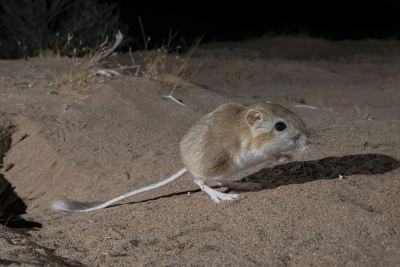
The Banner-tailed Kangaroo Rat (Dipodomys spectabilis) is a large kangaroo rate that inhabits desert grasslands with scattered shrubs.
Description
From Armstrong et al. (2010): "The banner-tailed kangaroo rat is a large rodent, similar in color to the much smaller Ord's kangaroo rat [Dipodomys ordii] except that the tail, with its large white top and proximal black band, is even more striking (hence the vernacular and scientific names). Only 4 toes are present on the hindfoot. The lateral tail stripes extend only about half the length of the tail."
From Hoffmeister (1986): "A large species of Dipodomys with the distal half of the tail black that is conspicuously tipped terminally with white; hind feet long, usually more than 45 mm, and with only four toes; skull with auditory bullae greatly enlarged but not to the point of eliminating the supraoccipital and interparietal; maxillary arches heavy and flared out."


Museum specimens
-

Holotype: 17886/24823. Dipodomys spectabilis spectabilis. Adult male. Dos Cabezos (Cabezas), Cochise County, Arizona. Collected 22 November 1889. Dorsal view. -

Holotype: 17886/24823. Dipodomys spectabilis spectabilis. Adult male. Dos Cabezos (Cabezas), Cochise County, Arizona. Collected 22 November 1889. Ventral view.


External measurements
Length measurements are in millimeters (mm) and weight measurements are in grams (g), unless stated otherwise. If available, the sample size (n=) is provided. If a range is not provided and n= is not given, then the listed measurement represents an average.
| Part of range | Reference | Total length | Tail length | Hindfoot length | Ear length | Mass |
|---|---|---|---|---|---|---|
| Arizona (Cochise Co., vicinity of San Simon and Willcox) | Hoffmeister (1986) | 322–353 (n=13) | 180–206 (n=13) | 45–57 (n=13) | ||
| Arizona (Santa Cruz Co., vicinity of Nogales) | Hoffmeister (1986) | 318–351 (n=16) | 182–204 (n=16) | 46–54 (n=16) | ||
| Colorado | Armstrong et al. (2010) | 310–350 | 180–210 | 47–51 | 90–135 | |
| New Mexico (Lincoln Co., vicinity of Roswell) | Hoffmeister (1986) | 340–373 (n=13) | 191–221 (n=13) | 53–56 (n=13) | ||
| Texas | Schmidly & Bradley (2016) | 350 | 210 | 53 | 115 |
Skull
From Best (1988): "The skull is large and heavy for Dipodomys, and the inflated mastoids are separated on top by about 3 mm, so that there is a distinct interparietal, cuneate in shape (Merriam, 1890).... The skull is large, with inflated bullae. The interparietal bone is variable in size and shape and is sometimes fused with the supraoccipital. The maxillary arches are heavy and their posterolateral edges are slightly slanted or flared out. The dorsal anteromedial edge of the maxillary arch is narrow and extends slightly along the premaxilla. A depression, the ectoglenoid fossa, for the attachment of the ventral slip of the temporal muscle is present between the glenoid fossa and the posterior end of the zygomatic arch. The external opening of the auditory meatus varies from round to oval in shape. The hyoid apparatus is composed of two parts, basihyal and a reduced thyrhyal. The basihyal is medium-sized with a prominent ventral ridge; the anteromedial border of the shoulders is somewhat round (Nader, 1978). The teeth are medium-sized to massive (Nader, 1966). The upper incisors are grooved anteriorly and the lower incisors also may have a distinct shallow groove (Wood, 1935)."
-

Holotype: 17886/24823. Dipodomys spectabilis spectabilis. Adult male. Dos Cabezos (Cabezas), Cochise County, Arizona. Collected 22 November 1889. Dorsal view of the skull. -

Holotype: 17886/24823. Dipodomys spectabilis spectabilis. Adult male. Dos Cabezos (Cabezas), Cochise County, Arizona. Collected 22 November 1889. Ventral view of the skull. -

Holotype: 17886/24823. Dipodomys spectabilis spectabilis. Adult male. Dos Cabezos (Cabezas), Cochise County, Arizona. Collected 22 November 1889. Lateral view of the skull. -

Holotype: 17886/24823. Dipodomys spectabilis spectabilis. Adult male. Dos Cabezos (Cabezas), Cochise County, Arizona. Collected 22 November 1889. Dorsal view of the mandible. -

Holotype: 17886/24823. Dipodomys spectabilis spectabilis. Adult male. Dos Cabezos (Cabezas), Cochise County, Arizona. Collected 22 November 1889. Lateral view of the left mandible. -

Holotype: 17886/24823. Dipodomys spectabilis spectabilis. Adult. Upper molars. -

Holotype: 17886/24823. Dipodomys spectabilis spectabilis. Adult. Lower molars.


Similar species
Comparison with Dipodomys deserti
From Hoffmeister (1986): "D. spectabilis, because of its large size, long feet, four toes only on hind feet, and large skulls, needs comparison only with D. deserti. D. spectabilis differs from D. deserti as follows: terminal white tip on tail more conspicuous; dorsal and ventral dark stripes on tail unite to form a nearly solid subterminal area of black or dark gray; interparietal present and supraoccipital narrow, but usually 1.0 mm wide or greater at narrowest constriction; suture between frontal and maxillary arm of zygomatic arch longer; rostrum heavier; external auditory meatus rounder and smaller; ventral stripe on tail darker and broader."
-

Banner-tailed Kangaroo Rat (Dipodomys spectabilis) photographed by Randy Babb. © Randy Babb -
Desert Kangaroo Rat (Dipodomys deserti) photographed by Randy Babb. © Randy Babb -
Holotype: 17886/24823. Dipodomys spectabilis spectabilis. Adult male. Dos Cabezos (Cabezas), Cochise County, Arizona. Collected 22 November 1889. Dorsal view of the skull. -

Holotype: 15629/22522. Dipodomys deserti deserti. Adult female. Mohave River, [San Bernardino County], California. Collected 29 June 1886. Dorsal view of the skull. From Best et al. (1989): "The mastoids meet immediately behind the parietals, having at most an inconspicuous spicule between them; this character distinguishes D. deserti from all other species of Dipodomys.

Comparison with Dipodomys merriami
The banner-tailed kangaroo rat differs from the Merriam's Kangaroo Rat (Dipodomys merriami) in having a striking white-tipped tail with a solid black band proximal to the white tip.
-
Banner-tailed Kangaroo Rat (Dipodomys spectabilis) photographed by Randy Babb. © Randy Babb -

Merriam's Kangaroo Rat (Dipodomys merriami) photographed by Randy Babb. © Randy Babb -
Holotype: 17886/24823. Dipodomys spectabilis spectabilis. Adult male. Dos Cabezos (Cabezas), Cochise County, Arizona. Collected 22 November 1889. Dorsal view of the skull. -

Holotype: 54552. Dipodomys merriami merriami. Adult female. Pyramid Lake, Washoe County, Nevada. Collected 26 June 1893. Dorsal view of the skull.
Comparison with Dipodomys ordii
From Armstrong et al. (2010): "The banner-tailed kangaroo rat differs from Ord's kangaroo rat [Dipodomys ordii] in having 4 toes on the hindfeet and a striking white-tipped tail with a solid black band proximal to the white tip."
-
Banner-tailed Kangaroo Rat (Dipodomys spectabilis) photographed by Randy Babb. © Randy Babb -

Ord's Kangaroo Rat (Dipodomys ordii) observed by Nick Cairns in Carbon County, Montana. -
Holotype: 17886/24823. Dipodomys spectabilis spectabilis. Adult male. Dos Cabezos (Cabezas), Cochise County, Arizona. Collected 22 November 1889. Dorsal view of the skull. -

Holotype: 243093. Dipodomys ordii cupidineus. Adult male. Kanab Wash, Mohave County, Arizona. Collected 12 October 1922. Dorsal view of the skull.
References
Armstrong DM, Fitzgerald JP, Meaney CA. 2010. Mammals of Colorado, Second Edition. Denver (CO, USA): University Press of Colorado.
Best TL. 1988. Dipodomys spectabilis. Mammalian Species (311): 1-10. https://doi.org/10.2307/3504199
Hoffmeister DF. 1986. Mammals of Arizona. Tucson (AZ, USA): University of Arizona Press.
Merriam CH. 1890-10-08. Descriptions of three new kangaroo rats, with remarks on the identity of Dipodomys ordii of Woodhouse. North American Fauna 4:41-50.
Nader IA. 1966. Roots of teeth as a generic character in the kangaroo rats, Dipodomys. Bulletin of Biological Research, Baghdad, 2:62-69.
Nader IA.1978. Kangaroo rats: intraspecific variation in Dipodomys spectabilis Merriam and Dipodomys deserti Stephens. Illinois Niological Monographs 49:1-116.
Schmidly DJ, Bradley RD. 2016. The mammals of Texas. Austin (TX, USA): University of Texas Press.
Wood AE. 1935. Evolution and relationships of the heteromyid rodents with new forms from the Tertiary of western North America. Annals of the Carnegie Museum 24:73-262.