Neotoma lepida
| Desert Woodrat
(Neotoma lepida) | |
|---|---|
| Range | |
 | |
| Taxonomic classification | |
| Order: | Rodentia |
| Suborder: | Supramyomorpha |
| Infraorder: | Myomorphi |
| Superfamily: | Muroidea |
| Family: | Cricetidae |
| Subfamily: | Neotominae |
| Tribe: | Neotomini |
| Genus: | Neotoma |
| Binomial details | |
| Neotoma lepida O. Thomas, 1893 | |
| Other resources | |
| Full taxonomic details at MDD | |
The Desert Woodrat (Neotoma lepida) is a relatively small-bodied woodrat limited to the drier deserts of western North America (Patton, 2007).
Description
From Armstrong et al. (2010): "The desert woodrat is a small yellow-buff to buffy gray woodrat. The tail is sharply bicolored and short-haired. The underparts are whitish to buff. White hairs on the chest are usually gray at their bases except for a small patch or mid-ventral strip with white base." From Patton et al. (2007): "Pelage typically long and soft; overall color tones pale, although melanism is present in many populations."

Museum specimens
-

ASUMAC009071. Desert Woodrat (Neotoma lepida). Adult male. Arizona Strip, Mohave County, Arizona. Collected 9 April 2025. -

ASUMAC009071. Desert Woodrat (Neotoma lepida). Adult male. Arizona Strip, Mohave County, Arizona. Collected 9 April 2025. -
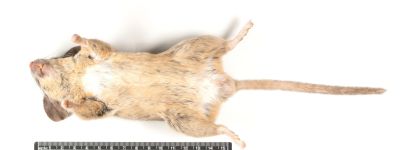
ASUMAC009071. Desert Woodrat (Neotoma lepida). Adult male. Arizona Strip, Mohave County, Arizona. Collected 9 April 2025. -

Holotype: USNM 25739/33139. Neotoma lepida lepida. Adult male. Furnace Creek, Death Valley, Inyo County, California. Collected 31 January 1891. -
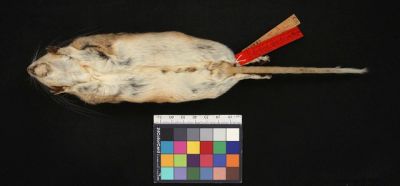
Holotype: USNM 25739/33139. Neotoma lepida lepida. Adult male. Furnace Creek, Death Valley, Inyo County, California. Collected 31 January 1891.


External measurements
Length measurements are in millimeters (mm) and weight measurements are in grams (g), unless stated otherwise. If available, the sample size (n=) is provided. If a range is not provided and n= is not given, then the listed measurement represents an average.
| Part of range | Reference | Total length | Tail length | Hindfoot length | Ear length | Mass |
|---|---|---|---|---|---|---|
| Arizona (northern Coconino County) and Nevada (Kane County) | Patton et al. (2007) | 261–326 (n=35) | 108–148 (n=35) | 27–34 (n=40) | 24–33 (n=26) | |
| Arizona (northern Mohave County) | Patton et al. (2007) | 267–324 (n=41) | 113–149 (n=41) | 29–33.5 (n=43) | 24–33 (n=29) | |
| California | Jameson & Peeters (2004) | 282–305 | 113–128 | 29–34 | 23–25 | 100–190 |
| California (eastern half of Riverside County) | Patton et al. (2007) | 253–334 (n=41) | 111–155 (n=41) | 27–32 (n=49) | 21–35 (n=49) | |
| California (eastern San Bernardino County) | Patton et al. (2007) | 261–334 (n=71) | 110–160 (n=71) | 28–36 (n=73) | 22–33 (n=73) | |
| California (Lassen County) and Nevada (central Washoe County) | Patton et al. (2007) | 273–310 (n=12) | 113–141 (n=12) | 30–34 (n=12) | 27–31 (n=6) | |
| California (Modoc County) and Nevada (Humboldt County and northern Washoe County) | Patton et al. (2007) | 259–316 (n=11) | 108–138 (n=111) | 20–33 (n=14) | 26–31 (n=13) | |
| California (northern and eastern Imperial County and southern San Bernardino County) | Patton et al. (2007) | 266–337 (n=62) | 112–166 (n=62) | 27–34 (n=67) | 24–35 (n=64) | |
| California (southern Mono County and northern Inyo County) and Nevada (Esmeralda County) | Patton et al. (2007) | 266–315 (n=39) | 91–141 (n=39) | 29–33 (n=45) | 24–32 (n=45) | |
| California (southwestern Inyo County) and Nevada (southern Nye County) | Patton et al. (2007) | 263–352 (n=73) | 106–172 (n=73) | 21–34 (n=66) | 21–35 (n=61) | |
California (western San Bernardino County, eastern Kern County, southwest Inyo County, northeast Los Angeles County)
|
Patton et al. (2007) | 255–330 (n=63) | 110–154 (n=63) | 28–34 (n=65) | 23–34 (n=45) | |
| Colorado | Armstrong et al. (2010) | 266–295 | 110–126 | 31–33 | 28–30 | 100–140 |
| Nevada (Lincoln County and east-central Nye County) | Patton et al. (2007) | 265–312 (n=24) | 105–142 (n=24) | 27–35 (n=24) | 24–32 (n=24) | |
| Nevada (northeast Elko County) and Utah (Box Elder County) | Patton et al. (2007) | 270–327 (n=12) | 105–136 (n=12) | 30–33 (n=14) | 21–31 (n=12) | |
| Nevada (northwest Nye County, southeast Churchill County, southwest Lander County) | Patton et al. (2007) | 253–320 (n=34) | 105–139 (n=34) | 28–35 (n=37) | 22–32 (n=30) | |
| Nevada (Pershing County, southeast Humboldt County, and northwest Lander County) | Patton et al. (2007) | 259–314 (n=36) | 101–134 (n=36) | 24–32 (n=39) | 24–34 (n=29) | |
| Nevada (vicinity of Grand, Emery, and Wayne counties) and Colorado (Rio Blanco County) | Patton et al. (2007) | 274–294 (n=13) | 111–132 (n=13) | 29–33 (n=16) | 29–33 (n=12) | |
| Nevada (vicinity of Storey, Carson City, Lyon, and Douglas counties) | Patton et al. (2007) | 265–310 (n=10) | 106–141 (n=10) | 29–35 (n=11) | 24–33 (n=11) | |
| Nevada (White Pine County, southeast Eureka County) and Utah (western Millard County) | Patton et al. (2007) | 264–319 (n=27) | 107–145 (n=27) | 28–33 (n=30) | 24–32 (n=30) | |
| Oregon (southest) and Idaho (southwest) | Patton et al. (2007) | 272–329 (n=20) | 112–144 (n=20) | 30–35 (n=21) | 27–31 (n=9) |
Color variation
From Patton et al. (2007): "overall color tones pale, although melanism is present in many populations."
Skull
From Patton et al. (2007): "Skull with large auditory bullae (averaging 7.2 x 7.5 mm in length and width); elongated vomerine portion to incisive foramen septum, with corresponding short vacuity; and frontal contact with lacrimal less than half the length of the maxillary contact. Anteromedial flexus of anteroloph of M1 is shallow in all but youngest aged individuals."
From Armstrong et al. (2010): "The skull is not strongly arched in the interorbital region. A maxillo-vomerine notch is present in the nasal septum. The anterior palatal spine is stout and blunt."
-

Holotype: USNM 25739/33139. Neotoma lepida lepida. Adult male. Furnace Creek, Death Valley, Inyo County, California. Collected 31 January 1891. Dorsal view of the skull. -

Holotype: USNM 25739/33139. Neotoma lepida lepida. Adult male. Furnace Creek, Death Valley, Inyo County, California. Collected 31 January 1891. Ventral view of the skull. -

Holotype: USNM 25739/33139. Neotoma lepida lepida. Adult male. Furnace Creek, Death Valley, Inyo County, California. Collected 31 January 1891. Lateral view of the skull. -

Holotype: USNM 25739/33139. Neotoma lepida lepida. Adult male. Furnace Creek, Death Valley, Inyo County, California. Collected 31 January 1891. Dorsal view of the mandible. -

Holotype: USNM 25739/33139. Neotoma lepida lepida. Adult male. Furnace Creek, Death Valley, Inyo County, California. Collected 31 January 1891. Lateral view of the left mandible. -

Holotype: USNM 25739/33139. Neotoma lepida lepida. Adult. Upper molars. -

Holotype: USNM 25739/33139. Neotoma lepida lepida. Adult. Lower molars.


Similar species
Comparison with Neotoma albigula
From Hoffmeister (1986): "N. albigula differs from Neotoma lepida in hairs on the throat white to their bases rather than dusky or gray basally, baculum short and broad basally rather than long and narrow, rostrum of skull broader, posterior extensions of premaxillaries usually expanded, second loph M3 more nearly diagonal rather than transverse." The anteromedial flexus of anteroloph of each upper molar (M1) is not a reliable character as it is shallow to obsolete in both species.
-

NEON0C8V8. White-throated Woodrat (Neotoma albigula). Adult male. Hairs on the throat are white to their bases. -
Holotype: USNM 25739/33139. Desert Woodrat (Neotoma lepida). Adult male. Furnace Creek, Death Valley, Inyo County, California. Collected 31 January 1891. -

Holotype: USNM 186485. Neotoma albigula albigula. Adult. Upper molars. Arrows point to the anteromedial flexus of the anteroloph of each upper molar (M1), which is shallow. -
Holotype: USNM 25739/33139. Neotoma lepida lepida. Adult. Upper molars. The anteromedial flexus of anteroloph of M1 is shallow in all but the youngest aged individuals (Patton et al., 2007).
Comparison with Neotoma cinerea
From Hoffmeister (1986): "N. lepida differs from N. cinerea in Arizona in much smaller size, tail far less bushy, hind feet 33 mm or less rather than more, skull smaller in all features although auditory bullae relative to size are more inflated, inter-parietal relatively wider, glans and os penis much longer."
-
Holotype: USNM 25739/33139. Neotoma lepida lepida. Adult male. Furnace Creek, Death Valley, Inyo County, California. Collected 31 January 1891. -

Holotype: USNM 208968. Neotoma cinerea lucida. Adult female. Charleston Peak, Charleston Mountains, Clark County, Nevada. Collected 1 July 1915. Dorsal view of the skin.
Comparison with Neotoma devia and N. bryanti
For differentiating Neotoma lepida from other members of the Neotoma lepida group, see Key to the species in the desert woodrat group by Patton et al. (2007). From Patton et al. (2007)'s diagnosis of N. lepida: "an absolutely and proportionately short tail in comparison to N. bryanti (approximately 80% of head-and-body length [Grinnell and Swarth, 1913], with a mean of 25.3 caudal vertebrae). Same number of caudal vertebrae as N. devia, but latter has a proportionately longer tail." Also from Patton et al. (2007), describing Neotoma lepida: "A glans penis with a greatly elongated hood with strongly reflected distal tip is shared with N. devia but distinct from those of N. bryanti and N. insularis."
Comparison with Neotoma mexicana
From Hoffmeister (1986): N. lepida "does not have an antero-internal fold in M1 (as in N. mexicana). From Armstrong et al. (2010): "From Neotoma mexicana it differs in having a much less arched skull, some hairs on the chest white to their bases, and a blunt anterior palatal spine."
-

Desert Woodrat (Neotoma lepida) photographed in Arizona by Rick Overson and Laura Steger. ©Rick Overson -

Mexican Woodrat (Neotoma mexicana) photographed by Rick Overson and Laura Steger in Arizona. ©Rick Overson -
Holotype: USNM 25739/33139. Neotoma lepida lepida. Adult. Upper molars. The anteromedial flexus of anteroloph of M1 is shallow in all but the youngest aged individuals (Patton et al., 2007). -

Holotype: USNM 17692/24628. Neotoma mexicana pinetorum. Adult. Upper molars. Arrows point to the anteromedial flexus of the anteroloph of each upper molar (M1), which is deeply notched.


Comparison with Neotoma stephensi
From Hoffmeister (1986): N. lepida differs from N. stephensi in having a less bushy tail, baculum much longer (and this is evident when it is everted but not when cleaned or prepared), second loph in M3 is more nearly transverse, nasals are more pointed posteriorly, interorbital region narrower, and dorsal surface of hind feet in non-melanistic specimens more whitish."
-
Desert Woodrat (Neotoma lepida) photographed in Arizona by Rick Overson and Laura Steger. ©Rick Overson -

Stephens's Woodrat (Neotoma stephensi) photographed in Arizona by Rick Overson and Laura Steger. ©Rick Overson -

Holotype: USNM 25739. Neotoma lepida lepida. Arrows point to the second loph in each third upper molar (M3), which are nearly transverse. -

Holotype: USNM 117466. Neotoma stephensi stephensi. Upper molars. The second loph of M3 (third upper molar) is long and narrow, extending diagonally across the tooth. -

Holotype: USNM 25739. Neotoma lepida lepida. Arrows point to the interorbital width, which is narrower than in N. stephensi. -

Holotype: USNM 117466. Neotoma stephensi stephensi. ADorsal view of the skull.


References
Armstrong DM, Fitzgerald JP, Meaney CA. 2010. Mammals of Colorado, Second Edition. Denver (CO, USA): University Press of Colorado.
Grinnell J, Swarth HS. 1913. An account of the birds and mammals of the San Jacinto area of southern California. University of California Publications in Zoology 10: 197-406.
Hoffmeister DF. 1986. Mammals of Arizona. Tucson (AZ, USA): University of Arizona Press.
Jameson EW, Peeters HJ. 2004. Mammals of California (No. 66). Berkeley (CA, USA): University of California Press.
Patton JL, Huckaby DG, Álvarez-Castañeda ST. 2007. The evolutionary history and a systematic revision of woodrats of the Neotoma lepida group (Vol. 135). Berkeley (CA, USA): University of California Press.