Neotoma bryanti
| Bryant's Woodrat
(Neotoma bryanti) | |
|---|---|
| Range | |
 | |
| Taxonomic classification | |
| Order: | Rodentia |
| Suborder: | Supramyomorpha |
| Infraorder: | Myomorphi |
| Superfamily: | Muroidea |
| Family: | Cricetidae |
| Subfamily: | Neotominae |
| Tribe: | Neotomini |
| Genus: | Neotoma |
| Binomial details | |
| Neotoma bryanti C. H. Merriam, 1887 | |
| Other resources | |
| Full taxonomic details at MDD | |
The Bryant's Woodrat (Neotoma bryanti) is a large bodied woodrat found along coastal California from the San Francisco Bay area south to the cape region of Baja California (Patton et al., 2007).
Description
From Patton et al. (2007): "Tail proportionally and absolutely long, averaging 85% of head-and-body length with 30 vertebral elements (range 29-34). Pelage relatively stiff and coarse (Grinnell and Swarth, 1913); overall color tones of body (dorsal, dorsal tail stripe, flank, and venter) dark, although considerable geographic variation exists."
From Alvarez-Castañeda & Yensen (1999) for Neotoma bryanti on Cedros Island, Baja California: "Neotoma bryanti is a large wood rat with large ears and a moderately long, bicolored tail. All hairs are plumbeous at the base.... Adult pelage is pale fulvous-brown dorsally with intermixed dark-tipped hairs. The head is grayer, and the sides of the body are pale fulvous-gray with less black. The underparts are white or off-white with a buff tint. The ventral midline, from the chest to the base of the tail, has hairs that are white to the base in contrast to the more lateral ventral hairs that are gray at the base. The feet are white, and the bicolored tail is grayish brown above and lighter below (Allen, 1898; Goldman, 1910). Young are grayish brown with more black dorsally and a narrower white ventral median band than in adults, but feet and tail are similar to adults (Allen, 1898)."
From Ceballos (ed., 2014): "Neotoma bryanti is a very large rat with large ears and a moderately long and bicolored tail. The dorsal coloration is creamy white with the underside whitish. The outer parts of the feet have conspicuous black marks resembling those of N. bryanti anthonyi and N. bryanti martinensis. The skull is similar to that of N. lepida, but is larger and angular; the frontals widen abruptly in the anterior part, between the lachrymals; the interpteriogoidal fossa is narrower and the teeth are more robust (Goldman, 1910; Merriam, 1887)."

Museum specimens
-

Holotype: USNM 146123. Neotoma bryanti bryanti. Adult male. Matancita, also called Soledad, north of Magdalena Bay, Baja California Sur, Mexico. Collected 17 November 1905. -

Holotype: USNM 146123. Neotoma bryanti bryanti. Adult male. Matancita, also called Soledad, north of Magdalena Bay, Baja California Sur, Mexico. Collected 17 November 1905.


External measurements
Length measurements are in millimeters (mm) and weight measurements are in grams (g), unless stated otherwise. If available, the sample size (n=) is provided. If a range is not provided and n= is not given, then the listed measurement represents an average.
| Part of range | Reference | Total length | Tail length | Hindfoot length | Ear length | Mass |
|---|---|---|---|---|---|---|
| California (central and coastal Monterey County) | Patton et al. (2007) | 297–352 (n=10) | 141–175 (n=10) | 31–36 (n=11) | 25–32 (n=10 | |
| California (central Kern County and southern Tulare County) | Patton et al. (2007) | 282–347 (n=22) | 138–166 (n=22) | 32–36.5 (n=22) | 25–35 (n=20) | |
| California (eastern San Diego County) | Patton et al. (2007) | 278–362 (n=65) | 127–179 (n=65) | 28–36 (n=71) | 25–33 (n=64) | |
| California (eastern San Luis Obispo County) | Patton et al. (2007) | 307–363 (n=22) | 143–174 (n=22) | 31–36 (n=25) | 31–36 (n=24) | |
| California (San Benito County and inland area of Monterey County) | Patton et al. (2007) | 302–360 (n=40) | 134–170 (n=40) | 30–37 (n=44) | 26–41 (n=43) | |
| California (south-central Kern County and northern Ventura County) | Patton et al. (2007) | 291–336 (n=13) | 135–162 (n=14) | 31–36 (n=15) | 25–34 (n=8) | |
| California (south-central Kern County, northeast Ventura County, and northwest Los Angeles County) | Patton et al. (2007) | 305–368 (n=36) | 133–177 (n=36) | 30–35 (n=40) | 29–33 (n=40) | |
| California (south-central Kern County) | Patton et al. (2007) | 313–375 (n=31) | 149–190 (n=31) | 32–36 (n=36) | 30–34 (n=36) | |
| California (southern Monterey County and northern San Luis Obispo County) | Patton et al. (2007) | 295–363 (n=28) | 134–174 (n=28) | 31–36 (n=32) | 29–36 (n=27) | |
| California (southwestern San Diego County) | Patton et al. (2007) | 295–366 (n=82) | 127–176 (n=82) | 30–38 (n=90) | 21–35 (n=68) | |
| California (vicinity of Alameda, Stanislaus, and Santa Clara counties) | Patton et al. (2007) | 291–367 (n=45) | 128–175 (n=45) | 31–37 (n=48) | 20–32 (n=38) | |
California (western half of Riverside County, Orange County, southeast Los Angeles County, southwest San Bernardino County)
|
Patton et al. (2007) | 279–387 (n=183) | 122–185 (n=183) | 27–38 (n=195) | 26–35 (n=124) | |
| not reported | Ceballos (editor, 2014) | 330–369 | 155–176 | 36–40 | 30–31 | 100–190 |
Skull
From Patton et al. (2007): "Skull with absolutely and proportionately small auditory bullae (averaging 6.7 x 7.1 mm in length and width dimensions); septum of incisive foramen comprised of small vomerine portion and elongated vacuity; and contact of lacrimal width frontal equal to or greater than contact with maxilla. Anteromedial flexus of anteroloph of M1 deeply notched in all age classes except very old individuals."
-
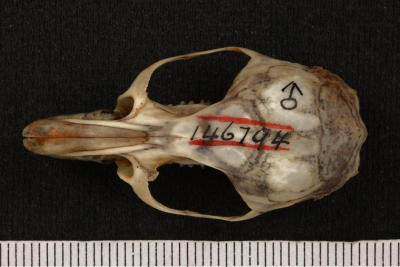
Holotype: USNM 146794. Neotoma bryanti bryanti. Adult male. La Laguna, Sierra de la Victoria, Baja California Sur, Mexico. Collected 27 January 1906. -

Holotype: USNM 146794. Neotoma bryanti bryanti. Adult male. La Laguna, Sierra de la Victoria, Baja California Sur, Mexico. Collected 27 January 1906. -

Holotype: USNM 146794. Neotoma bryanti bryanti. Adult male. La Laguna, Sierra de la Victoria, Baja California Sur, Mexico. Collected 27 January 1906. -

Holotype: USNM 146794. Neotoma bryanti bryanti. Adult male. La Laguna, Sierra de la Victoria, Baja California Sur, Mexico. Collected 27 January 1906. -
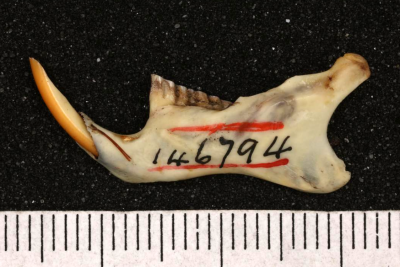
Holotype: USNM 146794. Neotoma bryanti bryanti. Adult male. La Laguna, Sierra de la Victoria, Baja California Sur, Mexico. Collected 27 January 1906. -

Holotype: USNM 146794. Neotoma bryanti bryanti. Adult male. Arrows point to the anteromedial flexus of the anteroloph of each upper molar (M1), which is deeply notched in all age classes except very old individuals (Patton et al., 2007).


Glans penis
From Patton et al. (2007): "Glans penis relatively thin with elongate baculum and hood, the latter with straight, tapered, and bifurcated tip."
Similar species
In the United States, Neotoma bryanti is sympatric or near-sympatric with the White-throated Woodrat (Neotoma albigula), Dusky-footed Woodrat (Neotoma fuscipes), Desert Woodrat (Neotoma lepida), and Big-eared Woodrat (Neotoma macrotis).
Comparison with Neotoma albigula
The White-throated Woodrat (Neotoma albigula) has hairs on the throat that are white to the base rather than plumbeous at the base as in Neotoma bryanti. In the White-throated Woodrat (Neotoma albigula), the anteromedial flexus of the anteroloph of each upper molar (M1), is shallow. In Neotoma bryanti, the anteromedial flexus of the anteroloph of each upper molar (M1), is deeply notched in all age classes except very old individuals (Patton et al., 2007).
-

White-throated Woodrat (Neotoma albigula) photographed by Rick Overson and Laura Steger in Arizona. -

Bryant's Woodrat (Neotoma bryanti) observed in Baja California Sur, Mexico, by Alan Harper. -

NEON0C8V8. White-throated Woodrat (Neotoma albigula). Adult male. Hairs on the throat are white to their bases. -
Bryant's Woodrat (Neotoma bryanti). Adult male. Hairs on the throat are plumbeous at the base. -

Holotype: USNM 186485. Neotoma albigula albigula. Adult. Upper molars. Arrows point to the anteromedial flexus of the anteroloph of each upper molar (M1), which is shallow. -
Holotype: USNM 146794. Neotoma bryanti bryanti. Adult male. Arrows point to the anteromedial flexus of the anteroloph of each upper molar (M1), which is deeply notched in all age classes except very old individuals (Patton et al., 2007).
Comparison with Neotoma devia and N. lepida
For differentiating Neotoma bryanti from other members of the Neotoma lepida group, see Key to the species in the desert woodrat group by Patton et al. (2007).
Comparison with Neotoma fuscipes
The Dusky-footed Woodrat (Neotoma fuscipes) can be separated from Neotoma bryanti by its grayish-brown dorsum and sooty-colored pelage on top of the hind feet (Howell, 1926; Jameson and Peeters, 1988; Carraway and Verts, 1991).
-
Bryant's Woodrat (Neotoma bryanti) observed in Baja California Sur, Mexico, by Alan Harper. -
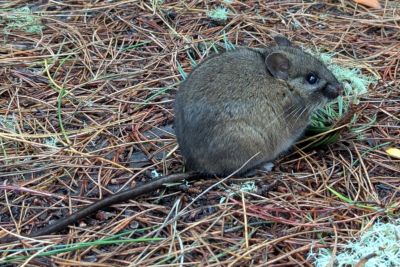
Dusky-footed Woodrat (Neotoma fuscipes) observed by Christian Naventi in Inverness, California. -

Arrows point to the top of the hind feet in the Bryant's Woodrat (Neotoma bryanti), which are white. -

Arrows point to the sooty-colored fur on the top of the hind feet in the Dusky-footed Woodrat (Neotoma fuscipes). -
Holotype: USNM 146794. Neotoma bryanti bryanti. Adult male. Arrows point to the anteromedial flexus of the anteroloph of each upper molar (M1), which is deeply notched in all age classes except very old individuals (Patton et al., 2007). -

Holotype: USNM 22026. Neotoma fuscipes fuscipes. Adult male. Upper molars. Arrows point to the anteromedial flexus of the anteroloph of each upper molar (M1), which is deeply notched.

Comparison with Neotoma macrotis
The Big-eared Woodrat (Neotoma macrotis) can be separated from Neotoma bryanti by the sooty-colored pelage on top of the hind feet. However, the degree to which the dorsal surface of the hind feet are covered in dark hairs appears to be variable.
References
Allen JA. 1898. Descriptions of new mammals from western Mexico and Lower California. Bulletin of the American Museum of Natural History 10:143-158.
Alvarez-Castañeda ST, Yensen E., 1999. Neotoma bryanti. Mammalian species (619): 1-3. https://doi.org/10.2307/3504345
Ceballos G, editor. 2014. Mammals of Mexico. Baltimore (MD, USA): Johns Hopkins University Press.
Goldman EA. 1910. Revision of the wood rats of the genus Neotoma. North American Fauna, 31:1-124.
Grinnell J, Swarth HS. 1913. An account of the birds and mammals of the San Jacinto area of southern California. University of California Publications in Zoology 10: 197-406.
Merriam CH. 1887. Description of a New Species of Wood-Rat from Cerros Island, Off Lower California. American Naturalist 21: 191.
Patton JL, Huckaby DG, Álvarez-Castañeda ST. 2007. The evolutionary history and a systematic revision of woodrats of the Neotoma lepida group (Vol. 135). Berkeley (CA, USA): University of California Press.