Sciurus aberti
| Abert's Squirrel
(Sciurus aberti) | |
|---|---|
| Range | |
 | |
| Taxonomic classification | |
| Order: | Rodentia |
| Suborder: | Sciuromorpha |
| Family: | Sciuridae |
| Subfamily: | Sciurinae |
| Tribe: | Sciurini |
| Genus: | Sciurus |
| Subgenus: | Hesperosciurus |
| Binomial details | |
| Sciurus aberti S. W. Woodhouse, 1853 | |
| Other resources | |
| Full taxonomic details at MDD | |
The Abert's Squirrel (Sciurus aberti) is a relatively large squirrel found in Ponderosa and yellow pine communities. Their long ears bear tassels or tufts that reach their maximum length in winter. In summer the tufts are reduced in size and may be completely absent.
Description
From Nash and Seaman (1977): "The long ears bear the tassels or tufts that give the species one of its vernacular names. The tassels may exceed 25 mm in length and reach their maximum length during the winter months. In summer the tufts are much reduced in size and may be completely absent. Keith (1965) studied the length of the ear tufts of Abert's squirrel in Arizona. Mean length was 0 to 5 mm from July through September; it increased rapidly to 25 mm in October, and then increase d gradually to a high of 40 mm in February and March. The tufts then decreased in size to 20 mm by June. Abert's squirrel is a relatively large squirrel and there appears to be no major difference in size between males and females... Abert's squirrel and its close relative, the Kaibab squirrel, have long and broad ears that bear pronounced tufts or tassels in the winter pelage. The tail is short and unusually broad. The upper parts, including the tail, are mainly gray and the underparts are white (in the Kaibab squirrel the tail is white above and below and the underparts are dark gray to black). The lateral line is usually black and distinct."


Museum type specimens
-

Holotype: USNM 70908. Sciurus aberti ferreus. Adult female. Hall Peak, at south end of Cimarron Mountains, Mora County, New Mexico. Collected 16 January 1895. Dorsal view. -

Holotype: USNM 70908. Sciurus aberti ferreus. Adult female. Hall Peak, at south end of Cimarron Mountains, Mora County, New Mexico. Collected 16 January 1895. Ventral view -

Holotype: USNM 70908. Sciurus aberti ferreus. Adult female. Hall Peak, at south end of Cimarron Mountains, Mora County, New Mexico. Collected 16 January 1895. Lateral view.


External measurements
Length measurements are in millimeters (mm) and weight measurements are in grams (g), unless stated otherwise. If available, the sample size (n=) is provided. If a range is not provided and n= is not given, then the listed measurement represents an average.
| Part of range | Reference | Total length | Tail length | Hindfoot length | Ear length | Mass |
|---|---|---|---|---|---|---|
| Arizona (central Mogollon Plateau) | Hoffmeister (1986) | 457–520 (n=46) | 200–249 (n=46) | 68–77 (n=46) | ||
| Arizona (Kaibab Plateau) | Hoffmeister (1986) | 485–570 (n=16) | 180–240 (n=16) | 67–78 (n=16) | ||
| Arizona (White Mtns.) | Hoffmeister (1986) | 457–515 (n=18) | 183–235 (n=18) | 66–74 (n=18) | ||
| AZ and NM (Chuska Mtns.) | Hoffmeister (1986) | 463–530 (n=11) | 199–255 (n=11) | 70–78 (n=11) | ||
| Colorado | Armstrong et al. (2010) | 450–580 | 200–300 | 65–75 | 35–45 | 550–750 |
Geographic variation
From Nash and Seaman (1977): "It presents an outstanding example of coat color polymorphism. The polymorphism appears limited to the northcentral part of Colorado and is confined to the subspecies Sciurus aberti ferreus (Ramey and Nash, 1971). Early biologists, including Warren (1910) typically identified three color phases: gray, brown, and black. However, more recent studies indicate that coat color exhibits a continuous variation as far as the intensity of brown is concerned (Ramey, 1972). Study of coat color polymorphism by Ramey utilized the presence or absence of the so-called agouti phase, which may be recognized from the characteristic banded pattern. The agouti category included specimens previously described as gray and the nonagouti category contained the melanistic squirrels, including the brown and black phases. The frequency of melanistic animals was 67.5% in north-central Colorado and approached 100% in the Black Forest region east of Colorado Springs. Ramey and Nash (1976b) found that the polymorphism seemed to be a balanced one as frequencies of the color phases have been fairly stable since the turn of the century. Frequencies of morphs revealed no obvious associations with elevation, temperature, humidity, or data on evaporation or freezing... Occurrence of coat color polymorphism in states other than Colorado has been reported, but it has not been studied in any depth. Ligon (1927) reported that approximately 85% of the San Mateo Mountains population was in the black phase. Findley et al. (1975) noted that on certain mountain ranges in New Mexico many individuals are black-bellied and that most of the squirrels in the Sandia and Manzano mountains are black-bellied, but they did not give specific data on frequencies."
This section shows some of the color variation present in Sciurus aberti. The location is provided for reference only. The individual shown does not necessarily represent the only color variant within the local population.
-

Sciurus aberti observed by Marleigh Fletcher in Pima County, Arizona. -
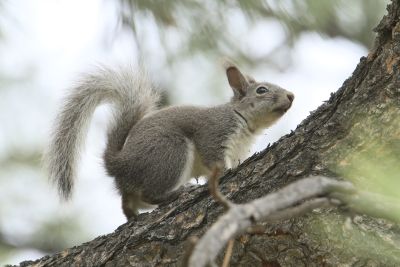
Sciurus aberti observed by M.L. Watson in Saguache County, Colorado. -
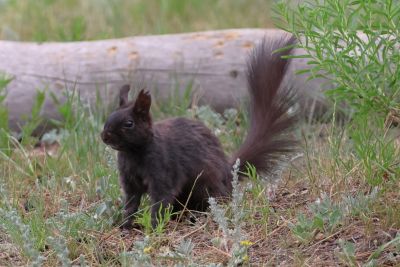
Sciurus aberti observed by Mike Masse in Larimer County, Colorado. -

Sciurus aberti observed by willem9 in Boulder County, Colorado. -

Sciurus aberti observed by Caleb Stroh in San Juan County, Utah. -

Sciurus aberti observed by Cathy Pasterczyk in Bernalillo County, New Mexico. -

Sciurus aberti observed by Patrick Coin in Sandia Park, Bernalillo County, New Mexico. -

Sciurus aberti observed by savvy2birding on Mount Lemmon, Pima County, Arizona. -
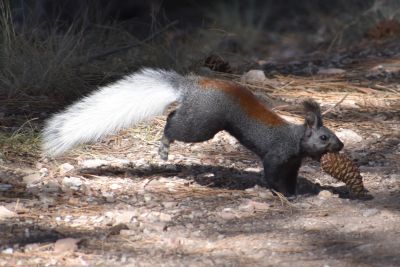
Sciurus aberti observed by Peter Jessen on the north rim of the Grand Canyon, Arizona.


Skull
-

Holotype: USNM 70908. Sciurus aberti ferreus. Adult female. Hall Peak, at south end of Cimarron Mountains, Mora County, New Mexico. Collected 16 January 1895. Dorsal view of the skull. -

Holotype: USNM 70908. Sciurus aberti ferreus. Adult female. Hall Peak, at south end of Cimarron Mountains, Mora County, New Mexico. Collected 16 January 1895. Ventral view of the skull. -

Holotype: USNM 70908. Sciurus aberti ferreus. Adult female. Hall Peak, at south end of Cimarron Mountains, Mora County, New Mexico. Collected 16 January 1895. Lateral view of the skull. -

Holotype: USNM 70908. Sciurus aberti ferreus. Adult female. Hall Peak, at south end of Cimarron Mountains, Mora County, New Mexico. Collected 16 January 1895. Dorsal view of the mandible. -

Holotype: USNM 70908. Sciurus aberti ferreus. Adult female. Hall Peak, at south end of Cimarron Mountains, Mora County, New Mexico. Collected 16 January 1895. Lateral view of the left mandible.


Similar species
Comparison with Sciurus arizonensis
From Best and Riedel (1995): "Sciurus arizonensis may be sympatric with S. aberti (Hall, 1981). Compared with S. aberti, the skull of S. arizonensis is longer, flatter, the rostrum is broader, the auditory bullae are less inflated, and S. arizonensis has one upper premolar rather than two. In addition, S. arizonensis has smaller ears, no ear tufts, the underside of the tail has a central stripe of reddish brown and black, and the sides do not have a black stripe between the gray sides and the white underparts (Hoffmeister, 1986)."
-

Arizona Gray Squirrel (Sciurus arizonensis) observed by Andrew McKinlay in Camp Verde, Arizona. Notice that the underside of the tail has a central stripe of reddish brown. -

Abert's Squirrel (Sciurus aberti) observed by Joel Gilb in Reserve, New Mexico. Notice that the underside of the tail is whittish. -

Arizona Gray Squirrel (Sciurus arizonensis) observed by ronthill in Sierra Vista, Arizona. Notice the ears are short and the sides lack a black stripe between the gray sides and the white underparts. -

Abert's Squirrel (Sciurus aberti) observed by Marleigh Fletcher in Summerhaven, Arizona. A summer individual without ear tufts is shown for easier comparison of the ears. Notice the long ears and the black stripe between the gray sides and the white underparts. -
Abert's Squirrel (Sciurus aberti) observed by Marleigh Fletcher in Pima County, Arizona. Individual shown was oberved in late spring and the ear tufts are present but reduced. Notice the black stripe between the gray sides and the white underparts, and the whittish underside of the tail. -
Abert's Squirrel (Sciurus aberti) observed by savvy2birding on Mount Lemmon, Pima County, Arizona. This individual was photographed in the spring and has long ear tufts.


References
Armstrong DM, Fitzgerald JP, Meaney CA. 2010. Mammals of Colorado, Second Edition. Denver (CO, USA): University Press of Colorado.
Best TL, Riedel S. 1995. Sciurus arizonensis. Mammalian Species (496):1-5. https://doi-org.ezproxy1.lib.asu.edu/10.1644/0.496.1
Hall ER. 1981. The mammals of North America. 2 vols. John Wiley and Sons, New York.
Hoffmeister DF. 1986. Mammals of Arizona. Tucson (AZ, USA): University of Arizona Press.
Nash DJ, Seaman RN. 1977. Sciurus aberti. Mammalian Species (80):1-5. https://doi.org/10.2307/3503958