Sciurus nayaritensis
| Mexican Fox Squirrel
(Sciurus nayaritensis) | |
|---|---|
| Range | |
 | |
| Taxonomic classification | |
| Order: | Rodentia |
| Suborder: | Sciuromorpha |
| Family: | Sciuridae |
| Subfamily: | Sciurinae |
| Tribe: | Sciurini |
| Genus: | Sciurus |
| Subgenus: | Parasciurus |
| Binomial details | |
| Sciurus nayaritensis J. A. Allen, 1890 | |
| Other resources | |
| Full taxonomic details at MDD | |


Museum type specimens
-

Holotype: AMNH MO-1254, AMNH MS-1985. Sciurus nayaritensis. Male. Valparaiso, Zacatecas, Mexico. Collected 24 July 1889. Dorsal view. -

Holotype: AMNH MO-1254, AMNH MS-1985. Sciurus nayaritensis. Male. Valparaiso, Zacatecas, Mexico. Collected 24 July 1889. Ventral view. -

Holotype: USNM 244124. Sciurus nayaritensis chiricahuae. Adult female. Cave Creek, Chiricahua Mountains, Cochise County, Arizona. Collected 16 August 1923. -

Holotype: USNM 244124. Sciurus nayaritensis chiricahuae. Adult female. Cave Creek, Chiricahua Mountains, Cochise County, Arizona. Collected 16 August 1923.


External measurements
Length measurements are in millimeters (mm) and weight measurements are in grams (g), unless stated otherwise. If available, the sample size (n=) is provided. If a range is not provided and n= is not given, then the listed measurement represents an average.
| Part of range | Reference | Total length | Tail length | Hindfoot length | Ear length | Mass |
|---|---|---|---|---|---|---|
| Arizona (Chiricahua Mtns.) | Hoffmeister (1986) | 510–582 (n=19) | 250–281 (n=19) | 66–80 (n=19) |
Skull
-

Holotype: AMNH MO-1254, AMNH MS-1985. Sciurus nayaritensis. Male. Valparaiso, Zacatecas, Mexico. Collected 24 July 1889. Dorsal view of the skull. -

Holotype: AMNH MO-1254, AMNH MS-1985. Sciurus nayaritensis. Male. Valparaiso, Zacatecas, Mexico. Collected 24 July 1889. Ventral view of the skull. -
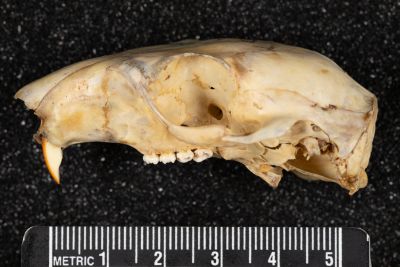
Holotype: AMNH MO-1254, AMNH MS-1985. Sciurus nayaritensis. Male. Valparaiso, Zacatecas, Mexico. Collected 24 July 1889. Lateral view of the skull. -
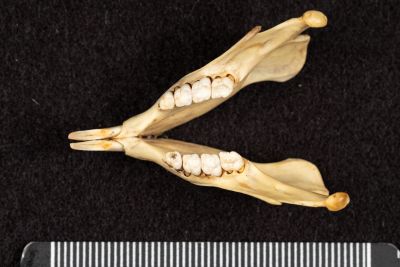
Holotype: AMNH MO-1254, AMNH MS-1985. Sciurus nayaritensis. Male. Valparaiso, Zacatecas, Mexico. Collected 24 July 1889. Dorsal view of the mandible. -

Holotype: AMNH MO-1254, AMNH MS-1985. Sciurus nayaritensis. Male. Valparaiso, Zacatecas, Mexico. Collected 24 July 1889. Lateral view of the left mandible. -
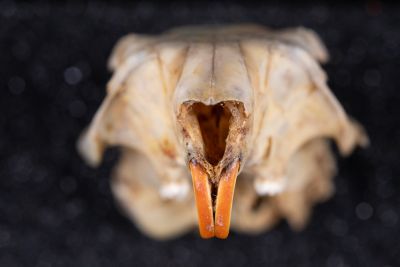
Holotype: AMNH MO-1254, AMNH MS-1985. Sciurus nayaritensis. Male. Valparaiso, Zacatecas, Mexico. Collected 24 July 1889. Upper incisors. -

Holotype: USNM 244124. Sciurus nayaritensis chiricahuae. Adult female. Cave Creek, Chiricahua Mountains, Cochise County, Arizona. Collected 16 August 1923. Dorsal view of the skull. -

Holotype: USNM 244124. Sciurus nayaritensis chiricahuae. Adult female. Cave Creek, Chiricahua Mountains, Cochise County, Arizona. Collected 16 August 1923. Ventral view of the skull. -

Holotype: USNM 244124. Sciurus nayaritensis chiricahuae. Adult female. Cave Creek, Chiricahua Mountains, Cochise County, Arizona. Collected 16 August 1923. Lateral view of the skull. -

Holotype: USNM 244124. Sciurus nayaritensis chiricahuae. Adult female. Cave Creek, Chiricahua Mountains, Cochise County, Arizona. Collected 16 August 1923. Dorsal view of the mandible. -

Holotype: USNM 244124. Sciurus nayaritensis chiricahuae. Adult female. Cave Creek, Chiricahua Mountains, Cochise County, Arizona. Collected 16 August 1923. Lateral view of the left mandible.


Similar species
Comparison with Sciurus arizonensis
From Best and Riedel (1995): "The ranges of S. nayaritensis and S. arizonensis approach each other in Arizona and Sonora (Hall, 1981). The skull of S. arizonensis is nearly indistinguishable from that of S. nayaritensis, and external and most cranial measurements of the two species are almost identical. Thus, these taxa may be conspecific, but there is a marked difference in color, and certain cranial features are useful in distinguishing the two. Compared with S. nayaritensis, the underparts of S. arizonensis are whitish rather than orangeish, the legs and feet are brownish interspersed with white and tan rather than reddish or ochraceous, and the tail is bordered with white rather than tan or yellow. Although color varies considerably throughout the range of S. nayaritensis, the variation is not as great as that between S. arizonensis and S. nayaritensis in Arizona. S. arizonensis has a narrower rostrum as measured across its base at the maxillary-premaxillary sutures than S. nayaritensis (usually < 14.6 mm in S. arizonensis and > 15.0 in S. nayaritensis). The distance between the infraorbital canals usually is ≤ 13.4 mm in S. arizonensis and ≥ 13.4 mm in S. nayaritensis. In S. arizonensis, the cranium is shallower between the orbits and the maxillary toothrow; all ≤ 21.5 mm in S. arizonensis, whereas most S. nayaritensis are > 21.5 mm. Discriminant function analysis produced a complete separation of these two species (Hoffmeister, 1986)."
-

ASUMAC009053. Mexican Fox Squirrel (Sciurus nayaritensis) -

ASUMAC009032. Arizona Gray Squirrel (Sciurus arizonensis)

References
Best TL, Riedel S. 1995. Sciurus arizonensis. Mammalian Species (496):1-5. https://doi-org.ezproxy1.lib.asu.edu/10.1644/0.496.1
Hall ER. 1981. The mammals of North America. 2 vols. John Wiley and Sons, New York.
Hoffmeister DF. 1986. Mammals of Arizona. Tucson (AZ, USA): University of Arizona Press.