Sigmodon fulviventer
| Tawny-bellied Cotton Rat
(Sigmodon fulviventer) | |
|---|---|
| Range | |
 | |
| Taxonomic classification | |
| Order: | Rodentia |
| Suborder: | Supramyomorpha |
| Infraorder: | Myomorphi |
| Superfamily: | Muroidea |
| Family: | Cricetidae |
| Subfamily: | Sigmodontinae |
| Tribe: | Sigmodontini |
| Genus: | Sigmodon |
| Binomial details | |
| Sigmodon fulviventer J. A. Allen, 1889 | |
| Other resources | |
| Full taxonomic details at MDD | |
The Tawny-bellied Cotton Rat (Sigmodon fulviventer) is a cotton rat of mesquite-grasslands and other grass-shrub communities in the Chihuahuan Desert (Wilson et al., 2017 accessed via GBIF).
Description
Hoffmeister (1986): A Sigmodon of small to medium size; underparts brownish, buffy, or fulvous, extending from throat to anus; tail blackish all around, sometimes slightly lighter below than above; upper parts with a "salt-and-pepper" or speckled appearance; antiplantar surface (top) of feet buffy; hind foot and ear short; skull of medium-size.
From Schmidley & Bradley (2016): A small to medium-sized cotton rat with brownish, buff brown, or fulvous underparts from throat to anus. Dorsal coloration is light brown, heavily speckled with dark brown to black, giving a salt-and-pepper or hispid appearance. The tail is uniformly blackish, and the tops of the feet are buff brown.


Museum type specimens
-
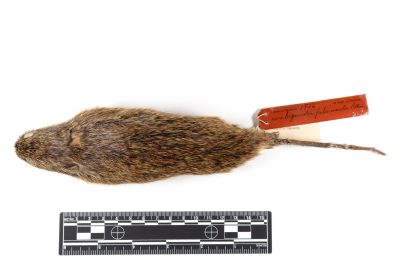
Holotype: AMNH MO-1244, AMNH MS-1975. Sigmodon fulviventer. Male. Zacatecas, Mexico. Collected 18 August 1889. Dorsal view. -
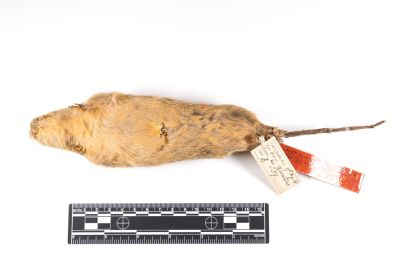
Holotype: AMNH MO-1244, AMNH MS-1975. Sigmodon fulviventer. Male. Zacatecas, Mexico. Collected 18 August 1889. Ventral view. -

Holotype: USNM 266327. Sigmodon fulviventer minimus. Adult male. East side of the Rio Grande River], near Bernardo, Socorro County, New Mexico. Collected 1 December 1940. Dorsal view of the skin. -

Holotype: USNM 266327. Sigmodon fulviventer minimus. Adult male. East side of the Rio Grande River], near Bernardo, Socorro County, New Mexico. Collected 1 December 1940. Ventral view of the skin. -

Holotype: USNM 167625. Sigmodon fulviventer goldmani. Young adult female. Sierra County, New Mexico. Collected 28 October 1909. Dorsal view of the skin. -

Holotype: USNM 167625. Sigmodon fulviventer goldmani. Young adult female. Sierra County, New Mexico. Collected 28 October 1909. Ventral view of the skin.


External measurements
Length measurements are in millimeters (mm) and weight measurements are in grams (g), unless stated otherwise. If available, the sample size (n=) is provided. If a range is not provided and n= is not given, then the listed measurement represents an average.
| Part of range | Reference | Total length | Tail length | Hindfoot length | Ear length | Mass |
|---|---|---|---|---|---|---|
| Arizona (Cochise, so. Graham, so. Greenlee, eastern Santa Cruz cos.) | Hoffmeister (1986) | males: 198–265 (n=9); females: 200–274 (n=11) | males: 85–115 (n=9); females: 83–125 (n=11) | males: 26–33 (n=9); females: 28–33 (n=11) | males: 16–18 (n=9); females: 15–21 (n=11) | |
| not reported | Ceballos (editor, 2014) | 216–278 | 101–118 | 26–31 | 19–23 | 82–136 |
| Texas (Fort Davis [holotype]) | Schmidly & Bradley (2016) | 242 | 90 | 28 | 18 |
Skull
From Baker and Shump (1978): "Distinctive cranial characters include: anterior end of mesopterygoid fossa narrow; foramen ovale large (≥ three-fourths width M3); palatal pits markedly deep; and median keel on palate well developed."
-

Holotype: AMNH MO-1244, AMNH MS-1975. Sigmodon fulviventer. Male. Zacatecas, Mexico. Collected 18 August 1889. Dorsal view of the skull. -

Holotype: AMNH MO-1244, AMNH MS-1975. Sigmodon fulviventer. Male. Zacatecas, Mexico. Collected 18 August 1889. Ventral view of the skull. The back of the skull is damaged. -

Holotype: USNM 266327. Sigmodon fulviventer minimus. Adult male. East side of the Rio Grande River], near Bernardo, Socorro County, New Mexico. Collected 1 December 1940. Dorsal view of the skull. -

Holotype: USNM 266327. Sigmodon fulviventer minimus. Adult male. East side of the Rio Grande River], near Bernardo, Socorro County, New Mexico. Collected 1 December 1940. Ventral view of the skull. -

Holotype: USNM 266327. Sigmodon fulviventer minimus. Adult male. East side of the Rio Grande River], near Bernardo, Socorro County, New Mexico. Collected 1 December 1940. Lateral view of the skull. -

Holotype: USNM 266327. Sigmodon fulviventer minimus. Adult male. East side of the Rio Grande River], near Bernardo, Socorro County, New Mexico. Collected 1 December 1940. Dorsal view of the mandible. The posterior-ventral portion of both mandibles broken. -

Holotype: USNM 266327. Sigmodon fulviventer minimus. Adult male. East side of the Rio Grande River], near Bernardo, Socorro County, New Mexico. Collected 1 December 1940. Lateral view of the left mandible. The posterior-ventral portion of the mandible is broken. -

Holotype: USNM 266327. Sigmodon fulviventer minimus. Adult male. Upper molars. -

Holotype: USNM 266327. Sigmodon fulviventer minimus. Adult male. Lower molars.


Similar species
Hoffmeister (1986): S. fulviventer differs from S. ochrognathus as follows: underparts brownish, buffy, or fulvous rather than whitish; dorsum speckled or "salt and peppery"; tops of feet buffy; tail blackish or nearly so all around. S. hispidus differs from S. fulviventer as follows: underparts silvery or grayish rather than buffy or fulvous; tail bicolored, lighter below than above; tops of hind feet silvery or grayish rather than buffy; hind feet an deasrs averaging longer; preoptic foramen usually absent; nasals usually truncate or notched rather than tapered posteriorly. S. fulviventer differs from S. arizonae in much the same way that S. hispidus does, but in addition the tail is shorter; skulls averages smaller in all measurements except length of palatine foramina and width of rostrum.
From Schmidley & Bradley (2016): From the yellow-nosed cotton rat (S. ochrognathus), S. fulviventer differs in having a rich buffy ventral coloration rather than whitish, a more heavily speckled dorsal coloration, buff-colored tops to the feet rather than grayish, and a uniformly dark-colored tail. Also, S. fulviventer lacks the tawny-colored nose of S. ochrognathus. The hispid cotton rat (S. hispidus) differs from S. fulviventer in having gray or whitish underparts, a bicolored tail that is lighter below than above, grayish tops of the feet, and slightly larger ears and hind feet.
-

Arizona Cotton Rat (Sigmodon arizonae) photographed by Gordon Karre in Gilbert, Arizona. Sigmodon hispidus and Sigmodon arizonae look superficially similar but their ranges are mostly non-overlapping. -

Tawny-bellied Cotton Rat (Sigmodon fulviventer) observed by Ricardo Arredondo T. in Coeneo, Michoacán, México. Sigmodon fulviventer has underparts that are distinctly brownish, buffy, or fulvous, extending from throat to anus. -

Hispid Cotton Rat (Sigmodon hispidus) observed by Bob Oswald in Gainesville, Florida. Sigmodon hispidus and Sigmodon arizonae look superficially similar but their ranges are mostly non-overlapping. -

Yellow-nosed Cotton Rat (Sigmodon ochrognathus) observed by Randy Babb. Sigmodon ochrognathus has a conspicuous "yellow" nose.
References
Allen JA. 1889. Notes on a collection of mammals from Southern Mexico, with descriptions of new species of the genera Sciurus, Tamias, and Sigmodon'. Bulletin of the American Museum of Natural History 2, 180.
Baker RH, Shump KA. 1978. Sigmodon fulviventer. Mammalian Species (94):1-4. https://doi.org/10.2307/3503788
Ceballos G, editor. 2014. Mammals of Mexico. Baltimore (MD, USA): Johns Hopkins University Press.
Hoffmeister DF. 1986. Mammals of Arizona. Tucson (AZ, USA): University of Arizona Press.
Schmidly DJ, Bradley RD. 2016. The mammals of Texas. Austin (TX, USA): University of Texas Press.
Sigmodon fulviventer J.A.Allen, 1889 in Don E. Wilson, Russell A. Mittermeier, Thomas E. Lacher J, carolina (2017). Cricetidae. Plazi.org taxonomic treatments database. Checklist dataset https://doi.org/10.15468/r73nyr accessed via GBIF.org on 2025-09-20.