Zapus trinotatus
| Northern Pacific Jumping Mouse
(Zapus trinotatus) | |
|---|---|
| Range | |
 | |
| Taxonomic classification | |
| Order: | Rodentia |
| Suborder: | Supramyomorpha |
| Infraorder: | Myomorphi |
| Superfamily: | Dipodoidea |
| Family: | Zapodidae |
| Genus: | Zapus |
| Binomial details | |
| Zapus trinotatus Rhoads, 1895 | |
| Other resources | |
| Full taxonomic details at MDD | |
Recently, molecular studies have found that the taxonomy and species delineations within Zapus are complex (Malaney et al., 2013; Malaney et al., 2017). Malaney et al. (2017) recognized 9 species within Zapus, elevating some of the subspecies in Krutzsch's (1954) revision of jumping mice to species status. Genetic approaches by Malaney et al. (2017) supported retaining only part of Zapus trinotatus trinotatus in this taxon. Subspecies no longer included in this taxon according to Malaney et al. (2017) are Zapus trinotatus eureka, Zapus trinotatus montanus, Zapus trinotatus orarius, and part of Zapus trinotatus trinotatus. The work of Malaney et al. (2017) has importantly exposed cryptic diversity and putative new species within Zapus. Further studies will be needed to fully understand new species boundaries and morphological variation.
Description
A formal species description for Zapus trinotatus currently does not exist. The following description from Krutzsch (1954) is provided for the subspecies that Malaney et al. (2017) retained under this taxon.
From Krutzsch (1954) for Zapus trinotatus trinotatus: "Size large; back from near Ochraceous-Buff to near Tawny with admixture of black hair forming broad dorsal band; sides lighter than back from near Ochraceous-Buff to near Tawny; lateral line usually distinct; belly white, sometimes with faint suffusion of ochraceous on lower throat and upper chest; tail bicolored, brown above, white to yellowish-white below; ears dark, sometimes flecked with color of sides, edged with ochraceous; feet grayish-white above; palatal bridge relatively short; incisive foramina relatively long; condylobasal region long; zygomatic width great; braincase relatively broad; distance from incisors to postpalatal notch relatively great."


Museum specimens
-

Holotype: ANSP 7360. Zapus trinotatus. Male. Lulu Island mouth of Frazer River, British Columbia, Canada. Collected 31 May 1892. -

Holotype: ANSP 7360. Zapus trinotatus. Male. Lulu Island mouth of Frazer River, British Columbia, Canada. Collected 31 May 1892.


External measurements
Length measurements are in millimeters (mm) and weight measurements are in grams (g), unless stated otherwise. If available, the sample size (n=) is provided. If a range is not provided and n= is not given, then the listed measurement represents an average.
| Part of range | Reference | Total length | Tail length | Hindfoot length | Ear length | Mass |
|---|---|---|---|---|---|---|
| not reported | Hall (1981), Maser et al. (1981), and (Krutzch (1954); compiled by Gannon (1988) | 221–242 | 112–155 | 30–36 | 14–16 | 27.5 |
| Washington (Lake Cushman) | Preble (1899) | 239.5 (n=10) | 144.5 (n=10) | 32.5 (n=10) | ||
| Washington (Lake Washington) | Preble (1899) | 240 (n=4) | 147.5 (n=4) | 34.2 (n=4) | ||
| Washington (Neah Bay) | Preble (1899) | 248 (n=4) | 153 (n=4) | 33.5 (n=4) |
Skull
From Jones (1981): "paracone in the M1 and M2 is isolated."
-

Holotype: ANSP 7360. Zapus trinotatus. Male. Lulu Island mouth of Frazer River, British Columbia, Canada. Collected 31 May 1892. Dorsal view of the skull. -

Holotype: ANSP 7360. Zapus trinotatus. Male. Lulu Island mouth of Frazer River, British Columbia, Canada. Collected 31 May 1892. Ventral view of the skull. -

Holotype: ANSP 7360. Zapus trinotatus. Male. Lulu Island mouth of Frazer River, British Columbia, Canada. Collected 31 May 1892. Lateral view of the skull. -

Holotype: ANSP 7360. Zapus trinotatus. Male. Lulu Island mouth of Frazer River, British Columbia, Canada. Collected 31 May 1892. Dorsal view of the mandible. -

Holotype: ANSP 7360. Zapus trinotatus. Male. Lulu Island mouth of Frazer River, British Columbia, Canada. Collected 31 May 1892. Lateral view of the left mandible. -

Holotype: ANSP 7360. Zapus trinotatus. Arrows point to the paracone in the first upper molar (M1) and second upper molar (M2), which is isolated and not attached to the body of the tooth.


Taxonomic notes
Recently, molecular studies have found that the taxonomy and species delineations within Zapus are complex (Malaney et al., 2013, Malaney et al., 2017). Malaney et al. (2017) recognized 9 species within Zapus, elevating some of the subspecies in Krutzsch's (1954) revision of jumping mice to species status. Genetic approaches by Malaney et al. (2017) supported retaining only part of Zapus trinotatus trinotatus in Zapus trinotatus. Subspecies no longer included in this taxon according to Malaney et al. (2017) are Z. trinotatus eureka, Z. trinotatus montanus, Z. trinotatus orarius, and part of Z. trinotatus trinotatus. The work of Malaney et al. (2017) has importantly exposed cryptic diversity and putative new species within Zapus. Further studies will be needed to fully understand new species boundaries and morphological variation.
-

Zapus trinotatus subspecies boundaries as defined by Krutzsch (1954). -

Dark area represents the distribution of Zapus trinotatus based on genetic analyses and niche-based geographic distribution modeling by Malaney et al. (2017). Lightly shaded area represents the range based on Krutzsch (1954).

Similar species
Where Zapus trinotatus is sympatric with the Northwestern Jumping Mouse (Zapus saltator), it may be possible to differentiate these species based on size, color of the ear fringe, and shape of the M1 and M2 (upper molars).
-

Northern Pacific Jumping Mouse (Zapus trinotatus) -

Northwestern Jumping Mouse (Zapus saltator)
-

Area of sympatry for Z. trinotatus and Z. saltator

After reviewing Krutzsch (1954) and Malaney et al. (2017), it appears that the color of the ear fringe is useful for distinguishing Zapus trinotatus from the Northwestern Jumping Mouse (Zapus saltator). The ears of Z. trinotatus are dark and narrowly edged with color of sides or edged with ochraceous, while the ears of Z. saltator are dark and edged with white or yellowish-white. Under Malaney et al.'s (2017) proposed species boundaries, it appears that the ear fringe character is useful for distinguishing Z. saltator from Z. trinotatus. See the Taxonomic notes section under Zapus for how the ear fringe character noted by Krutzsch (1954) was evaluated and applied to Malaney et al.'s (2017) species delimitations.
-

Northwestern Jumping Mouse (Zapus saltator) ears are dark and edged with white or yellowish-white. -

Northern Pacific Jumping Mouse (Zapus trinotatus) lack white fringes on the ears.

Jones (1981) noted that the shape and attachment of the paracone to the M1 and M2 (upper molars) was helpful for differentiating species of Zapus. Using Malaney et al. (2017) delimitations, we find that for Z. trinotatus the paracone in the M1 and M2 is isolated, while the paracone in the M1 and M2 is attached to the body of the tooth in Z. saltator. See the Taxonomic notes section under Zapus for how the M1 and M2 characters noted by Jones (1981) were evaluated and applied to Malaney et al.'s (2017) species delimitations.
-
Holotype: ANSP 7360. Northern Pacific Jumping Mouse (Zapus trinotatus). Arrows point to the paracone in the first upper molar (M1) and second upper molar (M2), which is isolated and not attached to the body of the tooth. -
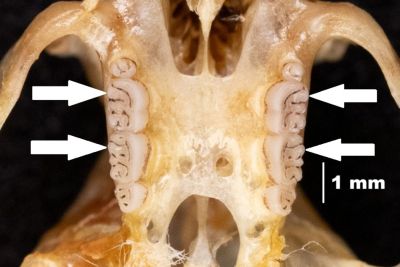
NEON0D0XP. Northwestern Jumping Mouse (Zapus saltator). Upper molars. Arrows point to the paracone in the first upper molar (M1) and second upper molar (M2), which is attached to the body of the tooth.

References
Gannon WL. 1988. Zapus trinotatus. Mammalian Species (315): 1-5.
Hall ER. 1981. The mammals of North America. 2 vols. John Wiley and Sons, New York.
Jones GS. 1981. The systematics and biology of the genus Zapus (Mammalia, Rodentia, Zapodidae)(Canada, United States) (Doctoral dissertation, Indiana State University).
Krutzsch PH. 1954. North American jumping mice (genus Zapus). University of Kansas Publications, Museum of Natural History 7:349-472. Link.
Malaney JL, Conroy CJ, Moffitt LA, Spoonhunter HD, Patton JL, Cook JA. 2013. Phylogeography of the western jumping mouse (Zapus princeps) detects deep and persistent allopatry with expansion. Journal of Mammalogy 94(5): 1016-1029.
Malaney JL, Demboski JR, Cook JA. 2017. Integrative species delimitation of the widespread North American jumping mice (Zapodinae). Molecular Phylogenetics and Evolution 114: 137-152.
Maser C, Mate BR, Franklin JF, Dyrness CT. 1981. Natural history of Oregon coast mammals. U.S. Dept. Agric., Forest Serv., Gen. Tech. Rept., PNW-133:1-496.
Preble EA. 1899-08-08. Revision of the jumping mice of the genus Zapus. North American Fauna 15:1-44.
Rhoads SN. 1895-01-15. A new jumping mouse from the Pacific slope. Proceedings of the Academy of Natural Sciences of Philadelphia 46:421-422.