Urocitellus richardsonii
| Richardson's Ground Squirrel
(Urocitellus richardsonii) | |
|---|---|
| Range | |
 | |
| Taxonomic classification | |
| Order: | Rodentia |
| Suborder: | Sciuromorpha |
| Family: | Sciuridae |
| Subfamily: | Xerinae |
| Tribe: | Marmotini |
| Genus: | Urocitellus |
| Binomial details | |
| Urocitellus richardsonii (Sabine, 1822) | |
| Other resources | |
| Full taxonomic details at MDD | |
The Richardson's Ground Squirrel (Urocitellus richardsonii) is a ground squirrel that occupies the northern grasslands of North America. It can also be found in pastures and croplands.
Description
Michener and Koeppl (1985): "richardsonii is a stoutbodied, semi-fossorial species, with relatively short but dense pelage. The upperparts are pinkish buff or cinnamon buff shaded with fuscous, with the posterior part of the back showing a dappled effect (Howell, 1938). The eye ring is light buff, and the sides of the head and neck and the fronts of the forelegs are cinnamon buff or clay. The tail is fuscous black above, cinnamon buff or clay below, and edged with pinkish buff."


External measurements
Length measurements are in millimeters (mm) and weight measurements are in grams (g), unless stated otherwise. If available, the sample size (n=) is provided. If a range is not provided and n= is not given, then the listed measurement represents an average.
| Part of range | Reference | Total length | Tail length | Hindfoot length | Ear length | Mass |
|---|---|---|---|---|---|---|
| Minnesota | Hazard (1982) | 286–330 | 66–84 | 41–47 | 9–15 | 249.3–397.7 |
| North Dakota | Seabloom et al. (2020) | 285 | 74 | 45 | 12 | emergent males: 371; emergent females: 233; immergent male 396; immergent female 372 |
Skull

Similar species
The range of Urocitellus richardsonii overlaps with that of Uinta Ground Squirrel (Urocitellus armatus), Columbian Ground Squirrel (Urocitellus columbianus), and Wyoming Ground Squirrel (Urocitellus elegans).
Comparison with Urocitellus armatus
Michener and Koeppl (1985): "differs from armatus by lacking gray coloration on the underside of the tail." Additionally, the sides of the head and neck and the fronts of the forelegs are cinnamon buff or clay in the Urocitellus richardsonii, whereas in U. armatus the sides of head and neck are a pale smoke-gray (Michener and Koeppl, 1985; Eshelman and Sonnemann, 2000).
| Species | Subgroup | Total length | Greatest length of skull | Measurement reference |
|---|---|---|---|---|
| Urocitellus armatus | big-eared | 280–303 mm | 45.6–48.5 mm | Eshelman and Sonnemann (2000) |
| Urocitellus richardsonii | big-eared | 277–330 mm | 45.1–48.4 mm | Michener and Koeppl (1985); Hazard (1982) |
-

Uinta Ground Squirrel (Urocitellus armatus) photographed by pirish761 in Yellowstone National Park, Wyoming. This is a big-eared species recognized by a crown sprinkled with gray and by cinnamon coloring on its head, front of face, and ears. Forelegs are cinnamon buff with pinkish shading towards forefeet. -

Richardson's Ground Squirrel (Urocitellus richardsonii) photographed by Pia Odgaard in Alberta, Canada. This is a big-eared species with upperparts that are pinkish buff or cinnamon buff shaded with fuscous and the posterior part of the back showing a dappled effect. The sides of the head and neck and the fronts of the forelegs are cinnamon buff or clay colored. -
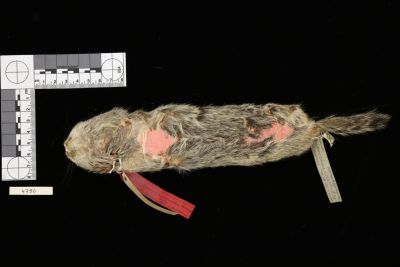
Syntype: MCZ:Mamm:4790. Urocitellus armatus. Female. Near Fort Bridger, foothills of Uinta Mountains, Camp Scott, Uinta County, Wyoming. Collected 26 May 1858.

Comparison with Urocitellus columbianus
From Elliott and Flinders (1991): "columbianus differs from other species by having buffy dorsal spots and hind feet longer than 43 mm. The skull resembles that of richardsonii, but is longer, the zygomatic arches are less expanded posteriorly, it is more nearly flat in dorsal outline, the supraorbital margins of frontals are not elevated or thickened, the rostrum and nasals are longer, and the upper toothrows are nearly parallel (Hall, 1981)."
| Species | Subgroup | Total length | Greatest length of skull | Measurement reference |
|---|---|---|---|---|
| Urocitellus columbianus | big-eared | 325–410 mm | 51.7 mm (ssp. ruficaudus) | Elliot and Flinders (1991) |
| Urocitellus richardsonii | big-eared | 277–330 mm | 45.1–48.4 mm | Michener and Koeppl (1985); Hazard (1982) |
-

Columbian Ground Squirrel (Urocitellus columbianus) photographed by Andrey Atuchin in Kananaskis, Alberta, Canada. This is a big-eared species. It is one of the largest and most richly colored species in the genus Urocitellus. -
Richardson's Ground Squirrel (Urocitellus richardsonii) photographed by Pia Odgaard in Alberta, Canada. This is a big-eared species with upperparts that are pinkish buff or cinnamon buff shaded with fuscous and the posterior part of the back showing a dappled effect. The sides of the head and neck and the fronts of the forelegs are cinnamon buff or clay colored.
Comparison with Urocitellus elegans
From Elliott and Flinders (1991): "Live richardsonii and elegans cannot be distinguished reliably by pelage color (Fagerstone, 1982), but the longer, higher pitched churr calls and monosyllabic, pier cing chirp calls of the former are diagnostic (Fagerstone, 1982; Koeppl et al., 1978). [Urocitellus] richardsonii differs from elegans by having a body length greater than 275 mm, hindfeet 43 mm or longer, a maxillary toothrow greater than 10 mm, nasal length greater than 16 mm, and a maximum skull length greater than 45 mm (Howell, 1938). The baculum of richardsonii has a slightly twisted shaft and lacks distinct projections on the distal expansion, whereas that of elegans has a markedly twisted shaft and 8 to 11 tooth-like projections (Burt, 1960). The diploid chromosome number of richardsonii is 36, whereas 2n for elegans is 34 (Nadler et al., 1971)."
From Zegers (1984): "Where sympatric with richardsonii, elegans can be recognized by a hindfoot length less than 275 mm, a maxillary toothrow less than 10 mm, nasal length less than 17 mm, a greatest skull length 42 to 45 mm, and a zygomatic breadth less than 30 mm (Howell, 1938). In total body length, 11 of 16 cranial measurements, and 11 of 19 measurements of the axial skeleton, elegans is significantly smaller than richardsonii (Fagerstone, 1982). Although the dorsal side sometimes is more grayish or brownish and less buffy, the head and shoulders are paler and the tail is darker with paler edgings than in richardsonii (Howell, 1938), pelage color is not consistently different between elegans and richardsonii (Fagerstone, 1982)."
| Species | Subgroup | Total length | Greatest length of skull | Measurement reference |
|---|---|---|---|---|
| Urocitellus elegans | big-eared | 253–307 mm | 43.0–46.8 mm | Zegers (1984) |
| Urocitellus richardsonii | big-eared | 277–330 mm | 45.1–48.4 mm | Michener and Koeppl (1985); Hazard (1982) |
-

Wyoming Ground Squirrel (Urocitellus elegans) photographed by Greg Lasley in Red Rocks Lake National Wildlife Refuge, Montana. This is a big-eared species with upperparts that are light drab and flecked or dappled with light pinkish buff, clay color, pinkish cinnamon, or blackish hairs. -
Richardson's Ground Squirrel (Urocitellus richardsonii) photographed by Pia Odgaard in Alberta, Canada. This is a big-eared species with upperparts that are pinkish buff or cinnamon buff shaded with fuscous and the posterior part of the back showing a dappled effect. The sides of the head and neck and the fronts of the forelegs are cinnamon buff or clay colored.
Comparison with prairie dogs (genus: Cynomys) and marmots (genus: Marmota)
Urocitellus ground squirrels are sometimes confused with prairie dogs (genus: Cynomys) or marmots (genus: Marmota). Urocitellus ground squirrels can be distinguished from prairie dogs and marmots by their smaller body size, smaller skull, and pelage coloration. Prairie dogs generally have more uniform, buff or tan coloration without much patterning. The coat coloration of marmots is variable, but they are much larger ground squirrels with thick coats and bushy tails. Example images are provided below. Please visit each genus page for more detailed information on marmots and prairie dogs.
-

Black-tailed Prairie Dog (Cynomys ludovicianus) observed by Liam Pentangelo in Boulder County, Colorado. -

Yellow-bellied Marmot (Marmota flaviventris) observed by Rick Overson and Laura Steger in Custer Gallatin National Forest, Montana.
Taxonomic notes
From Zegers (1984): "Before Howell (1938) grouped them together as Citellus richardsonii, S. elegans and S. richardsonii were considered distinct species. Differences in bacula (Burt, 1960), cranial morphology of living and fossil forms (Neuner, 1975; Robinson and Hoffmann, 1975), axial skeleton (Fagerstone, 1982), blood proteins (Nadler et al., 1974), fleas (Jellison, 1945), alarm calls (Fagerstone, 1982; Koeppl et al., 1978) and diploid number (Nadler et al., 1971) indicate that the two should be considered separate species."
References
Burt WH. 1960. Bacula of North American mammals. Misc. Publ. Mus. Zool., Univ. Michigan, 113:5-7.
Hazard EB. 1982. The mammals of Minnesota. Minneapolis (MN, USA): University of Minnesota Press.
Howell AH. 1938. Revision of the North American ground squirrels with a classification of North American Sciuridae. North American Fauna 56:1-256.
Elliott CL, Flinders JT. 1991. Spermophilus columbianus. Mammalian species (372):1-9. https://doi.org/10.2307/3504178
Eshelman BD, Sonnemann CS. 2000. Spermophilus armatus. Mammalian Species (637):1-6. https://www.jstor.org/stable/3504467
Fagerstone KA. 1987. Comparison of vocalizations between and within Spermophilus elegans elegans and S. richardsonii. Journal of Mammalogy 68(4):853-857.
Hall ER. 1981. The mammals of North America. 2 vols. John Wiley and Sons, New York.
Howell AH 1938. Revision of the North American ground squirrels, with a classification of the North American Sciuridae. North American Fauna 56:1-256.
Jellison WL. 1945. Siponaptera: the genus Oropsylla in North America. J. Parasitol. 31:83-97.
Koeppl JW, Hoffmann RS, Nadler CF. 1978. Pattern analysis of acoustical behavior in four species of ground squirrels. Journal of Mammalogy 59:677-696.
Michener GR, Koeppl JW. 1985. Spermophilus richardsonii. Mammalian Species, no. 243, pp. 1–8, https://doi.org/10.2307/3503990.
Nadler CF. 1966. Chromosomes and systematics of American ground squirrels of the subgenus Spermophilus. Journal of Mammalogy 47(4):579-596.
Nadler CF, Hoffmann RS, Greer KR. 1971. Chromosomal divergence during evolution of ground squirrel populations (Rodentia: Spermophilus). Systematic Zoology, 20(3):298-305.
Nadler CF, Sukernik RI, Fomichova II, Hoffmann RS, Vorontsov NN. 1974. Evolution in ground squirrels-I. Transferrins in Holarctic populations of Spermophilus. Comparative Biochemistry and Physiology. Part A: Physiology, 47(2), pp.663-681.
Neuner AM. 1975. Evolution and distribution of the Spermophilus richardsonii complex of ground squirrels in the middle and late Pleistocene: a multivariate analysis. Unpubl. M.A. thesis, Univ. of Kansas, Lawrence.
Robinson JW, Hoffmann RS. 1975. Geographical and interspecific cranial variation in big-eared ground squirrels (Spermophilus): a multivariate study. Syst. Zool. 24:79-88.
Sabine J. 1822-12-19. Account of the marmots of North America hitherto known, with notices and descriptions of three new species. Transactions of the Linnean Society of London 13(2):579-591.
Seabloom R, Hoganson JW, Jensen WF. 2020. The mammals of North Dakota. Fargo (ND, USA): North Dakota State University Press.
Zegers DA. 1984. Spermophilus elegans. Mammalian Species (214):1-7. https://doi.org/10.2307/3503955