Urocitellus armatus
| Uinta Ground Squirrel
(Urocitellus armatus) | |
|---|---|
| Range | |
 | |
| Taxonomic classification | |
| Order: | Rodentia |
| Suborder: | Sciuromorpha |
| Family: | Sciuridae |
| Subfamily: | Xerinae |
| Tribe: | Marmotini |
| Genus: | Urocitellus |
| Binomial details | |
| Urocitellus armatus (Kennicott, 1863) | |
| Other resources | |
| Full taxonomic details at MDD | |
The Uinta Ground Squirrel (Urocitellus armatus) is mainly found in large open meadows at high elevations in parts of Montana, Idaho, Wyoming, and Utah.
Description
From Eshelman and Sonnemann (2000): "The Uinta ground squirrel is recognized by a crown sprinkled with gray and by cinnamon coloring on its head, front of face, and ears. Sides of head and neck are a pale smoke-gray. Dorsal pelage is sayal brown or cinnamon buff (Howell, 1938). Limbs are colored as follows: forelegs are cinnamon buff with pinkish shading towards forefeet, hind legs are cinnamon, and hind feet are buff. A cinnamon buff or sayal brown dorsum with pinkish-tipped hairs is darker than buffy sides and pinkish buff venter (Hall, 1981)."


Museum specimens
-

Syntype: MCZ:Mamm:4790. Urocitellus armatus. Female. Near Fort Bridger, foothills of Uinta Mountains, Camp Scott, Uinta County, Wyoming. Collected 26 May 1858. -
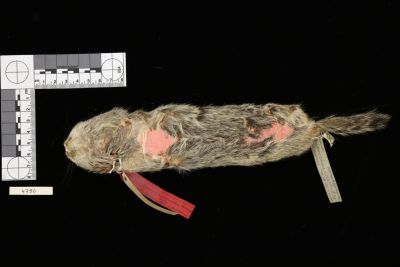
Syntype: MCZ:Mamm:4790. Urocitellus armatus. Female. Near Fort Bridger, foothills of Uinta Mountains, Camp Scott, Uinta County, Wyoming. Collected 26 May 1858. -

Syntype: MCZ:Mamm:4793. Urocitellus armatus. Male. Near Fort Bridger, foothills of Uinta Mountains, Camp Scott, Uinta County, Wyoming. Collected 2 Apr 1858. -
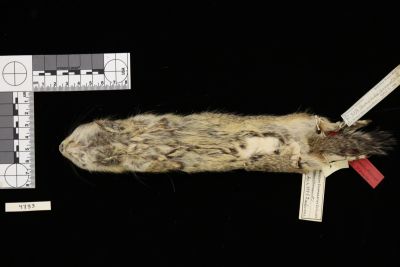
Syntype: MCZ:Mamm:4793. Urocitellus armatus. Male. Near Fort Bridger, foothills of Uinta Mountains, Camp Scott, Uinta County, Wyoming. Collected 2 Apr 1858.


External measurements
Length measurements are in millimeters (mm) and weight measurements are in grams (g), unless stated otherwise. If available, the sample size (n=) is provided. If a range is not provided and n= is not given, then the listed measurement represents an average.
| Part of range | Reference | Total length | Tail length | Hindfoot length | Ear length | Mass |
|---|---|---|---|---|---|---|
| rangewide | Eshelman and Sonnemann (2000) from Hall (1981) and Howell (1938) | 280–303 (n=12) | 63–81 (n=12) | 42–45.5 (n=12) | 10–12 (n=12) | 211 (minimum adult mass) Sauer and Slade (1987) |
Skull
-

Syntype: USNM A04809. Urocitellus armatus. Female. Fort Bridger, Camp Scott, unita County, Wyoming. Collected 26 May 1858. Dorsal view of the skull. Posterior of cranium is missing. -

Syntype: USNM A04809. Urocitellus armatus. Female. Fort Bridger, Camp Scott, unita County, Wyoming. Collected 26 May 1858. Dorsal view of the skull. Posterior of cranium is missing. -

Syntype: USNM A04809. Urocitellus armatus. Female. Fort Bridger, Camp Scott, unita County, Wyoming. Collected 26 May 1858. Dorsal view of the skull. Posterior of cranium is missing. -

Syntype: USNM A04809. Urocitellus armatus. Female. Fort Bridger, Camp Scott, unita County, Wyoming. Collected 26 May 1858. Dorsal view of the mandible. -

Syntype: USNM A04809. Urocitellus armatus. Female. Fort Bridger, Camp Scott, unita County, Wyoming. Collected 26 May 1858. Lateral view of the left mandible.


Similar species
Comparison with prairie dogs (genus: Cynomys) and marmots (genus: Marmota)
Urocitellus ground squirrels are sometimes confused with prairie dogs (genus: Cynomys) or marmots (genus: Marmota). Urocitellus ground squirrels can be distinguished from prairie dogs and marmots by their smaller body size, smaller skull, and pelage coloration. Prairie dogs generally have more uniform, buff or tan coloration without much patterning. The coat coloration of marmots is variable, but they are much larger ground squirrels with thick coats and bushy tails. Example images are provided below. Please visit each genus page for more detailed information on marmots and prairie dogs.
-

White-tailed Prairie Dog (Cynomys leucurus) observed by Liam Pentangelo in Jackson County, Colorado. -

Yellow-bellied Marmot (Marmota flaviventris) observed by Rick Overson and Laura Steger in Custer Gallatin National Forest, Montana.
Comparison with Urocitellus beldingi and Urocitellus elegans
From Eshelman and Sonnemann (2000): "A buff-colored tail with black above and below and edged with pinkish buff aids in distinguishing armatus from closely related ground squirrels. Underside of tail of armatus is gray, whereas that of elegans is ochraceous buff and lacks the black wash and pinkish edge. Tail of beldingi is reddish underneath (Hall, 1981; Jenkins and Eshelman, 1984; Zeveloff, 1988)."
| Species | Subgroup | Total length | Greatest length of skull | Measurement reference |
|---|---|---|---|---|
| Urocitellus armatus | big-eared | 280–303 mm | 45.6–48.5 mm | Eshelman and Sonnemann (2000) |
| Urocitellus beldingi | big-eared | 230–300 mm | 41.3–46.3 mm | Jenkins and Eshelman (1984) |
| Urocitellus elegans | big-eared | 253–307 mm | 43.0–46.8 mm | Zegers (1984) |
-

Uinta Ground Squirrel (Urocitellus armatus) photographed by pirish761 in Yellowstone National Park, Wyoming. This is a big-eared species recognized by a crown sprinkled with gray and by cinnamon coloring on its head, front of face, and ears. Forelegs are cinnamon buff with pinkish shading towards forefeet. -

Belding's Ground Squirrel (Urocitellus beldingi) photographed by Roger Woodruff in Tuolumne County, California. This is a big-eared species with a mid-dorsal area often is darker reddish-brown than the sides, although the conspicuousness of this trait varies geographically. -

Wyoming Ground Squirrel (Urocitellus elegans) photographed by wyattherp in Grand County, Colorado. This is a big-eared species with upperparts that are light drab and flecked or dappled with light pinkish buff, clay color, pinkish cinnamon, or blackish hairs. -
Syntype: MCZ:Mamm:4790. Urocitellus armatus. Female. Near Fort Bridger, foothills of Uinta Mountains, Camp Scott, Uinta County, Wyoming. Collected 26 May 1858. -

Holotype: USNM 186467. Urocitellus beldingi beldingi. Skin Adult female. Donner, Placer County, California. Collected 22 June 1886. -

Syntype: 3479/4810. Urocitellus elegans elegans. Skin and skull. Female. Fort Bridger, Camp Scott, Uinta County, Wyoming. Collected 17 April 1858.


Comparison with Urocitellus columbianus
The Columbian Ground Squirrel (Urocitellus columbianus) is one of the largest and most richly colored species in the genus Urocitellus. From Elliott and Flinders (1991): "columbianus differs from other species by having buffy dorsal spots and hind feet longer than 43 mm."
| Species | Subgroup | Total length | Greatest length of skull | Measurement reference |
|---|---|---|---|---|
| Urocitellus armatus | big-eared | 280–303 mm | 45.6–48.5 mm | Eshelman and Sonnemann (2000) |
| Urocitellus columbianus | big-eared | 325–410 mm | 51.7 mm (ssp. ruficaudus) | Elliot and Flinders (1991) |
-
Uinta Ground Squirrel (Urocitellus armatus) photographed by pirish761 in Yellowstone National Park, Wyoming. This is a big-eared species recognized by a crown sprinkled with gray and by cinnamon coloring on its head, front of face, and ears. Forelegs are cinnamon buff with pinkish shading towards forefeet. -

Columbian Ground Squirrel (Urocitellus columbianus) photographed by Andrey Atuchin in Kananaskis, Alberta, Canada. This is a big-eared species. It is one of the largest and most richly colored species in the genus Urocitellus.
Comparison with Urocitellus idahoensis
| Species | Subgroup | Total length | Greatest length of skull | Measurement reference |
|---|---|---|---|---|
| Urocitellus armatus | big-eared | 280–303 mm | 45.6–48.5 mm | Eshelman and Sonnemann (2000) |
| Urocitellus idahoensis | small-eared | 188 mm (holotype for subspecies artemesiae); 263 mm (holotype for subspecies idahoensis) | 32.7–36.2 mm (condylobasal length for subspecies artemesiae); 36.2–39.0 (condylobasal length subspecies idahoensis) | McLean (2025) |
-
Uinta Ground Squirrel (Urocitellus armatus) photographed by pirish761 in Yellowstone National Park, Wyoming. This is a big-eared species recognized by a crown sprinkled with gray and by cinnamon coloring on its head, front of face, and ears. Forelegs are cinnamon buff with pinkish shading towards forefeet. -
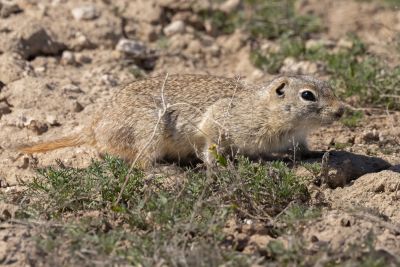
Snake River Plains Ground Squirrel (Urocitellus idahoensis) photographed by myworldofbirdphotography in Ada County, Idaho. This is a small-eared species. Dorsal color is variegated yellowish-brown with pale yellow dappling that is most distinct on rump but extending to shoulders in some individuals. Top of nose, outer surfaces of the lower hind legs, and underside of the tail are reddish-brown.
Comparison with Urocitellus mollis
| Species | Subgroup | Total length | Greatest length of skull | Measurement reference |
|---|---|---|---|---|
| Urocitellus armatus | big-eared | 280–303 mm | 45.6–48.5 mm | Eshelman and Sonnemann (2000) |
| Urocitellus mollis | small-eared | 188 mm (holotype) | 33.4–38.6 mm (condylobasal length) | McLean (2025) |
-
Uinta Ground Squirrel (Urocitellus armatus) photographed by pirish761 in Yellowstone National Park, Wyoming. This is a big-eared species recognized by a crown sprinkled with gray and by cinnamon coloring on its head, front of face, and ears. Forelegs are cinnamon buff with pinkish shading towards forefeet. -

Piute Ground Squirrel (Urocitellus mollis) photographed by Caleb Stroh in Box Elder County, Utah. This is a small-eared species. The upper parts are finely variegated silvery-gray, light yellowish-brown, and black; these colors are uniformly mixed throughout, without any indication of spots.
Comparison with Urocitellus richardsonii
From Michener and Koeppl (1985) comparing the Richardson's Ground Squirrel (Urocitellus richardsonii) with U. armatus: "differs from armatus by lacking gray coloration on the underside of the tail." Additionally, the sides of the head and neck and the fronts of the forelegs are cinnamon buff or clay in the Richardson's Ground Squirrel (Urocitellus richardsonii), whereas in U. armatus the sides of head and neck are a pale smoke-gray (Michener and Koeppl, 1985; Eshelman and Sonnemann, 2000).
| Species | Subgroup | Total length | Greatest length of skull | Measurement reference |
|---|---|---|---|---|
| Urocitellus armatus | big-eared | 280–303 mm | 45.6–48.5 mm | Eshelman and Sonnemann (2000) |
| Urocitellus richardsonii | big-eared | 277–330 mm | 45.1–48.4 mm | Michener and Koeppl (1985); Hazard (1982) |
-
Uinta Ground Squirrel (Urocitellus armatus) photographed by pirish761 in Yellowstone National Park, Wyoming. This is a big-eared species recognized by a crown sprinkled with gray and by cinnamon coloring on its head, front of face, and ears. Forelegs are cinnamon buff with pinkish shading towards forefeet. -

Richardson's Ground Squirrel (Urocitellus richardsonii) photographed by Pia Odgaard in Alberta, Canada. This is a big-eared species with upperparts that are pinkish buff or cinnamon buff shaded with fuscous and the posterior part of the back showing a dappled effect. The sides of the head and neck and the fronts of the forelegs are cinnamon buff or clay colored.
References
Elliott CL, Flinders JT. 1991. Spermophilus columbianus. Mammalian species (372):1-9. https://doi.org/10.2307/3504178
Eshelman BD, Sonnemann CS. 2000. Spermophilus armatus. Mammalian Species (637):1-6. https://www.jstor.org/stable/3504467
Hall ER. 1981. The mammals of North America. 2 vols. John Wiley and Sons, New York.
Howell AH. 1938. Revision of the North American ground squirrels with a classification of the North American Sciuridae. North American Fauna 56:1-25.
Jenkins SH, Eshelman BD. 1984. Spermophilus beldingi. Mammalian Species 221:1-8.
Michener GR, Koeppl JW. 1985. Spermophilus richardsonii. Mammalian Species, no. 243, pp. 1–8, https://doi.org/10.2307/3503990.
Zeveloff SI. 1988. Mammals of the Intermountain West. Salt Lake City (UT, USA): University of Utah Press.