Sciurus arizonensis
| Arizona Gray Squirrel
(Sciurus arizonensis) | |
|---|---|
| Range | |
 | |
| Taxonomic classification | |
| Order: | Rodentia |
| Suborder: | Sciuromorpha |
| Family: | Sciuridae |
| Subfamily: | Sciurinae |
| Tribe: | Sciurini |
| Genus: | Sciurus |
| Subgenus: | Parasciurus |
| Binomial details | |
| Sciurus arizonensis Coues, 1867 | |
| Other resources | |
| Full taxonomic details at MDD | |
The Arizona Gray Squirrel (Sciurus arizonensis) inhabits deciduous or mixed forests of canyon bottoms and montane riparian areas in Arizona, western New Mexico and northern Sonora, Mexico (Hoffmeister, 1986).
Description
From Best and Riedel (1995): "The upperparts of the Arizona gray squirrel are uniform grizzled gray with tawny suffusion (in winter with a pronounced ochraceous or fulvous dorsal stripe). Postauricular patches of rusty yellowsometimes are present (Hall, 1981), and the tops of the feet are gray (Hoffmeister, 1986). Dorsally, the tail is black washed with white. Ventrally, the tail is grizzled yellow-orange to rusty brown medially, bordered with black and edged with white. The underparts are white or nearly so. Compared with other tree squirrels, Arizona gray squirrels differ more seasonally in color, being grayer in winter. Some authors have mistaken the striking seasonal difference of molting animals for geographic variation. Furthermore, it is known that walnut juice stains the pelage, especially the feet and underparts, a fact that has led at times to erroneous descriptions of color of the species (Hall, 1981)."


Museum type specimens
-

Holotype: USNM 8475/37607. Sciurus arizonensis. Female. Fort Whipple, Yavapai County, Arizona. Collected 20 December 1865. Dorsal view. -

Holotype: USNM 8475/37607. Sciurus arizonensis. Female. Fort Whipple, Yavapai County, Arizona. Collected 20 December 1865. Ventral view.


External measurements
Length measurements are in millimeters (mm) and weight measurements are in grams (g), unless stated otherwise. If available, the sample size (n=) is provided. If a range is not provided and n= is not given, then the listed measurement represents an average.
| Part of range | Reference | Total length | Tail length | Hindfoot length | Ear length | Mass |
|---|---|---|---|---|---|---|
| Arizona (central Mogollon Plateau) | Hoffmeister (1986) | 445–547 (n=26) | 200–285 (n=26) | 64–73 (n=26) | ||
| Arizona (Huachuca Mtns.) | Hoffmeister (1986) | 492–574 (n=40) | 225–275 (n=40) | 67–77 (n=40) | ||
| Arizona (Sierra Ancha) | Hoffmeister (1986) | 465–536 (n=19) | 200–272 (n=19) | 68–74 (n=19) | ||
| Arizona (White Mtns.) | Hoffmeister (1986) | 487–557 (n=29) | 226–285 (n=29) | 53–73 (n=29) |
Color variation
From Best and Riedel (1995): "Compared with other tree squirrels, Arizona gray squirrels differ more seasonally in color, being grayer in winter. Some authors have mistaken the striking seasonal difference of molting animals for geographic variation. Furthermore, it is known that walnut juice stains the pelage, especially the feet and underparts, a fact that has led at times to erroneous descriptions of color of the species (Hall, 1981)... There are two molts a year in S. arizonensis. The more luxuriant winter pelage is present from about November through mid-April. In summer, the pelage is less grizzled, more brownish, and the tail is less plumelike (Brown, 1984). During July and August, the pelage commonly is stained with the juice of immature walnuts (Juglans rupestris). The white hair of the undersurface becomes tawny ochraceous where the walnut juices come in contact with it, and toward the end of the season those squirrels that feed habitually on the walnut become almost uniformly this color on the whole undersurface. The naked palms and soles are likewise stained. Such individuals have coloration similar to that of S. niger, and the staining has the appearance of a natural hair coloring. Around the nipples where new hair is coming in or where the young in nursing removed the walnut juice, the hair is white. At the first molt after the walnut-eating season is past, the pelage becomes white. Individuals having the pelage discolored invariably have their palms stained also, while those living away from walnut trees have white bellies and clean feet (Mearns, 1907)."
-

Sciurus arizonensis observed by M.L. Watson in Patagonia, Arizona. -

Sciurus arizonensis observed by M.L. Watson in Patagonia, Arizona. -

Sciurus arizonensis observed by brutledge in Hereford, Arizona. -
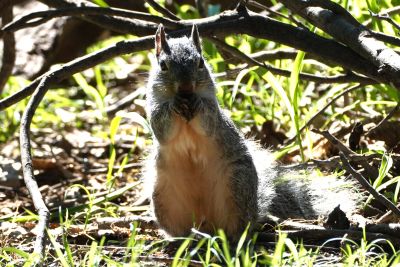
Sciurus arizonensis observed in September by Cameron Eckert in Patagonia, Arizona. The white hair on the underside is stained tawny from walnut juices.


Skull
-

Holotype: USNM 8475/37607. Sciurus arizonensis. Female. Fort Whipple, Yavapai County, Arizona. Collected 20 December 1865. Dorsal view of the skull. -

Holotype: USNM 8475/37607. Sciurus arizonensis. Female. Fort Whipple, Yavapai County, Arizona. Collected 20 December 1865. Ventral view of the skull. -

Holotype: USNM 8475/37607. Sciurus arizonensis. Female. Fort Whipple, Yavapai County, Arizona. Collected 20 December 1865. Lateral view of the skull. -

Holotype: USNM 8475/37607. Sciurus arizonensis. Female. Fort Whipple, Yavapai County, Arizona. Collected 20 December 1865. Dorsal view of the mandible. -

Holotype: USNM 8475/37607. Sciurus arizonensis. Female. Fort Whipple, Yavapai County, Arizona. Collected 20 December 1865. Lateral view of the left mandible.


Similar species
Comparison with Sciurus aberti
From Best and Riedel (1995): "Sciurus arizonensis may be sympatric with S. aberti (Hall, 1981). Compared with S. aberti, the skull of S. arizonensis is longer, flatter, the rostrum is broader, the auditory bullae are less inflated, and S. arizonensis has one upper premolar rather than two. In addition, S. arizonensis has smaller ears, no ear tufts, the underside of the tail has a central stripe of reddish brown and black, and the sides do not have a black stripe between the gray sides and the white underparts (Hoffmeister, 1986)."
-

Arizona Gray Squirrel (Sciurus arizonensis) observed by Andrew McKinlay in Camp Verde, Arizona. Notice that the underside of the tail has a central stripe of reddish brown. -

Abert's Squirrel (Sciurus aberti) observed by Joel Gilb in Reserve, New Mexico. Notice that the underside of the tail is whittish. -

Arizona Gray Squirrel (Sciurus arizonensis) observed by ronthill in Sierra Vista, Arizona. Notice the ears are short and the sides lack a black stripe between the gray sides and the white underparts. -

Abert's Squirrel (Sciurus aberti) observed by Marleigh Fletcher in Summerhaven, Arizona. A summer individual without ear tufts is shown for easier comparison of the ears. Notice the long ears and the black stripe between the gray sides and the white underparts. -

Abert's Squirrel (Sciurus aberti) observed by Marleigh Fletcher in Pima County, Arizona. Individual shown was oberved in late spring and the ear tufts are present but reduced. Notice the black stripe between the gray sides and the white underparts, and the whittish underside of the tail. -

Abert's Squirrel (Sciurus aberti) observed by savvy2birding on Mount Lemmon, Pima County, Arizona. This individual was photographed in the spring and has long ear tufts.

Comparison with Sciurus nayaritensis
From Best and Riedel (1995): "The ranges of S. nayaritensis and S. arizonensis approach each other in Arizona and Sonora (Hall, 1981). The skull of S. arizonensis is nearly indistinguishable from that of S. nayaritensis, and external and most cranial measurements of the two species are almost identical. Thus, these taxa may be conspecific, but there is a marked difference in color, and certain cranial features are useful in distinguishing the two. Compared with S. nayaritensis, the underparts of S. arizonensis are whitish rather than orangeish, the legs and feet are brownish interspersed with white and tan rather than reddish or ochraceous, and the tail is bordered with white rather than tan or yellow. Although color varies considerably throughout the range of S. nayaritensis, the variation is not as great as that between S. arizonensis and S. nayaritensis in Arizona. S. arizonensis has a narrower rostrum as measured across its base at the maxillary-premaxillary sutures than S. nayaritensis (usually < 14.6 mm in S. arizonensis and > 15.0 in S. nayaritensis). The distance between the infraorbital canals usually is ≤ 13.4 mm in S. arizonensis and ≥ 13.4 mm in S. nayaritensis. In S. arizonensis, the cranium is shallower between the orbits and the maxillary toothrow; all ≤ 21.5 mm in S. arizonensis, whereas most S. nayaritensis are > 21.5 mm. Discriminant function analysis produced a complete separation of these two species (Hoffmeister, 1986)."
-

Arizona Gray Squirrel (Sciurus arizonensis) -

Mexican Fox Squirrel (Sciurus nayaritensis)

References
Best TL, Riedel S. 1995. Sciurus arizonensis. Mammalian Species (496):1-5. https://doi-org.ezproxy1.lib.asu.edu/10.1644/0.496.1
Brown DE. 1984. Arizona's tree squirrels. Arizona Game and Fish Department, Phoenix, 114 pp.
Hall ER. 1981. The mammals of North America. 2 vols. John Wiley and Sons, New York.
Hoffmeister DF. 1986. Mammals of Arizona. Tucson (AZ, USA): University of Arizona Press.
Mearns EA. 1907. Mammals of the Mexican boundary of the United States: a descriptive catalogue of the species of mammals occurring in that region; with a general summary of the natural history, and a list of trees. Bulletin of the United States National Museum, 56: 1-530.