Callospermophilus lateralis
| Common Golden-mantled Ground Squirrel
(Callospermophilus lateralis) | |
|---|---|
| Range | |
 | |
| Taxonomic classification | |
| Order: | Rodentia |
| Suborder: | Sciuromorpha |
| Family: | Sciuridae |
| Subfamily: | Xerinae |
| Tribe: | Marmotini |
| Genus: | Callospermophilus |
| Binomial details | |
| Callospermophilus lateralis (Say in James, 1823) | |
| Other resources | |
| Full taxonomic details at MDD | |
The Common Golden-mantled Ground Squirrel (Callospermophilus lateralis) is a ground squirrel that looks like a large chipmunk. It is most abundant on talus and rocky slopes bordering alpine and subalpine meadows and grasslands.
Description
From Bartels and Thompson (1993): "Whitish fur rings the eyes. The underparts are whitish or yellowish-gray. The tail is brownish black above, edged with buff, and yellow-gray or reddish-brown below. Winter pelage is grayer than in summer and the mantle is dull (MacClintock, 1970). The dorsal guard hairs have a distal dark band 4 mm in length (Mayer, 1952)." Additionally, lateralis exhibits sexual dimorphism in the brightness of the mantle (males are redder) and depth of skull (Hoffmeister, 1986; Merriam, 1890)... Subspecies differ in pelage color and markings, body size, and cranial and dental characters (Howell, 1938; Merriam, 1901)."


Museum specimens
-

Holotype: USNM 56661. Callospermophilus lateralis bernardinus. Adult female. San Bernardino Peak, San Bernardino County, California. Collected 9 October 1893. -

Holotype: USNM 186464. Callospermophilus lateralis chrysodeirus. Adult male. Fort Klamath, Klamath County, Oregon. Collected 31 July 1888. -
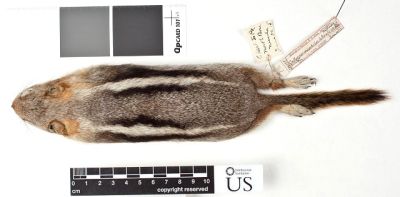
Holotype: USNM 208891. Callospermophilus lateralis certus. Adult male. North base of Charleston Peak, Clark County, Nevada. Collected 29 June 1915. -
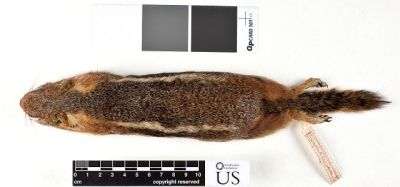
Holotype: USNM 17527/24463. Callospermophilus lateralis arizonensis. Adult male. San Francisco Mountain (Peaks), Coconino County, Arizona. Collected 8 August 1889. -
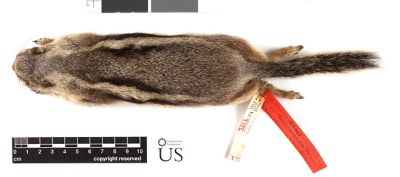
Holotype: USNM 186465. Callospermophilus lateralis cinerascens. Adult female. Helena, Lewis and Clark County, Montana. Collected 13 August 1888. -

Holotype: USNM 22733/30197. Callospermophilus lateralis castanurus. Adult male. Park City, Wasatch Mountains, Summit County, Utah. Collected 3 July 1890.


External measurements
Length measurements are in millimeters (mm) and weight measurements are in grams (g), unless stated otherwise. If available, the sample size (n=) is provided. If a range is not provided and n= is not given, then the listed measurement represents an average.
| Part of range | Reference | Total length | Tail length | Hindfoot length | Ear length | Mass |
|---|---|---|---|---|---|---|
| Arizona | Hoffmeister (1986) | 251–300 (n=101) | 75–115 (n=101) | 37–46 (n=101) | ||
| California | Jameson & Peeters (2004) | 235–295 | 83–102 | 37–41 | 13–16 | 136–245 |
| Canada | Naughton (2012) | 171–360 | 60–132 | 35–55 | 12–24 | 152–378 |
| Colorado | Armstrong et al. (2010) | 240–300 | 70–120 | 38–45 | 16–23 | 170–290 |
| Oregon (Cascade Range and Columbia Basin) | Verts & Carraway (1998) | 225–356 (n=60) | 31–47 (n=60) | 104.4–230.4 (n=60) | ||
| Oregon (Josephine and Curry Cos.) | Verts & Carraway (1998) | 240–300 (n=13) | 34–43 (n=13) |
Skull
If determining age from a skull, Bartels and Thompson (1993) note that "skulls of adults have well-developed sagittal crests, while subadult skulls do not."
-

Holotype: USNM 186465. Callospermophilus lateralis cinerascens. Adult female. Helena, Lewis and Clark County, Montana. Collected 13 August 1888. Dorsal view of the skull. -

Holotype: USNM 186465. Callospermophilus lateralis cinerascens. Adult female. Helena, Lewis and Clark County, Montana. Collected 13 August 1888. Ventral view of the skull. -

Holotype: USNM 186465. Callospermophilus lateralis cinerascens. Adult female. Helena, Lewis and Clark County, Montana. Collected 13 August 1888. Lateral view of the skull. -
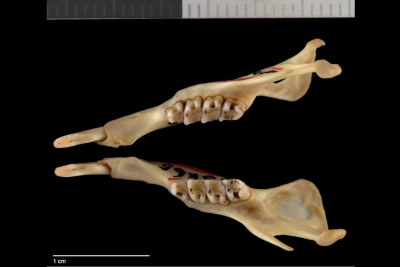
Holotype: USNM 186465. Callospermophilus lateralis cinerascens. Adult female. Helena, Lewis and Clark County, Montana. Collected 13 August 1888. Dorsal view of the mandible. -
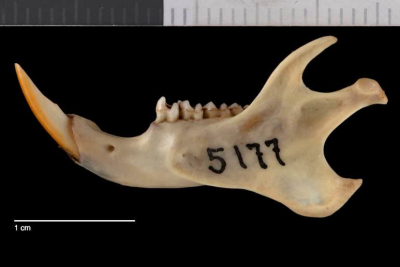
Holotype: USNM 186465. Callospermophilus lateralis cinerascens. Adult female. Helena, Lewis and Clark County, Montana. Collected 13 August 1888. Lateral view of the left mandible.


Similar species
Comparison with Callospermophilus saturatus
In general, the colors of the Cascade Golden-mantled Ground Squirrel (Callospermophilus saturatus) are more muted and the white stripe is less bright and distinct and the black borders are more diffuse (Naughton, 2012). The ranges of the two species do not overlap.
-

Common Golden-mantled Ground Squirrel (Callospermophilus lateralis) photographed by Rick Overson on Mount Howard, Oregon. -

Cascade Golden-mantled Ground Squirrel (Callospermophilus saturatus) photographed by Pierce Louderback in Pierce County, Washington.
Comparison with chipmunks (Neotamias, Tamias)
From Naughton (2012): "Chipmunks are smaller and have multiple light stripes that continue onto the head and through the eye. They also carry their tails stiffly vertical when they run."
-
Common Golden-mantled Ground Squirrel (Callospermophilus lateralis) photographed by Rick Overson on Mount Howard, Oregon. Golden-mantled ground squirrels may superficially resemble chipmunks, but they lack light stripes that continue onto the head and through the eye. -

Cliff Chipmunk (Neotamias dorsalis) photographed by Rick Overson in the Superstition Mountains of Arizona. Chipmunks have multiple light stripes that continue onto the head and through the eye. -
Dorsal view of the skull of an adult Common Golden-mantled Ground Squirrel (Callospermophilus lateralis). -

Dorsal view of the skull of an adult Least Chipmunk (Neotamias minimus) for general comparison of skulls of chipmunks with that of golden-mantled ground squirrels.

References
Bartels MA, Thompson DP. 1993. Spermophilus lateralis. Mammalian Species (440):1-8. https://doi.org/10.2307/3504114
Helgen KM, Cole FR, Helgen LE, Wilson DE. 2009. Generic Revision in the Holarctic Ground Squirrel Genus Spermophilus. Journal of Mammalogy 90(2):270-305. http://doi.org/10.1644/07-MAMM-A-309.1
Hoffmeister DF. 1986. Mammals of Arizona. Tucson (AZ, USA): University of Arizona Press.
Howell AH. 1938. Revision of the North American ground squirrels, with a classification of the North American Sciuridae. North American Fauna 56:1-256.
James E. 1823. Account of an Expedition from Pittsburgh to the Rocky Mountains, performed in the years 1819 and '20, by order of the Hon. J. C. Calhoun, Sec'y of War: under the Command of Major Stephen H. Long. Vol. II. H. C. Carey and I. Lea, Philadelphia, 442 pp.
MacClintock D. 1970. Squirrels of North America. New York (NY, USA): Van Nostrand Reinhold Company.
Mayer WV. 1952. The hair of California mammals with keys to the dorsal guard hairs of California mammals. The American Midland Naturalist 48:480-512.
Merriam CH. 1890. Descriptions of five new ground squirrels of the genus Tamias. North American Fauna 4:17-20.
Merriam CH. 1901. Two new rodents from northwestern California. Proceedings of the Biological Society of Washington 14: 125-126.
Naughton D. 2012. The natural history of Canadian mammals. Toronto (ON, CA): University of Toronto Press.