Neotamias minimus
| Least Chipmunk
(Neotamias minimus) | |
|---|---|
| Range | |
 | |
| Taxonomic classification | |
| Order: | Rodentia |
| Suborder: | Sciuromorpha |
| Family: | Sciuridae |
| Subfamily: | Xerinae |
| Tribe: | Tamiini |
| Genus: | Neotamias |
| Binomial details | |
| Neotamias minimus (Bachman, 1839) | |
| Other resources | |
| Full taxonomic details at MDD | |
The Least Chipmunk (Neotamias minimus) is the most widely distributed member of the genus Neotamias. It is found in a variety of habitats.
Description
From Verts and Carraway (2001): "Pelage on sides, rump, and thighs ranges from Pinkish Buff or Light Pinkish Cinnamon through Clay or Sayal Brown to Ochraceous Tawny (color nomenclature follows Ridgway, 1912). Venter is whitish. Dorsum is marked with 5 dark and 4 light longitudinal stripes that extend from nape to base of tail. The dark stripes range from Pinkish Cinnamon through Snuff Brown to Black. Innermost light stripes are whitish or grayish mixed with shades of brown; outermost light stripes are white or cream and usually not mixed with brown. Pate is grayish or brownish with colors often intermixed (Howell 1929). Face is marked with 2 light and 2 dark stripes extending from nosepad to ear; uppermost dark stripe passes through eye. Colors of stripes on face are similar to those on dorsum. [Neotamias] minimus undergoes 2 annual molts; summer pelage is brighter than grayish winter pelage (Nowak 1991). In some regions, variation in pelage color is clinal..."


Subspecies

subspecies atristriatus
-

Holotype: USNM 119028. Neotamias minimus atristriatus. Adult female. Sacramento Mountains, Sacramento Mountains, Otaro County, New Mexico. Collected 6 September 1902. -

Holotype: USNM 119028. Neotamias minimus atristriatus. Adult female. Sacramento Mountains, Sacramento Mountains, Otaro County, New Mexico. Collected 6 September 1902. -

Holotype: USNM 119028. Neotamias minimus atristriatus. Adult female. Sacramento Mountains, Sacramento Mountains, Otaro County, New Mexico. Collected 6 September 1902.


subspecies borealis
-

Lectotype: USNM 6506. Neotamias minimus borealis. Fort Laird, Mackenzie District, Northwest Territories, Canada. Collected about 1860.

subspecies cacodemus
-

Holotype: USNM 138737. Neotamias minimus cacodemus. Adult female. Sheep Mountain, Big Badlands, Pennington County, South Dakota. Collected 2 September 1905. -

Holotype: USNM 138737. Neotamias minimus cacodemus. Adult female. Sheep Mountain, Big Badlands, Pennington County, South Dakota. Collected 2 September 1905. -

Holotype: USNM 138737. Neotamias minimus cacodemus. Adult female. Sheep Mountain, Big Badlands, Pennington County, South Dakota. Collected 2 September 1905.


subspecies caniceps
-

Holotype: USNM 99200. Neotamias minimus caniceps. Adult female. Lake Labarge, Northwest Territory (Yukon), Canada. Collected 13 July 1899. -

Holotype: USNM 99200. Neotamias minimus caniceps. Adult female. Lake Labarge, Northwest Territory (Yukon), Canada. Collected 13 July 1899. -

Holotype: USNM 99200. Neotamias minimus caniceps. Adult female. Lake Labarge, Northwest Territory (Yukon), Canada. Collected 13 July 1899.


subspecies caryi
-

Holotype: USNM 150740. Neotamias minimus caryi. Young adult male. San Luis Valley, Costilla County, Colorado. Collected 24 October 1907. -

Holotype: USNM 150740. Neotamias minimus caryi. Young adult male. San Luis Valley, Costilla County, Colorado. Collected 24 October 1907. -

Holotype: USNM 150740. Neotamias minimus caryi. Young adult male. San Luis Valley, Costilla County, Colorado. Collected 24 October 1907.


subspecies confinis
-

Holotype: USNM 168957. Neotamias minimus confinis. Adult female. West slope of Bighorn Mountains, Big Horn County, Wyoming. Collected 7 June 1910. -

Holotype: USNM 168957. Neotamias minimus confinis. Adult female. West slope of Bighorn Mountains, Big Horn County, Wyoming. Collected 7 June 1910. -

Holotype: USNM 168957. Neotamias minimus confinis. Adult female. West slope of Bighorn Mountains, Big Horn County, Wyoming. Collected 7 June 1910.


subspecies consobrinus
-

Holotype: USNM 227313. Neotamias minimus consobrinus. Adult male. Swan Lake Valley, Yellowstone National Park, Wyoming. Collected 13 September 1917. -

Holotype: USNM 227313. Neotamias minimus consobrinus. Adult male. Swan Lake Valley, Yellowstone National Park, Wyoming. Collected 13 September 1917. -

Holotype: USNM 227313. Neotamias minimus consobrinus. Adult male. Swan Lake Valley, Yellowstone National Park, Wyoming. Collected 13 September 1917.


subspecies neglectus
-

Holotype: USNM 227423. Neotamias minimus neglectus. Adult male. Crescent Lake, Oneida County, Wisconsin. Collected 7 September 1917.

subspecies operarius
-

Holotype: USNM 205869. Neotamias minimus operarius. Adult male. Prieto Plateau at south end of Blue Range, Greenlee County, Arizona. Collected 7 September 1914. -

Holotype: USNM 205869. Neotamias minimus operarius. Adult male. Prieto Plateau at south end of Blue Range, Greenlee County, Arizona. Collected 7 September 1914. -

Holotype: USNM 205869. Neotamias minimus operarius. Adult male. Prieto Plateau at south end of Blue Range, Greenlee County, Arizona. Collected 7 September 1914.


subspecies oreocetes
-

Holotype: USNM 72468. Neotamias minimus oreocetes. Adult female. Teton Mountains, Flathead County, Montana. Collected 14 June 1895. -

Holotype: USNM 72468. Neotamias minimus oreocetes. Adult female. Teton Mountains, Flathead County, Montana. Collected 14 June 1895.


subspecies pallidus
-

Lectotype: USNM 11656. Neotamias minimus pallidus. Nearly adult]. Camp Thorne, near present town of Glendive, Yellowstone River, Dawson County, Montana. Collected 18 July 1873. -
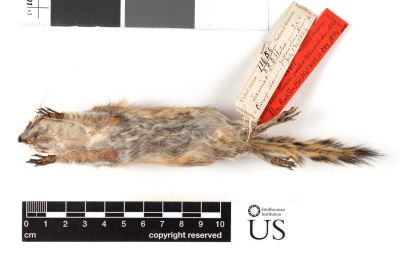
Lectotype: USNM 11656. Neotamias minimus pallidus. Nearly adult]. Camp Thorne, near present town of Glendive, Yellowstone River, Dawson County, Montana. Collected 18 July 1873.


subspecies melanurus
-

Holotype: USNM 23048. Neotamias minimus melanurus. Adult male. West side of Snake River, near Blackfoot, Bingham County, Idaho. Collected 17 July 1890. -

Holotype: USNM 23048. Neotamias minimus melanurus. Adult male. West side of Snake River, near Blackfoot, Bingham County, Idaho. Collected 17 July 1890.


subspecies pictus
-

Holotype: USNM 186459. Neotamias minimus pictus. Adult male. Kelton, Box Elder County, Utah. Collected 25 October 1888. -

Holotype: USNM 186459. Neotamias minimus pictus. Adult male. Kelton, Box Elder County, Utah. Collected 25 October 1888.


External measurements
Length measurements are in millimeters (mm) and weight measurements are in grams (g), unless stated otherwise. If available, the sample size (n=) is provided. If a range is not provided and n= is not given, then the listed measurement represents an average.
| Part of range | Reference | Total length | Tail length | Hindfoot length | Ear length | Mass |
|---|---|---|---|---|---|---|
| Arizona (Kaibab Plateau, Coconino Co.) | Hoffmeister (1986) | 180–202 (n=7) | 73–93 (n=7) | 30–33 (n=7) | ||
| Arizona (White Mtns.) | Hoffmeister (1986) | 191–200 (n=12) | 80–100 (n=12) | 29–33 (n=12) | ||
| California | Jameson & Peeters (2004) | 184–203 | 71–90 | 28–32 | 12–14 | 27–38 |
| Colorado | Armstrong et al. (2010) | 185–218 | 75–100 | 28–31 | 26–60 | |
| Minnesota | Hazard (1982) | 202–220 | 94–107 | 30–33 | 14–18 | 38.3–52.2 |
| Nebraska | Johnsgard (2020) | 190–212 | 74–91 | 29–55 | ||
| Nevada (Toyabe Mtns.) | Hall (1946) | males: 173–192 (n=10); females: 185–203 (n=10) | males: 71–86 (n=10); females: 74–90 (n=10) | males: 28–32 (n=10); females: 28–30 (n=10) | males: 30.0–36.6 (April and May, n=10); females: 37.9–54.0 (April and May, n=10) | |
| North Dakota | Seabloom et al. (2020) | 211 | 99 | 32 | 16 |
Skull
-

Holotype: USNM 150740. Neotamias minimus caryi. Young adult male. San Luis Valley, Costilla County, Colorado. Collected 24 October 1907. Dorsal view of the skull. -

Holotype: USNM 150740. Neotamias minimus caryi. Young adult male. San Luis Valley, Costilla County, Colorado. Collected 24 October 1907. Ventral view of the skull. -

Holotype: USNM 150740. Neotamias minimus caryi. Young adult male. San Luis Valley, Costilla County, Colorado. Collected 24 October 1907. Lateral view of the skull. -

Holotype: USNM 150740. Neotamias minimus caryi. Young adult male. San Luis Valley, Costilla County, Colorado. Collected 24 October 1907. Dorsal view of the mandible. -

Holotype: USNM 150740. Neotamias minimus caryi. Young adult male. San Luis Valley, Costilla County, Colorado. Collected 24 October 1907. Lateral view of the left mandible.


Similar species
From Verts and Carraway (2001): "Although no character or group of characters serve to distinguish minimus from sympatric or parapatric chipmunks of similar size throughout its geographic range, at any one locality it usually can be distinguished readily from its congeners (Hall 1981)... In some areas, little or no ochre on the flanks, yellowish underside of the tail, rounded braincase, rounded zygomatic arches, short rostrum, and only slightly recurved upper incisors are characters that may serve to distinguish minimus from sympatric congeners."
Comparison with Neotamias quadrivittatus
From Best et al. (1994): "Compared with minimus, quadrivittatus has bright orange on the shoulders. In addition, quadrivittatus has three prominent dark dorsal stripes while minimus has five (Hoffmeister, 1986). The ears and hind feet of minimus are smaller (Howell, 1929). Where quadrivittatus and minimus occur together, quadrivittatus is recognized by its larger size and affinity for rocky sites instead of wooded habitats. The elevational range of quadrivittatus on the eastern slope of the Rocky Mountains is more restricted than that of minimus (Armstrong, 1972)."
-

USNM 17144/[24077]. Colorado Chipmunk (Neotamias quadrivittatus). Female. San Pedro, Socorro County, New Mexico. Collected 4 July 1889. -
USNM 119028. Least Chipmunk (Neotamias minimus). Adult female. Sacramento Mountains, Sacramento Mountains, Otaro County, New Mexico. Collected 6 September 1902.
References
Hall ER. 1981. The mammals of North America. 2 vols. New York (NY, USA): John Wiley and Sons.
Howell AH. 1929. Revision of the American chipmunks (genera Tamias and Eutamias). North American Fauna 52:1-157.
Nowak, RM. 1991. Walker's mammals of the world. Fifth ed. Baltimore (MD, USA): The Johns Hopkins University Press.
Verts BJ, Carraway LN. 2001. Tamias minimus. Mammalian Species 2001(653):1-10. https://doi.org/10.2307/0.653.1