Chaetodipus formosus
| Long-tailed Pocket Mouse
(Chaetodipus formosus) | |
|---|---|
| Range | |
 | |
| Taxonomic classification | |
| Order: | Rodentia |
| Suborder: | Supramyomorpha |
| Infraorder: | Castorimorphi |
| Superfamily: | Geomyoidea |
| Family: | Heteromyidae |
| Subfamily: | Perognathinae |
| Genus: | Chaetodipus |
| Binomial details | |
| Chaetodipus formosus (C. H. Merriam, 1889) | |
| Other resources | |
| Full taxonomic details at MDD | |
The Long-tailed Pocket Mouse (Chaetodipus formosus) is a medium-sized, long-tailed pocket mouse. It can be found in a variety of arid habitats.
Description
From Ceballos (ed., 2014): "Chaetodipus formosus is medium in size. Its pelage is smooth, sepia in color with gray hair on the back, and the underside and legs are white. The tail is long; it is buffy on the ventral surface, it has a crest of hair, and it ends with a darker tuft than the rest of the pelage. Ears... with a tuft of black and white hairs on the bases. The subauricular spot is small."

Museum specimens
-

Holotype: 186508. Chaetodipus formosus formosus. Adult male. St. George, Washington County, Utah. Collected 2 January 1889. -

Holotype: 186508. Chaetodipus formosus formosus. Adult male. St. George, Washington County, Utah. Collected 2 January 1889. -

ASUMAC009070. Chaetodipus formosus. Arizona Strip of northern Mohave County, Arizona. -

ASUMAC009070. Chaetodipus formosus. Arizona Strip of northern Mohave County, Arizona. -

ASUMAC009070. Chaetodipus formosus. Arizona Strip of northern Mohave County, Arizona.


External measurements
Length measurements are in millimeters (mm) and weight measurements are in grams (g), unless stated otherwise. If available, the sample size (n=) is provided. If a range is not provided and n= is not given, then the listed measurement represents an average.
| Part of range | Reference | Total length | Tail length | Hindfoot length | Ear length | Mass |
|---|---|---|---|---|---|---|
| Arizona (Coconino County, Houserock Valley, Marble Canyon) | Hoffmeister (1986) | body length: 72–91 (n=24) | 95–112 (n=24) | 23–25 (n=24) | ||
| Arizona (Mohave County, lower end of Toroweap Valley) | Hoffmeister (1986) | body length: 75–89 (n=19) | 94–111 (n=19) | 23–26 (n=19) | ||
| Arizona (Mohave County, vicinity of Pakoon Springs) | Hoffmeister (1986) | body length: 78–92 (n=15) | 98–112 (n=15) | 22–26 (n=15) | ||
| California | Jameson & Peeters (2004) | 172–211 | 86–118 | 22–26 | 19–25 | |
| not reported | Ceballos (editor, 2014) | 104 | 118 | 25 | 5–8 | 18 |
| Utah & Arizona (vicinity of St. George) | Hoffmeister (1986) | body length: 75–93 (n=29) | 96–125 (n=29) | 21–26 (n=29) |
Skull
From Hoffmeister (1986): "mastoids project only slightly beyond (posterior to) plane of occiput..."
-

Holotype: 186508. Chaetodipus formosus formosus. Adult male. St. George, Washington County, Utah. Collected 2 January 1889. Dorsal view of the skull. -

Holotype: 186508. Chaetodipus formosus formosus. Black arrows identify the interorbital width. The interparietal bone is colored yellow. -

Holotype: 186508. Chaetodipus formosus formosus. Adult male. St. George, Washington County, Utah. Collected 2 January 1889. Ventral view of the skull. -

Holotype: 186508. Chaetodipus formosus formosus. Adult male. St. George, Washington County, Utah. Collected 2 January 1889. Lateral view of the skull. -

Holotype: 186508. Chaetodipus formosus formosus. Adult male. St. George, Washington County, Utah. Collected 2 January 1889. Dorsal view of the mandible. -

Holotype: 262918. Chaetodipus formosus formosus. Adult female. Lower end of Toroweap Valley, rim of Grand Canyon, Mojave County, Arizona. Collected 30 July 1937. Lateral view of the left mandible. -
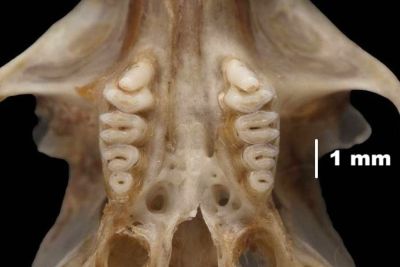
Holotype: 262918. Chaetodipus formosus formosus. Adult. Upper molars. -

Holotype: 262918. Chaetodipus formosus formosus. Adult. Lower molars.


Similar species
In the USA, Chaetodipus formosus is sympatric or near-sympatric with the following pocket mice: California Pocket Mouse (Chaetodipus californicus), San Diego Pocket Mouse (Chaetodipus fallax), Rock Pocket Mouse (Chaetodipus intermedius), Desert Pocket Mouse (Chaetodipus penicillatus), Peninsular Pocket Mouse (Chaetodipus rudinoris), Spiny Pocket Mouse (Chaetodipus spinatus), White-eared Pocket Mouse (Perognathus alticolus), Little Pocket Mouse (Perognathus longimembris), and Great Basin Pocket Mouse (Perognathus mollipilosus).
Comparison with Chaetodipus californicus
The rump of the California Pocket Mouse (Chaetodipus californicus) has numerous stiff spines, whereas the rump of Chaetodipus formosus lacks spines. If comparing skulls, the interparietal width is greater than the interorbital width in C. californicus and in C. formosus the interparietal width is narrower than the interorbital width.
-
Long-tailed Pocket Mouse (Chaetodipus formosus) -

California Pocket Mouse (Chaetodipus californicus) -
Holotype: 186508. Chaetodipus formosus formosus. Arrows identify the interorbital width. The interparietal bone is colored yellow. The interparietal width is narrower than the interorbital width. -

Holotype: 32116/43928. Chaetodipus californicus dispar. Arrows identify the interorbital width. The interparietal bone is colored yellow. The interparietal width is greater than the interorbital width.
Comparison with Chaetodipus fallax
The rump of the San Diego Pocket Mouse (Chaetodipus fallax) has prominent spines, whereas the rump of C. formosus lacks spines. When comparing skulls, the interparietal width is greater than the interorbital width in C. fallax and in C. formosus the interparietal width is narrower than the interorbital width.
-

Long-tailed Pocket Mouse (Chaetodipus formosus) observed by Laura Steger in the Arizona Strip of northern Mohave County, Arizona. -

San Diego Pocket Mouse (Chaetodipus fallax) observed by Alyssa Semerdjian in Rancho Jamul Ecological Reserve, San Diego County, California. Black arrows point to one of each of the many white and black spiny hairs. -
Holotype: 186508. Chaetodipus formosus formosus. Arrows identify the interorbital width. The interparietal bone is colored yellow. The interparietal width is narrower than the interorbital width. -

Holotype: 15889/22684. Chaetodipus fallax fallax. Arrows identify the interorbital width. The interparietal bone is colored yellow. The interparietal width is greater than the interorbital width.
Comparison with Chaetodipus intermedius
From Hoffmeister (1986), Chaetodipus formosus differs from the Rock Pocket Mouse (Chaetodipus intermedius) in: "longer tail, with the interorbital width greater than the interparietal width rather than the reverse." Additionally, C. intermedius has rump spines, but they may be difficult to detect.
-
Long-tailed Pocket Mouse (Chaetodipus formosus) -

Rock Pocket Mouse (Chaetodipus intermedius) -
Holotype: 186508. Chaetodipus formosus formosus. Arrows identify the interorbital width. The interparietal bone is colored yellow. The interorbital width is greater than the interparietal width (Hoffmeister, 1986). -

Holotype: 203003. Chaetodipus intermedius phasma. Arrows identify the interorbital width. The interparietal bone is colored yellow. The interparietal with is greater than the interorbital width (Hoffmeister, 1986).

Comparison with Chaetodipus penicillatus
In Chaetodipus formosus, the interorbital width is greater than the interparietal, whereas in the Desert Pocket Mouse (Chaetodipus penicillatus) the interorbital breadth is less than interparietal breadth (Hoffmeister, 1986).
-
Long-tailed Pocket Mouse (Chaetodipus formosus) -

Desert Pocket Mouse (Chaetodipus penicillatus) -
Holotype: 186508. Chaetodipus formosus formosus. Black arrows identify the interorbital width. The interparietal bone is colored yellow. The interorbital width is greater than the interparietal width (Hoffmeister, 1986). -

Holotype: 73881. Chaetodipus penicillatus angustirostris . Black arrows identify the interorbital width. The interparietal bone is colored yellow. The interparietal with is greater than the interorbital width.

Comparison with Chaetodipus rudinoris
Chaetodipus formosus differs from the Peninsular Pocket Mouse (Chaetodipus rudinoris) in shorter body, skull, hind foot, and toothrow (Hoffmeister, 1986).
-
Long-tailed Pocket Mouse (Chaetodipus formosus) observed by Laura Steger in the Arizona Strip of northern Mohave County, Arizona. -

Peninsular Pocket Mouse (Chaetodipus rudinoris) observed by Alan Harper in Baja California Sur, Mexico. -
Holotype: 186508. Chaetodipus formosus formosus. Arrows identify the interorbital width. The interparietal bone is colored yellow. The interparietal width is narrower than the interorbital width. -

Holotype: 146672. Chaetodipus rudinoris extimus. Dorsal view of the skull. The right zygomatic arch is unfortunately broken.
Comparison with Chaetodipus spinatus
The pelage of of the Spiny Pocket Mouse (Chaetodipus spinatus) is hispid, with large and prominent spines on the rump, scattered on the flanks and sides, and often extending to the shoulders (Lackey, 1991), whereas C. formosus lacks spines on the rump. When comparing skulls, the interparietal width is greater than the interorbital width in C. spinatus and in C. formosus the interparietal width is narrower than the interorbital width.
-
Long-tailed Pocket Mouse (Chaetodipus formosus) observed by Laura Steger in the Arizona Strip of northern Mohave County, Arizona. -

Spiny Pocket Mouse (Chaetodipus spinatus) photographed by Charles A. Drost and Jan Hart, USGS. The pelage of C. spinatus is hispid, with large and prominent spines on the rump, scattered on the flanks and sides, and often extending to the shoulders (Lackey, 1991). -
Holotype: 186508. Chaetodipus formosus formosus. Arrows identify the interorbital width. The interparietal bone is colored yellow. The interparietal width is narrower than the interorbital width. The interparietal width is narrower than the interorbital width. -
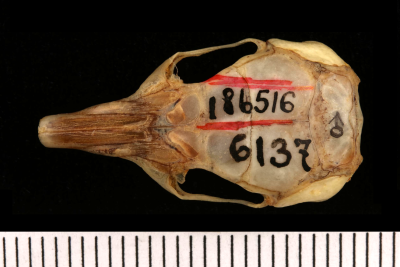
Holotype: 186516. Chaetodipus spinatus spinatus. Dorsal view of the skull. The interparietal width is greater than the interorbital width.

Comparison with Perognathus mollipilosus
From Hoffmeister (1986), Chaetodipus formosus differs from the Great Basin Pocket Mouse (Perognathus mollipilosus): "in longer tail, both actually and relatively, much bushier tail; broader interparietal (5.6 mm or more); rostrum narrower and longer."
-
Long-tailed Pocket Mouse (Chaetodipus formosus) -

Great Basin Pocket Mouse (Perognathus mollipilosus) -
Holotype: 186508. Chaetodipus formosus formosus. Black arrows identify the interorbital width. The interparietal bone is colored yellow. -

Neotype: USNM 36760. Perognathus mollipilosus. Black arrows identify the interorbital width. The interparietal bone is colored yellow.

References
Ceballos G, editor. 2014. Mammals of Mexico. Baltimore (MD, USA): Johns Hopkins University Press.
Hoffmeister DF. 1986. Mammals of Arizona. Tucson (AZ, USA): University of Arizona Press.
Jameson EW, Peeters HJ. 2004. Mammals of California (No. 66). Berkeley (CA, USA): University of California Press.
Merriam CH. 1889. Revision of the North American pocket mice. North American Fauna 1:1-29.