Cratogeomys castanops
| Yellow-faced Pocket Gopher
(Cratogeomys castanops) | |
|---|---|
| Range | |
 | |
| Taxonomic classification | |
| Order: | Rodentia |
| Suborder: | Supramyomorpha |
| Infraorder: | Castorimorphi |
| Superfamily: | Geomyoidea |
| Family: | Geomyidae |
| Subfamily: | Geomyinae |
| Tribe: | Geomyini |
| Genus: | Cratogeomys |
| Binomial details | |
| Cratogeomys castanops (S. F. Baird, 1852) | |
| Other resources | |
| Full taxonomic details at MDD | |
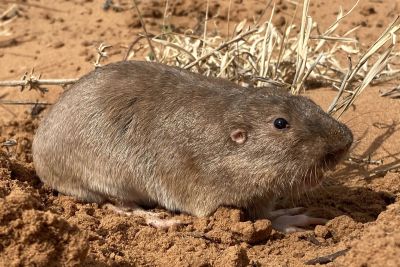
The Yellow-faced Pocket Gopher (Cratogeomys castanops) is a moderately large, dull yellowish-brown pocket gopher that occupies deep sandy or silty soils suitable for digging burows, which it rarely leaves.
Description
From Schmidly & Bradley (2016): "A moderately large pocket gopher, dull yellowish brown in color, with one deep groove on outer face of each upper incisor; feet blackish (whitish in most other gophers)."

For additional images by Marco Zozaya: https://www.gbif.org/occurrence/3760212039
Museum images
-

Holotype: USNM 4007/3861. Cratogeomys castanops castanops . Unknown age and sex. Along the prairie road to Bent’s Fort. [Merriam (1895:159): on the Arkansas River near the present town of Las Animas, Bent County, Colorado]. Collected by [Baird (1857:385): J. W.] Abert, date unknown. [Cataloged 18 Jun 1860]. Type not designated by number, but Baird (1857:385) states there was only one specimen collected by Abert at this locality. Dorsal view. -

Holotype: USNM 4007/3861. Cratogeomys castanops castanops . Unknown age and sex. Along the prairie road to Bent’s Fort. [Merriam (1895:159): on the Arkansas River near the present town of Las Animas, Bent County, Colorado]. Collected by [Baird (1857:385): J. W.] Abert, date unknown. [Cataloged 18 Jun 1860]. Type not designated by number, but Baird (1857:385) states there was only one specimen collected by Abert at this locality. Ventral view. -

Holotype: USNM 58325. Cratogeomys castanops hirtus. Adult male. Albuquerque, Bernalillo County, New Mexico. Collected 17 January 1894. Dorsal view. -

Holotype: USNM 58325. Cratogeomys castanops hirtus. Adult male. Albuquerque, Bernalillo County, New Mexico. Collected 17 January 1894. Ventral view.


External measurements
Length measurements are in millimeters (mm) and weight measurements are in grams (g), unless stated otherwise. If available, the sample size (n=) is provided. If a range is not provided and n= is not given, then the listed measurement represents an average.
| Part of range | Reference | Total length | Tail length | Hindfoot length | Ear length | Mass |
|---|---|---|---|---|---|---|
| Colorado | Armstrong et al. (2010) | 245–300 | 68–80 | 34–40 | less than 7 | 160–350 |
| Texas | Schmidly & Bradley (2016) | males: 295; females: 256 | males: 95; females: 77 | 33 | males: 216–321; females: 213–330 |
Skull
-

Holotype: USNM 58325. Cratogeomys castanops hirtus. Adult male. Albuquerque, Bernalillo County, New Mexico. Collected 17 January 1894. Dorsal view of the skull. -

Holotype: USNM 58325. Cratogeomys castanops hirtus. Adult male. Albuquerque, Bernalillo County, New Mexico. Collected 17 January 1894. Ventral view of the skull. -

Holotype: USNM 58325. Cratogeomys castanops hirtus. Adult male. Albuquerque, Bernalillo County, New Mexico. Collected 17 January 1894. Lateral view of the skull. -

Holotype: USNM 58325. Cratogeomys castanops hirtus. Adult male. Albuquerque, Bernalillo County, New Mexico. Collected 17 January 1894. Dorsal view of the mandible. -

Holotype: USNM 58325. Cratogeomys castanops hirtus. Adult male. Albuquerque, Bernalillo County, New Mexico. Collected 17 January 1894. Lateral view of the left mandible.


Similar species
From Schmidly & Bradley (2016): "These large-sized gophers are partial to deep, mellow soils that are relatively free from rocks. Where the three genera (Cratogeomys, Geomys, and [Megascapheus]) occur in the same general area, as in western Texas, [Megascapheus] usually occupies the shallower rocky soils in the mountains, Geomys lives in the deep sands along the rivers, and Cratogeomys utilizes the areas in between. However, the sandy areas in which no Geomys occur are likely to be occupied by Cratogeomys. The three genera are usually mutually exclusive in their distribution."
Comparison with Geomys arenarius
Cratogeomys castanops is a moderately large pocket gopher, dull yellowish brown in color, with one deep groove on outer face of each upper incisor; feet blackish, whereas the Desert Pocket Gopher (Geomys arenarius) is a dull, pale-brown pocket gopher, with two longitudinal grooves on outer face of each incisor; feet and underparts white (Schmidly and Bradley, 2016).
-

Yellow-faced Pocket Gopher (Cratogeomys castanops) photographed by Marco Zozaya in Coahuila, Mexico. -

Desert Pocket Gopher (Geomys arenarius) photographed by Robert Dowler near El Paso, Texas.
Comparison with Geomys bursarius
Cratogeomys castanops is a moderately large pocket gopher, dull yellowish brown in color, with one deep groove on outer face of each upper incisor; feet blackish, whereas the Plains Pocket Gopher (Geomys bursarius) pelage varies from buff, reddish brown, liver brown, or chestnut to black, with two longitudinal grooves on outer face of each incisor; feet and underparts white (Connior, 2011; Schmidly and Bradley, 2016).
-
Yellow-faced Pocket Gopher (Cratogeomys castanops) photographed by Marco Zozaya in Coahuila, Mexico. -

Plains Pocket Gopher (Geomys bursarius) photographed by Yinan Li in Reno County, Kansas. Dorsal coloration in this species varies from buff, reddish brown, liver brown, or chestnut to black.
Comparison with Geomys jugossicularis
Cratogeomys castanops is a moderately large pocket gopher, dull yellowish brown in color, with one deep groove on outer face of each upper incisor; feet blackish, whereas the Hall's Pocket Gopher (Geomys jugossicularis) is smaller, yellowish cinnamon in coloration, with two longitudinal grooves on outer face of each incisor; feet and underparts white (Schmidly and Bradley, 2016; Bradley et al., 2023).
-
Yellow-faced Pocket Gopher (Cratogeomys castanops) photographed by Marco Zozaya in Coahuila, Mexico. -

Hall's Pocket Gopher (Geomys jugossicularis) photographed by Robert Dowler in Cibola National Forest, Dalhart, Texas. Specimen deposited in Angelo State Natural History Collections.
Comparison with Geomys knoxjonesi
Cratogeomys castanops is a moderately large pocket gopher, dull yellowish brown in color, with one deep groove on outer face of each upper incisor; feet blackish, whereas the Jones's Pocket Gopher (Geomys knoxjonesi) is a small pocket gopher, pale buffy-brown in color, with two longitudinal grooves on outer face of each upper incisor; feet white (Baker and Genoways, 1975; Schmidly and Bradley, 2016).
-
Yellow-faced Pocket Gopher (Cratogeomys castanops) photographed by Marco Zozaya in Coahuila, Mexico. -
Jones's Pocket Gopher (Geomys knoxjonesi) photographed by Robert Dowler in Gaines County, Texas.
Comparison with Geomys personatus
The range of Cratogeomys castanops overlaps with that of the Texas Pocket Gopher (Geomys personatus). Cratogeomys castanops is dull yellowish brown in color, with one deep groove on the outer face of each upper incisor; feet blackish, whereas the Texas Pocket Gopher (Geomys personatus) is pale drab or grayish drab in color, with two longitudinal grooves on outer face of each upper incisor; feet white (Baker and Genoways, 1975; Schmidly and Bradley, 2016).
-
Yellow-faced Pocket Gopher (Cratogeomys castanops) photographed by Marco Zozaya in Coahuila, Mexico. -

Texas Pocket Gopher (Geomys personatus) photographed by Ben Horstmann on Padre Island, Corpus Christi, Texas.
Comparison with Megascapheus baileyi
The range of Cratogeomys castanops overlaps with that of the Southwestern Texas Pocket Gopher (Megascapheus baileyi). Color may not be reliable for differentiating these two species as the Southwestern Texas Pocket Gopher (Megascapheus baileyi) contains many subspecies that range in color, including buffy-yellow. The most reliable character requires examination of the upper incisors; Cratogeomys castanops has one deep groove on outer face of each upper incisor, whereas Megascapheus baileyi has smooth upper incisors that lack grooves. Additionally, the feet of Cratogeomys castanops are blackish and in Megasscapheus baileyi they are whittish.
Comparison with Megascapheus ruidosae
Cratogeomys castanops is a moderately large pocket gopher, dull yellowish brown in color, with one deep groove on outer face of each upper incisor; feet blackish, whereas the Ruidoso Pocket Gopher (Megascapheus ruidosae) is fuscous to fuscous-black above with underparts having a strong wash of ochraceous-tawny; the upper incisors are smooth and lack grooves; the feet and ankles are white Bradley et al. (2023).
-
Holotype: USNM 58325. Cratogeomys castanops hirtus. Adult male. Albuquerque, Bernalillo County, New Mexico. Collected 17 January 1894. -
Holotype: USNM 58325. Cratogeomys castanops hirtus. Adult male. Albuquerque, Bernalillo County, New Mexico. Collected 17 January 1894. -

Holotype: MVZ:Mamm:50431. Megascapheus ruidosae. Female. Ruidoso, Lincoln County, New Mexico. Collected 30 September 1931. Dorsal view of the skull. -

Holotype: MVZ:Mamm:50431. Megascapheus ruidosae. Female. Ruidoso, Lincoln County, New Mexico. Collected 30 September 1931. Ventral view of the skull.


Comparison with Thomomys talpoides
The coloration of the Northern Pocket Gopher (Thomomys talpoides) is variable and may not be a reliable character for distinguishing it from Cratogeomys castanops. However, Cratogeomys castanops has one deep groove on the outer face of each upper incisor and the are feet blackish, whereas the Northern Pocket Gopher (Thomomys talpoides) has upper incisors that are smooth (lack grooves) and the feet are white or partly white.
-
Yellow-faced Pocket Gopher (Cratogeomys castanops) photographed by Marco Zozaya in Coahuila, Mexico. -

Northern Pocket Gopher (Thomomys talpoides) photographed by ML Watson in Conejos County, Colorado.
References
Armstrong DM, Fitzgerald JP, Meaney CA. 2010. Mammals of Colorado, Second Edition. Denver (CO, USA): University Press of Colorado.
Baird SF. 1852. Mammals. Pp. 309–313 in Stansbury, H. (eds.). Exploration and Survey of the Valley of the Great Salt Lake of Utah, including a Reconnaissance of a New Route through the Rocky Mountains. Lippincott, Grambo & Co., Philadelphia, 487 pp.
Baker RJ, Genoways HH. 1975. A new subspecies of Geomys bursarius (Mammalia: Geomyidae) from Texas and New Mexico. Occasional Papers of the Museum of Texas Tech University (April 25, 1975) number 29: 1-18.
Bradley RD, Pham AT, Rich KA, Roberts EK, Soniat TJ, Poehlein CM, Mills MN, Ballard M, Pitts RM, Lindsey LL, Halsey MK. 2023. Genetic identification of pocket gophers (Genera Cratogeomys, Geomys, and Thomomys) in Texas and surrounding areas. Museum of Texas Tech University. https://www.depts.ttu.edu/nsrl/publications/downloads/SP78.pdf
Connior, MB. 2011. Geomys bursarius (rodentia: Geomyidae). Mammalian Species 43(879): 104-117. https://doi.org/10.1644/879.1
Schmidly DJ, Bradley RD. 2016. The mammals of Texas. Austin (TX, USA): University of Texas Press.