Dipodomys californicus
An infobox can't be produced because this taxon can't be found in the WhiskerWiki database!
A taxon category tag can't be returned because this taxon can't be found in the WhiskerWiki database!
An italic title template can't be produced because this taxon can't be found in the WhiskerWiki database!
The No common name found for Dipodomys californicus is a large kangaroo rat found in open areas of chaparral and other scrub communities with well-draining soils.
Description
From Jameson & Peeters (2004): "A rather large, dark kangaroo rat with a white-tipped tail. The hind foot has four toes."

Museum specimens
-

Holotype: USNM 16618/23544. Dipodomys californicus californicus. Adult male. Mendocino County, California. Collected 4 May 1889. -

Holotype: USNM 16618/23544. Dipodomys californicus californicus. Adult male. Mendocino County, California. Collected 4 May 1889. -

Holotype: USNM 16618/23544. Dipodomys californicus californicus. Adult male. Mendocino County, California. Collected 4 May 1889.


External measurements
Length measurements are in millimeters (mm) and weight measurements are in grams (g), unless stated otherwise. If available, the sample size (n=) is provided. If a range is not provided and n= is not given, then the listed measurement represents an average.
| Part of range | Reference | Total length | Tail length | Hindfoot length | Ear length | Mass |
|---|---|---|---|---|---|---|
| California | Jameson & Peeters (2004) | 270–340 | 174–194 | 39–47 | 57–78 | |
| not reported | Grinnell (1922) and Grinnell & Linsdale (1929) | 260–340 | 152–217 | 40–47 | 11–16 | |
| Oregon | Verts & Carraway (1998) | 254–338 (n=45) | 152–204 (n=45) | 40–49 (n=45) | 56.6–96.6 (n=45) |
Color variation
From Kelt (1988): "The dorsal body surface in this species ranges from tawny-olive strongly overwashed with black (D. c. californicus) to various shades of cinnamon-buff and pinkish-buff extensively obscured (D. c. eximius)."
Skull
From Kelt (1988): "prominent and sharp posteroexternal angle of the maxillary arches; breadth of maxillary roots is greater than 54.8 % of the greatest length of the skull (Hall, 1981)."
-

Holotype: USNM 16618/23544. Dipodomys californicus californicus. Adult male. Mendocino County, California. Collected 4 May 1889. Dorsal view of the skull. -

Holotype: USNM 16618/23544. Dipodomys californicus californicus. Adult male. Mendocino County, California. Collected 4 May 1889. Ventral view of the skull. -

Holotype: USNM 16618/23544. Dipodomys californicus californicus. Adult male. Mendocino County, California. Collected 4 May 1889. Lateral view of the skull. -

Holotype: USNM 16618/23544. Dipodomys californicus californicus. Adult male. Mendocino County, California. Collected 4 May 1889. Dorsal view of the mandible. -

Holotype: USNM 16618/23544. Dipodomys californicus californicus. Adult male. Mendocino County, California. Collected 4 May 1889. Lateral view of the left mandible.


Similar species
Comparison with Dipodomys deserti, D. heermanni and D. merriami
From Kelt (1988): "Where D. californicus evidently is sympatric with D. deserti and D. merriami (James and James, 1984), it may be distinguished by its darker coloration and by size. D. californicus is intermediate in weight and external measurements, especially hindfoot length, between the smaller D. merriami and the larger D. deserti (Grinnell, 1922; Hall, 1981). Additionally, both D. deserti and D. merriami are narrow-faced kangaroo rats (Grinnell, 1922). Southern members of D. californicus closely resemble some northern members of D. heermanni in external appearance and cranial features. The former can usually be distinguished by the absence of the hallux or by the presence of a distinct white tip on the tail (Grinnell, 1922; Grinnell and Linsdale, 1929)."
-

A young No common name found for Dipodomys californicus observed in Siskiyou County, California, by akerwin70. This is a large species with four toes on each hind foot and a white-tipped tail. -

Holotype: USNM 127158. Dipodomys heermanni tularensis. Adult female. Tulare County, California. Collected 23 June 1903. This is a medium to large, dark kangaroo rat with five toes on each hind foot and a tail that lacks a white tip. -
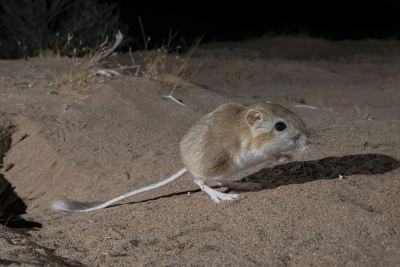
No common name found for Dipodomys deserti photographed by Randy Babb. © Randy Babb. his is a large kangaroo rat with four toes on each hind foot and a white-tipped tail. -

No common name found for Dipodomys merriami photographed by Randy Babb. © Randy Babb. This is a small- to medium-sized kangaroo rat with four toes on each hind foot and a tail that lacks a white tip. -
Holotype: USNM 16618/23544. Dipodomys californicus californicus. Adult male. Mendocino County, California. Collected 4 May 1889. Dorsal view of the skull. -

Holotype: USNM 127158. Dipodomys heermanni tularensis. Adult female. Tulare County, California. Collected 23 June 1903. Dorsal view of the skull. -

Holotype: USNM 15629/22522. Dipodomys deserti deserti. Adult female. Mohave River, [San Bernardino County], California. Collected 29 June 1886. Dorsal view of the skull. -

Holotype: USNM 54552. Dipodomys merriami merriami. Adult female. Pyramid Lake, Washoe County, Nevada. Collected 26 June 1893. Dorsal view of the skull.

Comparison with Dipodomys ordii
Dipodomys californicus differs from No common name found for Dipodomys ordii in larger size, white-tipped tail, and having four toes on each hind foot instead of five.
-
A young No common name found for Dipodomys californicus observed in Siskiyou County, California, by akerwin70. This is a large species with four toes on each hind foot and a white-tipped tail. -

No common name found for Dipodomys ordii observed by Nick Cairns in Carbon County, Montana. This is a medium to large species with 5 toes on each hind foot and a tail that lacks a white tip. -
Holotype: USNM 16618/23544. Dipodomys californicus californicus. Adult male. Mendocino County, California. Collected 4 May 1889. Dorsal view of the skull. -

Holotype: USNM 243093. Dipodomys ordii cupidineus. Adult male. Kanab Wash, Mohave County, Arizona. Collected 12 October 1922. Dorsal view of the skull.
| Species | Toes | Tail_tip | Size |
|---|---|---|---|
| Dipodomys californicus | 4 | white | large |
| Dipodomys deserti | 4 | white | large |
| Dipodomys heermanni | 5 | dusky | medium to large |
| Dipodomys merriami | 4 | dusky | small to medium |
| Dipodomys ordii | 5 | dusky | medium to large |
References
Grinnell, J. 1922. A geographical study of the kangaroo rats of California. University of California Publications in Zoology 24: 1-124. File:Grinnell 1922 California kangaroo rats.pdf
Grinnell J, Linsdale JM. 1929. A new kangaroo rat from the upper Sacramento Valley, California. University of California Publications in Zoology 30:453-459.
Hall ER. 1981. The mammals of North America. Second edition. John Wiley & Sons, New York.
James AH, James DK. 1984. Dipodomys californicus in Sierra Valley, Plumas County, California. California Fish and Game, 70:58-64.
Jameson EW, Peeters HJ. 2004. Mammals of California (No. 66). Berkeley (CA, USA): University of California Press.
Kelt DA. 1988. Dipodomys californicus. Mammalian Species (324): 1-4. https://doi.org/10.2307/3504267
Mayer WV. 1952. The hair of California mammals with keys to the dorsal guard hairs of California mammals. American Midland Naturalist 48:480-512.
Merriam CH. 1890. Descriptions of three new kangaroo rats, with remarks on the identity of Dipodomys ordii of Woodhouse. North American Fauna 4:41-49.