Geomys mobilensis
| Alabama Pocket Gopher
(Geomys mobilensis) | |
|---|---|
| Range | |
 | |
| Taxonomic classification | |
| Order: | Rodentia |
| Suborder: | Supramyomorpha |
| Infraorder: | Castorimorphi |
| Superfamily: | Geomyoidea |
| Family: | Geomyidae |
| Subfamily: | Geomyinae |
| Tribe: | Geomyini |
| Genus: | Geomys |
| Subgenus: | Geomys (subgenus) |
| Binomial details | |
| Geomys mobilensis C. H. Merriam, 1895 | |
| Other resources | |
| Full taxonomic details at MDD | |
Description
The following is from Pembleton and Williams (1978) describing Geomys pinetis from which Geomys mobilensis was recently split and is morphologically indistinguishable: "a medium-sized rodent with the typical geomyid adaptations for a fossorial way of life: small eyes; reduced pinnae; stout, strong-clawed forelimbs; nearly naked tail; external, fur-lined cheek pouches; and thickset body."

Museum specimens
-
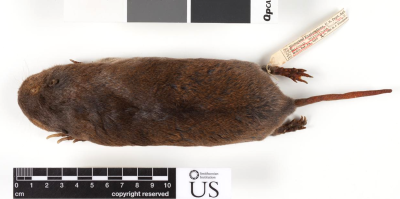
Holotype: 33988/46023. Geomys mobilensis. Adult male. Mobile Bay, Baldwin County, Alabama. Collected 26 April 1892. -

Holotype: 33988/46023. mobilensis. Adult male. Mobile Bay, Baldwin County, Alabama. Collected 26 April 1892.


External measurements
Skull
-
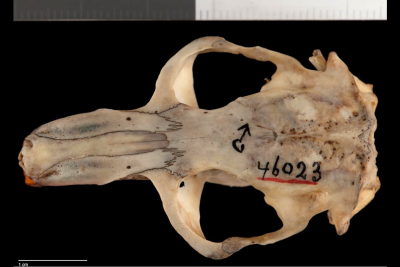
Holotype: 33988/46023. Geomys mobilensis. Adult male. Mobile Bay, Baldwin County, Alabama. Collected 26 April 1892. Dorsal view of the skull. -
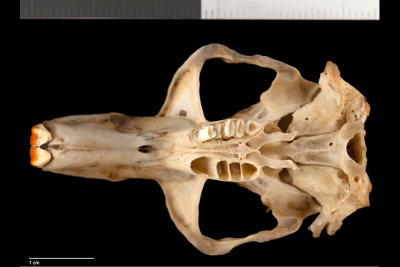
Holotype: 33988/46023. Geomys mobilensis. Adult male. Mobile Bay, Baldwin County, Alabama. Collected 26 April 1892. Ventral view of the skull. -
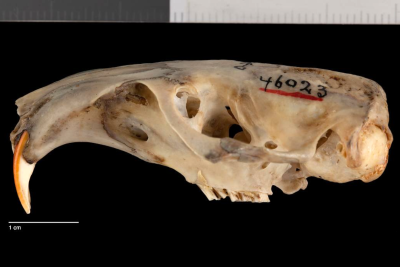
Holotype: 33988/46023. Geomys mobilensis. Adult male. Mobile Bay, Baldwin County, Alabama. Collected 26 April 1892. Lateral view of the skull. -

Holotype: 33988/46023. Geomys mobilensis. Adult male. Mobile Bay, Baldwin County, Alabama. Collected 26 April 1892. Dorsal view of the mandible. -
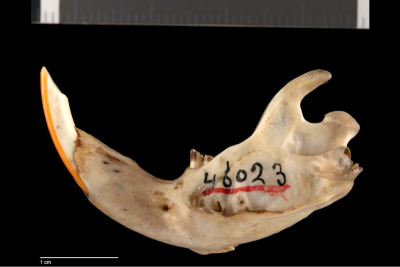
Holotype: 33988/46023. Geomys mobilensis. Adult male. Mobile Bay, Baldwin County, Alabama. Collected 26 April 1892. Lateral view of the left mandible.


Taxonomic notes
Geomys pinetis mobilensis was elevated to species status by Duncan et al. (2024): "In agreement with previous genetic work (Avise et al. 1979; Sudman et al. 2006; Chambers et al. 2009; Soto-Centeno et al. 2013), our results provide strong evidence that southeastern pocket gophers consist of two distinct lineages that have been reproductively isolated for an extended period (i.e., likely since the Pleistocene) and may have undergone some degree of adaptive divergence."
Similar species
Geomys mobilensis is morphologically indistinguishable from the Southeastern Pocket Gopher (Geomys pinetis) from which it was recently split.
References
Avise JC, Giblin-Davidson C, Laerm J, Patton JC, Lansman RA. 1979. Mitochondrial DNA clones and matriarchal phylogeny within and among geographic populations of the pocket gopher, Geomys pinetis. Proceedings of the National Academy of Sciences 76:6694–6698. https://doi.org/10.1073/pnas.76.12.6694
Chambers RR, Sudman PD, Bradley RD. 2009. A phylogenetic assessment of pocket gophers (Geomys): evidence from nuclear and mitochondrial genes. Journal of Mammalogy 90(3): 537-547.
Duncan SI, McCleery RA, Carneiro CM, Pynne JT, Parsons EI, Conner LM, Castleberry SB, Gitzen RA, Austin JD. 2024. Genetic support for discrete conservation units of the fossorial rodent Geomys pinetis. Conservation Genetics 25(5):1087-1101.
Pembleton EF, Williams SL. 1978. Geomys pinetis. Mammalian Species (86):1-3.
Soto-Centeno JA, Barrow LN, Allen JM, Reed DL. 2013. Reevaluation of a classic phylogeographic barrier: new techniques reveal the infuence of microgeographic climate variation on population divergence. Ecology and Evolution 3:1603–1613. https://doi.org/10.1002/ece3. 576
Sudman PD, Wicklife JK, Horner P, Smolen MJ, Bickham JW, Bradley RD. 2006. Molecular systematics of pocket gophers of the genus Geomys. Journal of Mammalogy 87:668–676. https://doi.org/10.1644/05-MAMM-A-349R2.1