Perognathus fasciatus
| Olive-backed Pocket Mouse
(Perognathus fasciatus) | |
|---|---|
| Range | |
 | |
| Taxonomic classification | |
| Order: | Rodentia |
| Suborder: | Supramyomorpha |
| Infraorder: | Castorimorphi |
| Superfamily: | Geomyoidea |
| Family: | Heteromyidae |
| Subfamily: | Perognathinae |
| Genus: | Perognathus |
| Subgenus: | Perognathus (subgenus) |
| Binomial details | |
| Perognathus fasciatus zu Wied-Neuwied, 1839 | |
| Other resources | |
| Full taxonomic details at MDD | |
The Olive-backed Pocket Mouse (Perognathus fasciatus) is a small pocket mouse that occupies grassland, shrub-steppe, and desert scrub habitats.
Description
From Armstrong et al. (2010): "The olive-backed pocket mouse has a dorsal pelage of olivaceous to buff, washed with black hairs. The darker hairs often form a distinct mid-dorsal band. This is the darkest-colored of our [Colorado] small pocket mice, although specimens from western Colorado are much paler in color. A conspicuous yellowish buff lateral line typically separates the darker dorsum from the usually white to pale buff belly." Additionally, "females have 3 pairs of mammae."
From Naughton (2012): "The Olive-backed Pocket Mouse has a large head with large dark eyes and small ears. A buffy yellowish band separates the white underside from the darker olive-coloured fur on the back. Black hairs on the back are usually scattered, but sometimes form a darker band along the spine. Melanistic animals have been reported. Juveniles have a slate-grey back. This pocked mouse has light rings around its eyes and a light patch directly behind each ear. The indistinctly bicoloured tail is about the same length as the body, but often looks longer, as the animal generally compresses itself by crouching over its hind legs to free up the for feet for food handling. Hind feet are large and front feet are small. Eye shine is pale amber."
From Seabloom et al. (2010): "Its dorsal pelage is olivaceous, mixed with black hairs. The sides have a buffy stripe, and the underparts are nearly white. There is usually a buffy spot behind the ear."

Museum specimens
-
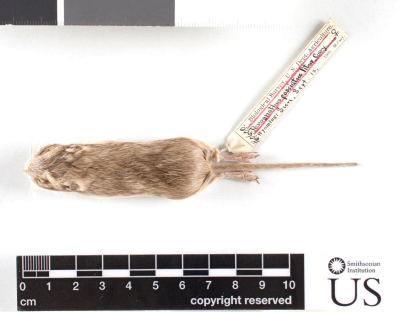
Holotype: 160600. Perognathus fasciatus fasciatus. Adult female. Sun, Sweetwater Valley, Natrona County, Wyoming. Collected 18 September 1909. -

Holotype: 160600. Perognathus fasciatus fasciatus. Adult female. Sun, Sweetwater Valley, Natrona County, Wyoming. Collected 18 September 1909. -
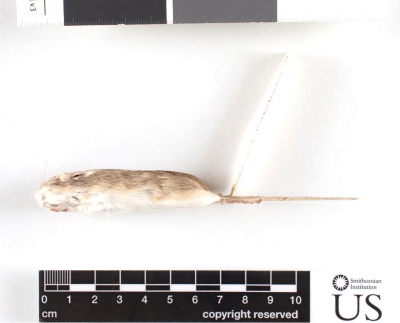
Holotype: 160600. Perognathus fasciatus fasciatus. Adult female. Sun, Sweetwater Valley, Natrona County, Wyoming. Collected 18 September 1909.


External measurements
Length measurements are in millimeters (mm) and weight measurements are in grams (g), unless stated otherwise. If available, the sample size (n=) is provided. If a range is not provided and n= is not given, then the listed measurement represents an average.
| Part of range | Reference | Total length | Tail length | Hindfoot length | Ear length | Mass |
|---|---|---|---|---|---|---|
| Colorado | Armstrong et al. (2010) | 125–145 | 55–75 | 14–19 | 7–12 | 10–13 |
| Nebraska | Johnsgard (2020) | 127–137 | 57–68 | 8–14 | ||
| North Dakota | Seabloom et al. (2020) | 135 | 62 | 17 | 8 | 12 |
Skull characters
From Armstrong et al. (2010): "The auditory bullae do not meet along their anterior margins. The interparietal bone is usually pentagonal and about equal in width to the interorbital breadth of the skull. The lower premolar is about the same length as the first lower molar."
-

Holotype: 160600. Perognathus fasciatus fasciatus. Adult female. Sun, Sweetwater Valley, Natrona County, Wyoming. Collected 18 September 1909. Dorsal view of the skull. Note the the left zygomatic arch is damaged and a portion is missing. -
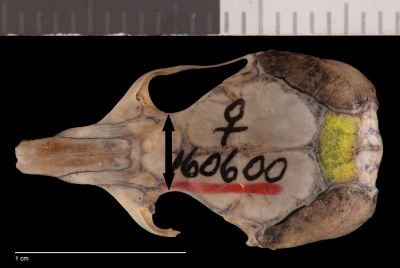
Holotype: 160600. Perognathus fasciatus fasciatus. Adult female. Sun, Sweetwater Valley, Natrona County, Wyoming. Collected 18 September 1909. Dorsal view of the skull. Black arrows identify the interorbital width. The interparietal bone is colored yellow. -
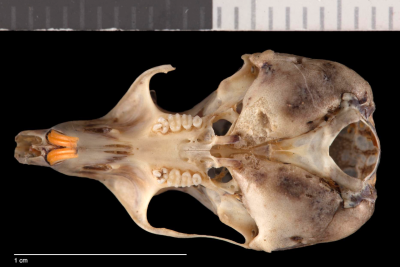
Holotype: 160600. Perognathus fasciatus fasciatus. Adult female. Sun, Sweetwater Valley, Natrona County, Wyoming. Collected 18 September 1909. Ventral view of the skull. -
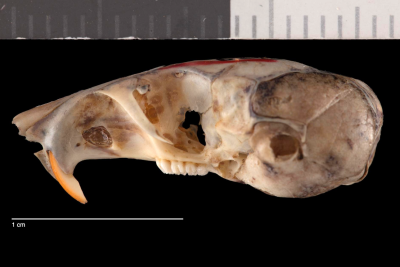
Holotype: 160600. Perognathus fasciatus fasciatus. Adult female. Sun, Sweetwater Valley, Natrona County, Wyoming. Collected 18 September 1909. Lateral view of the skull. -
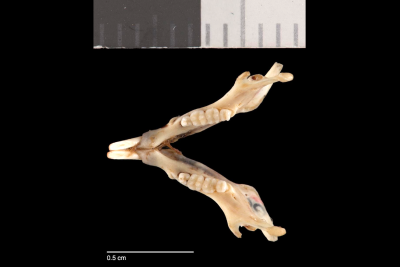
Holotype: 160600. Perognathus fasciatus fasciatus. Adult female. Sun, Sweetwater Valley, Natrona County, Wyoming. Collected 18 September 1909. Dorsal view of the mandible. -
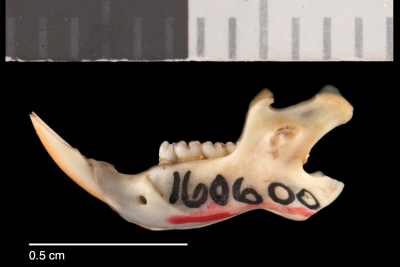
Holotype: 160600. Perognathus fasciatus fasciatus. Adult female. Sun, Sweetwater Valley, Natrona County, Wyoming. Collected 18 September 1909. Lateral view of the left mandible.


Similar species

References
Armstrong DM, Fitzgerald JP, Meaney CA. 2010. Mammals of Colorado, Second Edition. Denver (CO, USA): University Press of Colorado.
Johnsgard PA. 2020. Wildlife of Nebraska: a natural history. Lincoln (NE, USA): University of Nebraska Press.
Naughton D. 2012. The natural history of Canadian mammals. Toronto (ON, CA): University of Toronto Press.
Seabloom R, Hoganson JW, Jensen WF. 2020. The mammals of North Dakota. Fargo (ND, USA): North Dakota State University Press.
Wied-Neuwied M. zu. 1839. Über einige Nager mit äusseren Backentaschen aus dem westlichen Nord-America. Nova Acta Physico-Medica Academiae Caesareae Leopoldino-Carolinae Naturae Curiosorum 19:365-384.