Perognathus merriami
| Merriam's Pocket Mouse
(Perognathus merriami) | |
|---|---|
| Range | |
 | |
| Taxonomic classification | |
| Order: | Rodentia |
| Suborder: | Supramyomorpha |
| Infraorder: | Castorimorphi |
| Superfamily: | Geomyoidea |
| Family: | Heteromyidae |
| Subfamily: | Perognathinae |
| Genus: | Perognathus |
| Subgenus: | Perognathus (subgenus) |
| Binomial details | |
| Perognathus merriami J. A. Allen, 1892 | |
| Other resources | |
| Full taxonomic details at MDD | |
The Merriam's Pocket Mouse (Perognathus merriami) is a small, silky-haired pocket mouse with yellowish to yellowish-orange dorsal coloration. It inhabits semiarid to arid grasslands and scrublands with sandy and rocky soils.
Description
From Best & Skupski (1994): "Merriam's pocket mouse is a small, silky-haired pocket mouse (Davis, 1974). The pelage is smooth (Schmidly, 1983), and when pressed down it almost appears oily (Dalquest and Horner, 1984). The dorsal color is yellowish or yellowish-orange, with a slight blackish tinge (Williams et al., 1993) produced by black tips on the longer hairs (Dalquest and Horner, 1984). There is little contrast between mid-dorsal and dorsolateral areas (Williams et al., 1993). Ventrally, including forelegs and feet, pelage usually is white to the base of the hairs (Merriam, 1889), but may be a rich creamy color (Dalquest and Horner, 1984). The ears have a white spot on the interior margin (Merriam, 1889). The buffy postauricular spot is small (Williams et al., 1993) and the subauricular spot is white (Davis, 1974). There is a pale ring around each eye (Merriam, 1889); the tail is darker above than below (Davis, 1974). The transverse nose stripes are prominent and black. The color of P. m. gilvus [western portion of range] is paler, more yellowish, and the pelage is softer than in P. m. merriami [eastern and southern portion of range] (Osgood, 1900). At Black Gap, Brewster Co., Texas, P. merriami from areas with lava rock did not appear darker than those from pale limestone soils (Tamsitt, 1954). In southern Texas, P. merriami is small and dark. In western Texas, Merriam's pocket mouse is moderate in size and long-tailed with large auditory bullae, large mastoids, and is pale. In northern Texas, P. merriami is large-bodied, short-tailed, has a large interparietal, and is moderately pale. Generally, variation among distant populations is greater than among populations in closer proximity (Al-Uthrnan, 1952)."
From Schmidly & Bradley (2016): A very small, silky-haired pocket mouse, similar to but slightly smaller than P. flavescens; upperparts ochraceous buff mixed with black; sides brighter, less blackish; underparts clear white; spot behind ear clear buff, the one below the ears white; eye ring light; tail slightly darker above than below; winter pelage brighter than in summer; young grayer, less ochraceous.
Ear without a lobed antitragus (fleshy projection at the inner base of the ear).

Museum specimens
From Brant and Lee (2006), regarding the type specimen for Perognathus merriami gilvus: "A notable problem with the taxonomy of this group is the type specimen for P. m. gilvus. Osgood (1900) designated the type locality to be near Eddy, Eddy County, New Mexico. This same locality was also the only place where Lee and Engstrom (1991) detected possible hybrids between P. merriami and P. flavus. Moreover, it is a location where the 2 species are sympatric (Lee and Engstrom, 1991). Therefore, the location brings into question the identity of the type specimen from Eddy County. It is possible that the type specimen designated by Osgood (1900) is actually a hybrid between P. merriami and P. flavus. If fact, analysis by Wilson (1973) assigned the type specimen in question to P. f. flavus with a 73% probability. In the current analysis, the type specimen was identified as a P. merriami with a boot strap probability of 99%. If the type specimen for P. m. gilvus turns out to represent a hybrid between P. merriami and P. flavus, then the taxonomy of these 2 species will need to be revised."
-

Holotype: AMNH 3177. Perognathus merriami merriami. Male. Brownsville, Cameron County, Texas. Collected 10 August 1891. -

Holotype: AMNH 3177. Perognathus merriami merriami. Male. Brownsville, Cameron County, Texas. Collected 10 August 1891. -
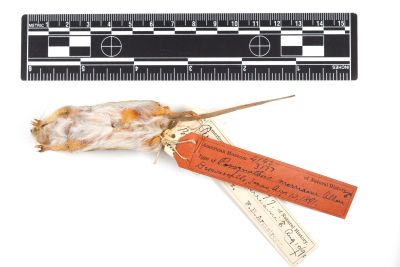
Holotype: AMNH 3177. Perognathus merriami merriami. Male. Brownsville, Cameron County, Texas. Collected 10 August 1891. -

Holotype: USNM 35939/48273. Perognathus merriami gilvus. Adult male. Eddy (Carlsbad), Eddy County, New Mexico. Collected 18 September 1892. -
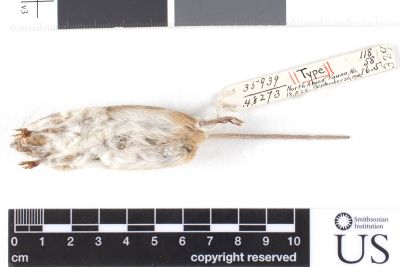
Holotype: USNM 35939/48273. Perognathus merriami gilvus. Adult male. Eddy (Carlsbad), Eddy County, New Mexico. Collected 18 September 1892.


External measurements
Length measurements are in millimeters (mm) and weight measurements are in grams (g), unless stated otherwise. If available, the sample size (n=) is provided. If a range is not provided and n= is not given, then the listed measurement represents an average.
| Part of range | Reference | Total length | Tail length | Hindfoot length | Ear length | Mass |
|---|---|---|---|---|---|---|
| not reported | Ceballos (editor, 2014) | 100–122 | 44–60 | 15–18 | 5–6 | 7–10 |
| Texas | Schmidly & Bradley (2016) | 116 | 57 | 16 | 7–9 |
Skull
From Osgood (1900): "maxillary branches of zygomata often squarely 'elbowed;' zygomata nearly parallel; interparietal more nearly quadrate than in flavescens, much wider than in flavus; lower premolar about equal to last molar."
-
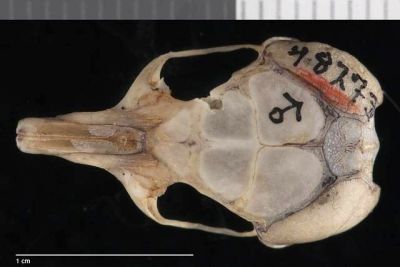
Holotype: USNM 35939/48273. Perognathus merriami gilvus. Adult male. Eddy (Carlsbad), Eddy County, New Mexico. Collected 18 September 1892. Dorsal view of the skull. -
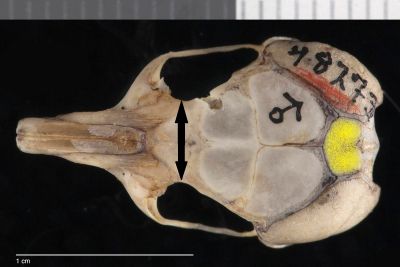
Holotype: USNM 35939/48273. Perognathus merriami gilvus. Adult male. Eddy (Carlsbad), Eddy County, New Mexico. Collected 18 September 1892. Dorsal view of the skull. Black arrows identify the interorbital width. The interparietal bone is colored yellow. -

Holotype: AMNH 3177. Perognathus merriami merriami. Male. Brownsville, Cameron County, Texas. Collected 10 August 1891. Dorsal view of the skull. The interparietal bone is colored yellow. -

Holotype: USNM 35939/48273. Perognathus merriami gilvus. Adult male. Eddy (Carlsbad), Eddy County, New Mexico. Collected 18 September 1892. Ventral view of the skull. -

Holotype: USNM 35939/48273. Perognathus merriami gilvus. Adult male. Eddy (Carlsbad), Eddy County, New Mexico. Collected 18 September 1892. Lateral view of the skull. -
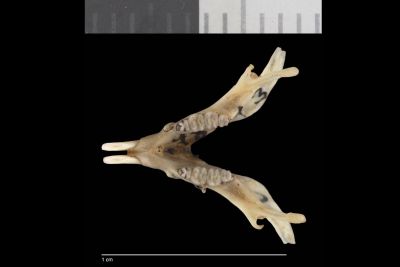
Holotype: USNM 35939/48273. Perognathus merriami gilvus. Adult male. Eddy (Carlsbad), Eddy County, New Mexico. Collected 18 September 1892. Dorsal view of the mandible. -
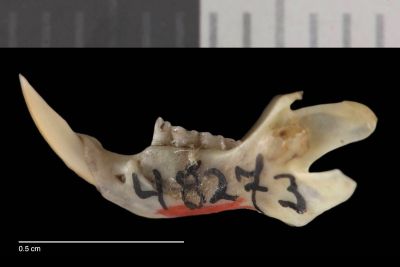
Holotype: USNM 35939/48273. Perognathus merriami gilvus. Adult male. Eddy (Carlsbad), Eddy County, New Mexico. Collected 18 September 1892. Lateral view of the left mandible.


Similar species
Comparison with Perognathus flavescens
From Best & Skupski (1994): "In part of its range, P. merriami is sympatric with P. flavescens. The general shape of the skull of P. merriami is similar to that of P. flavescens, but it is more angular and smaller. The rostrum of P. merriami is much heavier, the maxillary branches of the zygomatic arches often are squarely bent, the zygomatic arches are nearly parallel, and the interparietal is more nearly quadrate than in P. flavescens (but much wider than in P. flavus). Compared with P. flavescens, P. merriami is smaller, has a shorter tail the interparietals are not as wide (Williams et al., 1993), it has shorter bullae, narrower palate, lesser transdental breadth, lesser occipitobullar, occipitomaxillary, and occipitonasal lengths, and lesser translacnmal breadth and dorsal transbullar breadth of skull. Relative to greatest length of skull, P. merriami has shorter bullae, lesser palatal width, lesser transdental width, lesser occipitobullar length, and lesser occipitomaxillary length than P. flavescens (Anderson, 1972)."
-

Arrow points to the postauricular spot in the Merriam's Pocket Mouse (Perognathus merriami). -

Arrow points to the postauricular spot in the Plains Pocket Mouse (Perognathus flavescens). -
Holotype: USNM 35939/48273. Perognathus merriami gilvus. Adult male. Dorsal view of the skull. Black arrows identify the interorbital width. The interparietal bone is colored yellow. -

Holotype: USNM 226344. Perognathus flavescens apache . Adult male. Dorsal view of the skull. Black arrows identify the interorbital width. The interparietal bone is colored yellow.


Comparison with Perognathus flavus
From Best & Skupski (1994): "P. merriami resembles P. flavus more than any other species of Perognathus; these taxa may hybridize at a few localities. Compared with P. flavus, P. merriami has: shorter and coarser pelage; paler, less-contrasting mid-dorsal color with a yellowish or yellowish-orange rather than pinkish hue; smaller postauricular spots; smaller, less-inflated auditory bullae; greater interorbital and interparietal widths; narrower P4 (Williams et al., 1993); greater nasal projection and nasal length; lesser transdental width; greater translacrimal width; shorter ears; greater length of head and body, length of tail, and length of hind foot. Relative to greatest length of skull, P. merriami has shorter maxillary toothrows and bullae, longer and more projecting nasals, lesser transdental width, and greater interorbital breadth (Anderson, 1972). No single set of characters will distinguish all P. merriami from all P. flavus."
Brant and Lee (2006) describe their study to determine which morphological characters significantly discriminate between Perognathus merriami and the Silky Pocket Mouse (Perognathus flavus) and to determine if those morphological characters could be used to identify unknown specimens. They found that: "Perognathus flavus has larger mastoids, longer and narrower interparietals, smaller interorbital distances, a shorter tail, and larger hind feet compared with P. merriami." The table of their summary statistics is shown below for the seven significant characters (bullar length, mastoid breadth, interorbital breadth, interparietal breadth, interparietal length, tail length, and hind foot length. For details on how their analysis was conducted, see Brant and Lee (2006).
-
Arrow points to the postauricular spot in Merriam's Pocket Mouse (Perognathus merriami). -

Arrow points to the postauricular spot in the Silky Pocket Mouse (Perognathus flavus). -
Holotype: USNM 35939/48273. Perognathus merriami gilvus. Adult male. Dorsal view of the skull. Black arrows identify the interorbital width. The interparietal bone is colored yellow. -

Holotype: USNM 168650. Perognathus flavus piperi. Adult male. Dorsal view of the skull. Black arrows identify the interorbital width. The interparietal bone is colored yellow. -
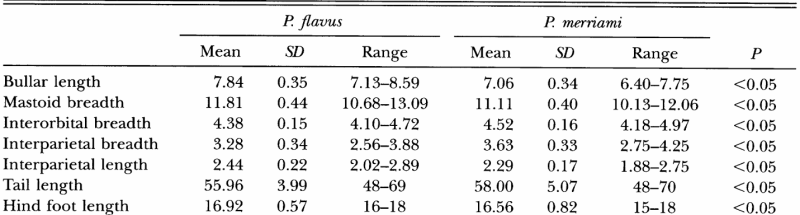
Table from Brant and Lee (2006): "Significance values were obtained from the bootstrapped discriminant function. The first 7 characters listed were significant in discriminating between Perognathus flavus and Perognathus merriami.


References
Al-Uthman HS. 1952. Geographical variations in the Merriam pocket mouse (Perognathus merriami) in three biotic provinces in Texas. M.A. thesis, The University of Texas, Austin, 31 pp.
Anderson S. 1972. Mammals of Chihuahua: taxonomy and distribution. Bulletin of the American Museum of Natural History, 148:149-410.
Best TL, Skupski MP. 1994. Perognathus merriami. Mammalian Species (473): 1-7. https://doi.org/10.2307/3504305
Brant JG, Lee Jr TE. 2006. Morphological analysis of Perognathus flavus and P. merriami (Rodentia: Heteromyidae). The Southwestern Naturalist 51(1):79-86.
Ceballos G, editor. 2014. Mammals of Mexico. Baltimore (MD, USA): Johns Hopkins University Press.
Dalquest WW, Horner NV. 1984. Mammals of northcentral Texas. Midwestern State University Press, Wichita Falls, Texas, 261 pp.
Davis WB. 1974. The mammals of Texas. Texas Parks and Wildlife Department Bulletin, 41: 1-294.
Lee Jr TE, Engstrom MD. 1991. Genetic variation in the silky pocket mouse (Perognathus flavus) in Texas and New Mexico. Journal of Mammalogy 72(2):273-285.
Merriam CH. 1889. Preliminary revision of the North American pocket mice (genera Perognathus et Cricetodipus auct.) with descriptions of new species and subspecies and a key to the known forms. North American Fauna, 1:1-36.
Osgood WH. 1900. Revision of the pocket mice of the genus Perognathus. North American Fauna, 18:1-73.
Schmidly DJ. 1983. Texas mammals east of the Balcones Fault Zone. Texas A&M University Press, College Station, 400 pp
Schmidly DJ, Bradley RD. 2016. The mammals of Texas. Austin (TX, USA): University of Texas Press.
Tamsitt JR. 1954. The mammals of two areas in the Big Bend region of Trans-Pecos Texas. The Texas Journal of Science, 6:33-61.
Williams DF, Genoways HH, Braun JK. 1993. Taxonomy. Pp. 38-196, in Biology of the Heteromyidae (H. H. Genoways and J. H. Brown, eds.). Special Publication, The American Society of Mammalogists 10: 1-719.
Wilson DE. 1973. The systematic status of Perognathus merriami Allen. Proceedings of the Biological Society of Washington 86:175-192.