Perognathus flavescens
| Plains Pocket Mouse
(Perognathus flavescens) | |
|---|---|
| Range | |
 | |
| Taxonomic classification | |
| Order: | Rodentia |
| Suborder: | Supramyomorpha |
| Infraorder: | Castorimorphi |
| Superfamily: | Geomyoidea |
| Family: | Heteromyidae |
| Subfamily: | Perognathinae |
| Genus: | Perognathus |
| Subgenus: | Perognathus (subgenus) |
| Binomial details | |
| Perognathus flavescens C. H. Merriam, 1889 | |
| Other resources | |
| Full taxonomic details at MDD | |
The Plains Pocket Mouse (Perognathus flavescens) is a small pocket mouse that, according to Wilson et al. (2016), "inhabits sand dunes and stabilized sandy soils with a sparse vegetative cover and occasionally reported from rocky, brushy slopes."
Description
From Monk & Jones (1996): Perognathus flavescens is among the small to medium sized species of Perognathus. Races on the Great Plains are generally smaller than those of intermountain areas at similar latitudes. The ears are relatively small and the postauricular patches are smaller and less conspicuous than in some congeners (P. flavus, for example). The tail is relatively short (<100% length of head and body) and nonpenicillate (Williams, 1978, and citations therein). Pelage is soft, not spiny. There is considerable geographic variation in pelage color; several subspecies are based on such variation (Williams, 1978). In general, however, dorsal color ranges from dark ochraceous buff heavily suffused with blackish hairs to pale ochraceous lightly mixed with dusky hairs. The lateral line is dark ochraceous to pale yellowish; the undersides are white except that they are the same color as the lateral line, or nearly so, in dark-colored northeastern races (cockrumi and perniger). The tail is slightly darker above than ventrally. Mice from the White Sands area of New Mexico are nearly white to almost yellowish in dorsal color (Benson, 1933)."
From Armstrong et al. (2010): "The plains pocket mouse is pale buff to yellowish or reddish, with a variable dorsal wash of black hairs. The lateral line of buffy orange is generally less striking and the dorsal color usually is not as dark as that of the olive-backed pocket mouse. A buffy postauricular patch is often present. This patch is never as large as in the silky pocket mouse, and the hair is coarser."


-

Arrow points to the location of the postauricular patch of the Plains Pocket Mouse (Perognathus flavescens). -
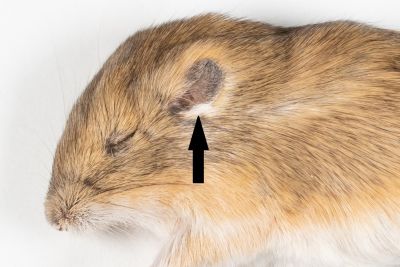
Arrow points to the location of the subauricular patch of the Plains Pocket Mouse (Perognathus flavescens).


Subspecies and type specimens

-
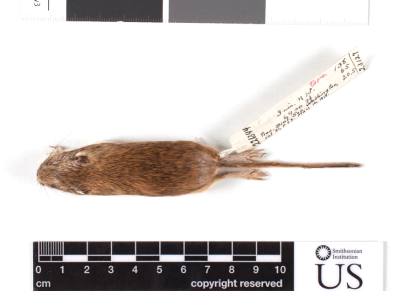
Holotype: USNM 226344. Perognathus flavescens apache . Adult male. Winona, Coconino County, Arizona. Collected 19 July 1917. -

Holotype: USNM 226344. Perognathus flavescens apache . Adult male. Winona, Coconino County, Arizona. Collected 19 July 1917. -

Holotype: USNM 148206. Perognathus flavescens caryi. Adult male. Eight miles (13 km) west of Rifle, Garfield County, Colorado. Collected 4 October 1906. -

Holotype: USNM 148206. Perognathus flavescens caryi. Adult male. Eight miles (13 km) west of Rifle, Garfield County, Colorado. Collected 4 October 1906. -
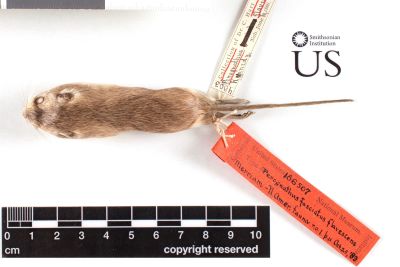
Holotype: USNM 186507. Perognathus flavescens flavescens. Adult male. Kennedy, Cherry County, Nebraska. Collected 11 June 1888. -
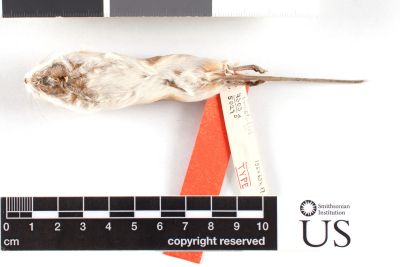
Holotype: USNM 186507. Perognathus flavescens flavescens. Adult male. Kennedy, Cherry County, Nebraska. Collected 11 June 1888. -
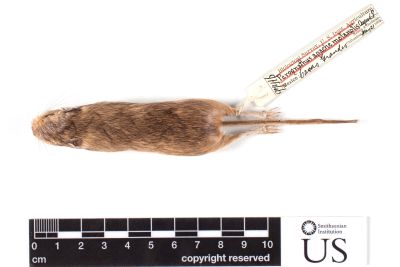
Holotype: USNM 97416. Perognathus flavescens melanotis. Adult female. Casas Grandes, Chihuahua, Mexico. Collected 21 May 1899. -

Holotype: USNM 97416. Perognathus flavescens melanotis. Adult female. Casas Grandes, Chihuahua, Mexico. Collected 21 May 1899. -
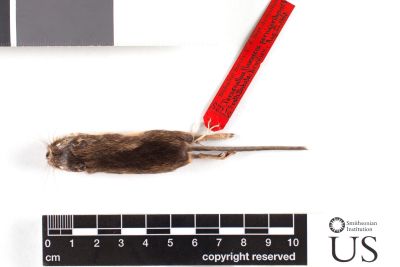
Holotype: USNM 57725. Perognathus flavescens perniger. Young adult female. Vermillion, Clay County, South Dakota. Collected 22 August 1889. -
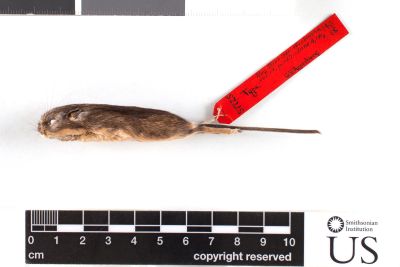
Holotype: USNM 57725. Perognathus flavescens perniger. Young adult female. Vermillion, Clay County, South Dakota. Collected 22 August 1889. -
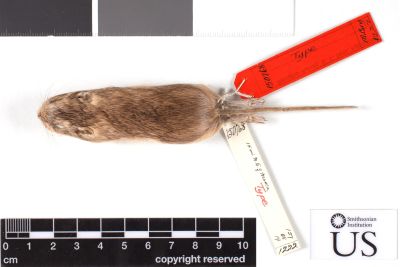
Holotype: USNM 150768. Perognathus flavescens relictus. Young adult male. Medano Springs Ranch, northeast of Mosca, San Luis Valley, Alamosa County, Colorado. Collected 2 November 1907. -
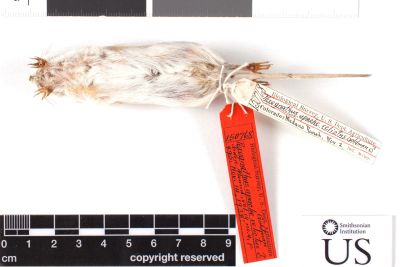
Holotype: USNM 150768. Perognathus flavescens relictus. Young adult male. Medano Springs Ranch, northeast of Mosca, San Luis Valley, Alamosa County, Colorado. Collected 2 November 1907.


External measurements
Length measurements are in millimeters (mm) and weight measurements are in grams (g), unless stated otherwise. If available, the sample size (n=) is provided. If a range is not provided and n= is not given, then the listed measurement represents an average.
| Part of range | Reference | Total length | Tail length | Hindfoot length | Ear length | Mass |
|---|---|---|---|---|---|---|
| Colorado | Armstrong et al. (2010) | 123–145 | 52–71 | 16–19 | 6–8 | 7–12 |
| Minnesota | Hazard (1982) | body length: 110–132 (n=48) | 49–60 (n=48) | 16–18 (n=48) | 5–7 (n=48) | males: 9.2; females: 6.9–11.5 |
| Nebraska | Johnsgard (2020) | 114–130 | 52–65 | 7–12 | ||
| North Dakota | Seabloom et al. (2020) | 122 | 60 | 17 | 6 | |
| not reported | Ceballos (editor, 2014) | 113–154 | 56–73 | 15–21 | 6.5 | 8–11 |
| Texas | Schmidly & Bradley (2016) | 130 | 61 | 17 | 8–11 |
Skull
From Armstrong et al. (2010): "The auditory bullae typically meet anteriorly. As with the olive-backed pocket mouse [Perognathus fasciatus], the interparietal bone is about the same width as the interorbital breadth of the skull."
From Hoffmeister (1986): "Skull of about the same as in Perognathus amplus but broader across the mastoids, pronounced posterior bulge of the occipital between the bullae, width of interparietal greater than maxillary toothrow."
-

Holotype: 226344. Perognathus flavescens apache . Adult male. Winona, Coconino County, Arizona. Collected 19 July 1917. Dorsal view of the skull. -

Holotype: 226344. Perognathus flavescens apache . Adult male. Winona, Coconino County, Arizona. Collected 19 July 1917. Dorsal view of the skull. Black arrows identify the interorbital width. The interparietal bone is colored yellow. -
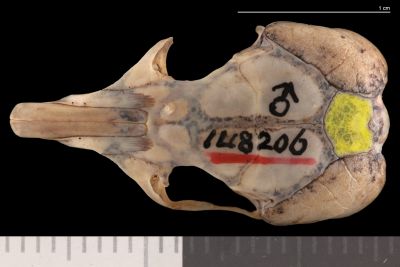
Holotype: USNM 148206. Perognathus flavescens caryi. Adult male. Eight miles (13 km) west of Rifle, Garfield County, Colorado. Collected 4 October 1906. Dorsal view of the skull. The interparietal bone is colored yellow. -
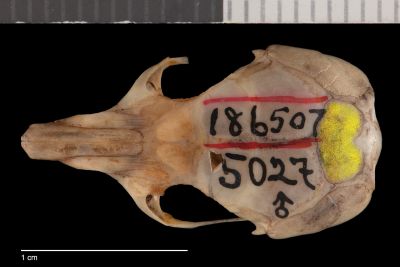
Holotype: USNM 186507. Perognathus flavescens flavescens. Adult male. Kennedy, Cherry County, Nebraska. Collected 11 June 1888. Dorsal view of the skull. The interparietal bone is colored yellow. -

Holotype: USNM 97416. Perognathus flavescens melanotis. Adult female. Casas Grandes, Chihuahua, Mexico. Collected 21 May 1899. Dorsal view of the skull. The interparietal bone is colored yellow. -

Holotype: USNM 57725. Perognathus flavescens perniger. Young adult female. Vermillion, Clay County, South Dakota. Collected 22 August 1889. Dorsal view of the skull. The interparietal bone is colored yellow. -
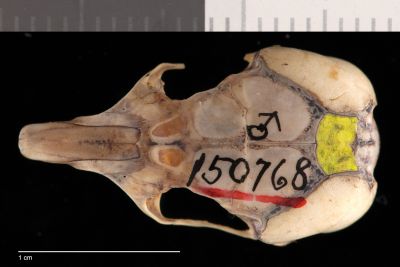
Holotype: USNM 150768. Perognathus flavescens relictus. Young adult male. Medano Springs Ranch, northeast of Mosca, San Luis Valley, Alamosa County, Colorado. Collected 2 November 1907. Dorsal view of the skull. The interparietal bone is colored yellow. -

Holotype: 226344. Perognathus flavescens apache . Adult male. Winona, Coconino County, Arizona. Collected 19 July 1917. Ventral view of the skull. -

Holotype: 226344. Perognathus flavescens apache . Adult male. Winona, Coconino County, Arizona. Collected 19 July 1917. Lateral view of the skull. -

Holotype: 226344. Perognathus flavescens apache . Adult male. Winona, Coconino County, Arizona. Collected 19 July 1917. Dorsal view of the skull. Dorsal view of the mandible. -

Holotype: 226344. Perognathus flavescens apache . Adult male. Winona, Coconino County, Arizona. Collected 19 July 1917. Lateral view of the left mandible.


Similar species
Perognathus flavescens can be separated from all Chaetodipus by its smooth pelage and ears that lack a lobed antitragus. It can also be separated from Perognathus mollipilosus by ears that lack a lobed antitragus.
Comparison with Perognathus amplus

Comparison with Perognathus flavus
From Hoffmeister (1986): "differs from P. flavus as follows: postauricular patch less prominent; tail averaging about 92 percent of head-body rather than between 80 and 90 percent; hind foot larger (averaging 19.4 mm rather than 16.8 mm); skull larger and with posterior bulge of the occipital projecting nearly as far posteriorly as the bullae do; width of interparietal greater than length of maxillary toothrow; whereas in P. flavus greater in only 39 percent and averaging smaller; interorbital region broader; skull broader across mastoids." From Monk & Jones (1996): "The ears are relatively small and the postauricular patches are smaller and less conspicuous than in some congeners (P. flavus, for example)."
-

Plains Pocket Mouse (Perognathus flavescens) -

Silky Pocket Mouse (Perognathus flavus) -
Postauricular patch of the Plains Pocket Mouse (Perognathus flavescens). -

Postauricular patch of the Silky Pocket Mouse (Perognathus flavus).

Comparison with Perognathus longimembris
Comparison with Perognathus merriami
Comparison with Perognathus mollipilosus
It can be separated from the Great Basin Pocket Mouse (Perognathus mollipilosus) by ears that lack a lobed antitragus.
-

Great Basin Pocket Mouse (Perognathus mollipilosus) -

Lobed antitragus of the Great Basin Pocket Mouse (Perognathus mollipilosus).
| Species | Size | Pelage_appearance | Postauricular_patch | Subaruicular_spot | Antitragus | Tail_bicolored | Tail_crest | Tail_tuft | Rump_spines | Lateral_lines | Lateral_line_color |
|---|---|---|---|---|---|---|---|---|---|---|---|
| Perognathus fasciatus | small to medium | smooth | present: buffy | present; white | absent | indistinctly | absent | absent | absent | present | bright buffy to yellowish buff |
| Perognathus flavescens | small to medium | smooth | present | present; white | absent | indistinctly | absent | absent | absent | present | dark ochraceous to pale yellowish |
| Perognathus flavus | small | smooth | present; buff | present; white or buff | absent | indistinctly | absent | absent | absent | present; may be indistinct, buff | buff or ochraceous |
| Perognathus merriami | small | smooth | present; clear buff | present; white | absent | indistinctly | absent | absent | absent | present | ochraceous |
References
Armstrong DM, Fitzgerald JP, Meaney CA. 2010. Mammals of Colorado, Second Edition. Denver (CO, USA): University Press of Colorado.
Benson SB. 1933. Concealing coloration among some desert rodents of the southwestern United States. University of California Publications in Zoology 40:1-7.
Ceballos G, editor. 2014. Mammals of Mexico. Baltimore (MD, USA): Johns Hopkins University Press.
Hazard EB. 1982. The mammals of Minnesota. Minneapolis (MN, USA): University of Minnesota Press.
Johnsgard PA. 2020. Wildlife of Nebraska: a natural history. Lincoln (NE, USA): University of Nebraska Press.
Merriam CH. 1889. Revision of the North American pocket mice. North American Fauna 1:1-36.
Monk RR, Jones JK. 1996. Perognathus flavescens. Mammalian Species (525):1-4. https://doi.org/10.2307/3504180
Seabloom R, Hoganson JW, Jensen WF. 2020. The mammals of North Dakota. Fargo (ND, USA): North Dakota State University Press.
Schmidly DJ, Bradley RD. 2016. The mammals of Texas. Austin (TX, USA): University of Texas Press.
Williams DF. 1978. Systematics and ecogeographic variation of the Apache pocket mouse (Rodentia, Heteromyidae). Bulletin of the Carnegie Museum of Natural History 10:1-57.
Wilson DE, Lacher Jr TE, Mittermeier RA. 2016. Heteromyidae. In: Handbook of the Mammals of the World – Volume 6 Lagomorphs and Rodents I. Barcelona: Lynx Edicions: 648-837, ISBN: 978-84-941892-3-4, DOI: http://doi.org/10.5281/zenodo.6840226