Neotoma albigula
| White-throated Woodrat
(Neotoma albigula) | |
|---|---|
| Range | |
 | |
| Taxonomic classification | |
| Order: | Rodentia |
| Suborder: | Supramyomorpha |
| Infraorder: | Myomorphi |
| Superfamily: | Muroidea |
| Family: | Cricetidae |
| Subfamily: | Neotominae |
| Tribe: | Neotomini |
| Genus: | Neotoma |
| Binomial details | |
| Neotoma albigula Hartley, 1894 | |
| Other resources | |
| Full taxonomic details at MDD | |
The White-throated Woodrat (Neotoma albigula) is a medium-sized woodrat that can be found in a variety of habitats in the southwestern United States and northwestern Mexico.
Description
From Armstrong et al. (2010): "The western white-throated woodrat is a medium-sized, brownish rat with short, dense soft fur. The dorsal pelage is washed with black, whereas the throat and chest are white, individual hairs white to their bases. The tail is distinctly bicolored, dark brown above and whitish below."

Museum specimens
-

Holotype: USNM 186485. Neotoma albigula albigula. Adult male. Southwest corner of Grant (Hidalgo), New Mexico. Collected 12 April 1886. Dorsal view. -

Holotype: USNM 186485. Neotoma albigula albigula. Adult male. Southwest corner of Grant (Hidalgo), New Mexico. Collected 12 April 1886. Ventral view. -

NEON0C8V8. White-throated Woodrat (Neotoma albigula). Adult male. Santa Rita Experimental Range, Pima County, Arizona. Collected 2 October 2024. Lateral view. -

NEON0C8V8. White-throated Woodrat (Neotoma albigula). Adult male. Santa Rita Experimental Range, Pima County, Arizona. Collected 2 October 2024. Dorsal view. -

NEON0C8V8. White-throated Woodrat (Neotoma albigula). Adult male. Santa Rita Experimental Range, Pima County, Arizona. Collected 2 October 2024. Ventral view. Note the midventral gland in this male, which is used to deposit scent in specific locations. The ventral gland is only moderately or poorly developed in most females (Macêdo and Mares, 1998).


External measurements
Length measurements are in millimeters (mm) and weight measurements are in grams (g), unless stated otherwise. If available, the sample size (n=) is provided. If a range is not provided and n= is not given, then the listed measurement represents an average.
| Part of range | Reference | Total length | Tail length | Hindfoot length | Ear length | Mass |
|---|---|---|---|---|---|---|
| Arizona (Central Coconino Co.) | Hoffmeister (1986) | 289–343 (n=17) | 120–150 (n=17) | 30–37 (n=17) | 27–33 (n=17) | |
| Arizona (Eastern Pima, NW Cochise cos.) | Hoffmeister (1986) | 285–353 (n=27) | 120–152 (n=27) | 31–37 (n=27) | 27–32 (n=27) | |
| Arizona (SW Pima Co.) | Hoffmeister (1986) | 282–336 (n=8) | 126–155 (n=8) | 31–34 (n=8) | 26–30 (n=8) | |
| Arizona (Tinajas Atlas) | Hoffmeister (1986) | 297–348 (n=22) | 137–162 (n=22) | 31–35 (n=22) | 25–28 (n=22) | |
| Arizona (vicinity Baboquivari Mtns.) | Hoffmeister (1986) | 281–337 (n=28) | 132–156 (n=28) | 30–37 (n=28) | 24–31 (n=28) | |
| Arizona (vicinity Kingman) | Hoffmeister (1986) | 280–360 (n=14) | 115–156 (n=14) | 31–35 (n=14) | 27–30 (n=14) | |
| Arizona (vicinity Yuma) | Hoffmeister (1986) | 363.3 (n=4) | 173.3 (n=4) | 34.0 (n=4) | 31.3 (n=4) | |
| California | Jameson & Peeters (2004) | 282–400 | 76–185 | 30–39 | 28–30 | 145–200 |
| California (Central Imperial Co.) | Hoffmeister (1986) | 298–385 (n=10) | 148–187 (n=10) | 34–37 (n=10) | 27–31 (n=10) | |
| California (Eastern Imperial Co.) | Hoffmeister (1986) | 330–394 (n=12) | 155–193 (n=12) | 34–36 (n=12) | 25–30 (n=12) | |
| Colorado | Armstrong et al. (2010) | 310–340 | 130–150 | 33–36 | 28–30 | 150–250 |
Skull
From Armstrong et al. (2010): "The skull has a pointed anterior palatal spine. The posterior margin of the palate is concave, as is the dorsal margin of the foramen magnum. The interorbital region is only slightly arched. The antero-internal reentrant angle of M1 is generally shallow."
From Hoffmeister (1986): "occlusal surface of M1 with only a slight or shallow antero-medial fold, skull robust, nasals often sharply pointed posteriorly, premaxillaries extend posteriorly to nasals often in an expanded fashion, second loph of M3 usually long and extending diagonally across the tooth..."
-

NEON01IHT. Neotoma albigula. Adult male. Santa Rita Experimental Range, Pima County, Arizona. Collected 18 September 2017. Dorsal view of the skull. -

Holotype: USNM 186485. Neotoma albigula albigula. Adult male. Southwest corner of Grant (Hidalgo), New Mexico. Collected 12 April 1886. Dorsal view of the skull. -

Holotype: USNM 186485. Neotoma albigula albigula. Adult male. Southwest corner of Grant (Hidalgo), New Mexico. Collected 12 April 1886. Ventral view of the skull. -
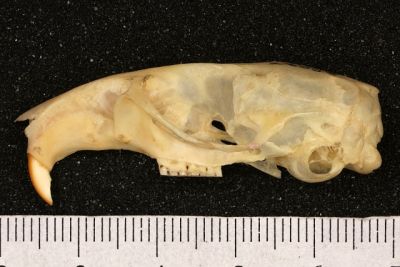
Holotype: USNM 186485. Neotoma albigula albigula. Adult male. Southwest corner of Grant (Hidalgo), New Mexico. Collected 12 April 1886. Lateral view of the skull. -

Holotype: USNM 186485. Neotoma albigula albigula. Adult male. Southwest corner of Grant (Hidalgo), New Mexico. Collected 12 April 1886. Dorsal view of the mandible. -

Holotype: USNM 186485. Neotoma albigula albigula. Adult male. Southwest corner of Grant (Hidalgo), New Mexico. Collected 12 April 1886. Lateral view of the left mandible. -

Holotype: USNM 186485. Neotoma albigula albigula. Adult. Upper molars. Arrows point to the anteromedial flexus of the anteroloph of each upper molar (M1), which is shallow. -

Holotype: USNM 186485. Neotoma albigula albigula. Adult. Lower molars.


Color variation
This section shows some of the color variation present in Neotoma albigula. The location is provided for reference only. The individual shown does not necessarily represent the only color variant within the local population. From Macêdo and Mares (1988): "There is substantial interpopulation variation in N. albigula, which has led to the designation of various subspecies. In western Arizona, for example, N. albigula is represented by populations (N. a. venusta) which have a larger, more angular skull than N. a. albigula. Dichromatic specimens have been obtained from Rio Puerco and San Rafael, New Mexico. Another variant is the form occurring on the western slopes of the Sierra Madre in southern Sonora and southwestern Chihuahua (N. a. melanura), which is intermediate both in color and cranial characters between N. a. albigula and populations occurring further south (Goldman, 1910.)"
-

Two Neotoma albigula individuals observed by K. Brown, N.J. Czaplewski et al. in Pima County, Arizona. Observed 11 March 1976. One individual is albino.

Taxonomic notes
Edwards et al. (2001) found that populations of Neotoma albigula west of the Rio Grande River were genetically distinct from populations to the east, which they referred to as Neotoma leucodon. Edwards et al. (2001) defined the range of N. leucodon as: "White-toothed woodrats located east of the Rio Grande in New Mexico, Texas, and Oklahoma (and, presumably, eastern Colorado) and those found east and south of the Rio Conchos in Mexico should be assigned to the same species [N. leucodon]." Additionally, "White-throated woodrats found west of the Rio Grande in Arizona, California, Nevada, New Mexico, and Utah (and, presumably western Colorado) and those west and north of the Rio Conchos in Mexico should be assigned to N. albigula."
Similar species
Comparison with Neotoma bryanti
Neotoma albigula has hairs on the throat that are white to the base rather than plumbeous at the base as in the Bryant's Woodrat (Neotoma bryanti). In Neotoma albigula, the anteromedial flexus of the anteroloph of each upper molar (M1), is shallow. In the Bryant's Woodrat (Neotoma bryanti), the anteromedial flexus of the anteroloph of each upper molar (M1), is deeply notched in all age classes except very old individuals (Patton et al., 2007).
-
NEON0C8V8. White-throated Woodrat (Neotoma albigula). Adult male. Hairs on the throat are white to their bases. -

Bryant's Woodrat (Neotoma bryanti). Adult male. Hairs on the throat are plumbeous at the base. -
Holotype: USNM 186485. Neotoma albigula albigula. Adult. Upper molars. Arrows point to the anteromedial flexus of the anteroloph of each upper molar (M1), which is shallow. -

Holotype: USNM 146794. Neotoma bryanti bryanti. Adult male. Arrows point to the anteromedial flexus of the anteroloph of each upper molar (M1), which is deeply notched in all age classes except very old individuals (Patton et al., 2007).


Comparison with Neotoma cinerea
The pelage coloration of the Bushy-tailed Woodrat (Neotoma cinerea) is variable, but it can be differentiated from Neotoma albigula by its large size, bushy tail, and the anteromedial flexus of the anteroloph of each upper molar (M1) being deeply notched. Both species have hairs on the throat that are white to the base.
-

White-throated Woodrat (Neotoma albigula) -

Bushy-tailed Woodrat (Neotoma cinerea), showing its bushy tail. -
Holotype: USNM 186485. Neotoma albigula albigula. Adult. Upper molars. Arrows point to the anteromedial flexus of the anteroloph of each upper molar (M1), which is shallow. -

Holotype: USNM 208968. Neotoma cinerea lucida. Adult. Upper molars.
Comparison with Neotoma devia
Neotoma albigula differs from the Arizona Woodrat (Neotoma devia) in hairs on the throat white to their bases rather than dusky or gray basally (Hoffmeister, 1986). The anteromedial flexus of anteroloph of each upper molar (M1) is not a reliable character as it is shallow to obsolete in both species.
-
NEON0C8V8. White-throated Woodrat (Neotoma albigula). Adult male. Hairs on the throat are white to their bases. -

Holotype: USNM 226376. Arizona Woodrat (Neotoma devia). Adult female. Hairs on the throat are dusky or gray basally. -
Holotype: USNM 186485. Neotoma albigula albigula. Adult. Upper molars. Arrows point to the anteromedial flexus of the anteroloph of each upper molar (M1), which is shallow. -

Holotype: USNM 226376. Neotoma devia. Adult. Upper molars. Arrows point to the anteromedial flexus of anteroloph of each upper molar (M1), which is shallow to obsolete except in very young individuals (Patton et al., 2007).
Comparison with Neotoma lepida
From Hoffmeister (1986): "N. albigula differs from Neotoma lepida in hairs on the throat white to their bases rather than dusky or gray basally, baculum short and broad basally rather than long and narrow, rostrum of skull broader, posterior extensions of premaxillaries usually expanded, second loph M3 more nearly diagonal rather than transverse." The anteromedial flexus of anteroloph of each upper molar (M1) is not a reliable character as it is shallow to obsolete in both species.
-
NEON0C8V8. White-throated Woodrat (Neotoma albigula). Adult male. Hairs on the throat are white to their bases. -
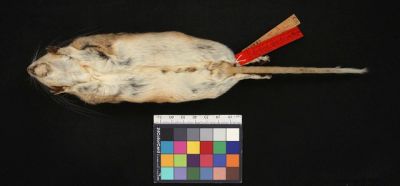
Holotype: USNM 25739/33139. Desert Woodrat (Neotoma lepida). Adult male. Furnace Creek, Death Valley, Inyo County, California. Collected 31 January 1891. -
Holotype: USNM 186485. Neotoma albigula albigula. Adult. Upper molars. Arrows point to the anteromedial flexus of the anteroloph of each upper molar (M1), which is shallow. -

Holotype: USNM 25739/33139. Neotoma lepida lepida. Adult. Upper molars. The anteromedial flexus of anteroloph of M1 is shallow in all but the youngest aged individuals (Patton et al., 2007).
Comparison with Neotoma leucodon
The White-toothed Woodrat (Neotoma leucodon) is a white-throated woodrat and was included in Neotoma albigula until Edwards et al. (2001) showed that the two populations were genetically distinct. Edwards et al. (2001) defined their ranges as: "White-toothed woodrats located east of the Rio Grande in New Mexico, Texas, and Oklahoma (and, presumably, eastern Colorado) and those found east and south of the Rio Conchos in Mexico should be assigned to the same species [N. leucodon]." Additionally, "White-throated woodrats found west of the Rio Grande in Arizona, California, Nevada, New Mexico, and Utah (and, presumably western Colorado) and those west and north of the Rio Conchos in Mexico should be assigned to N. albigula."
-
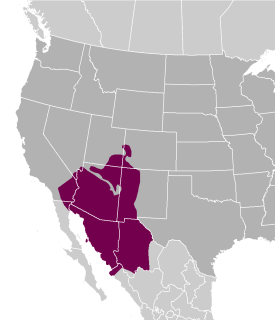
White-throated Woodrat (Neotoma albigula) -

White-toothed Woodrat (Neotoma leucodon)
Comparison with Neotoma mexicana
From Hoffmeister (1986): "N. albigula differs from Neotoma mexicana in hairs on the throat white to their bases rather than dusky, antero-internal reentrant angle of M1 shallow rather than extending more than half way across the crown, premaxillaries extending farther posteriorly relative to end of nasals."
-
White-throated Woodrat (Neotoma albigula) -

Mexican Woodrat (Neotoma mexicana) -
Holotype: USNM 186485. Neotoma albigula albigula. Adult. Upper molars. Arrows point to the anteromedial flexus of the anteroloph of each upper molar (M1), which is shallow. -

Holotype: USNM 17692/24628. Neotoma mexicana pinetorum. Adult. Upper molars. Arrows point to the anteromedial flexus of the anteroloph of each upper molar (M1), which is deeply notched.
Comparison with Neotoma micropus
Neotoma albigula is a medium-sized brownish rat, whereas the Southern Plains Woodrat (Neotoma micropus) is a medium-sized slate to ash gray woodrat (Armstrong et al., 2010).
-
White-throated Woodrat (Neotoma albigula) -

Southern Plains Woodrat (Neotoma micropus) observed in Texas by Greg Lasley. The pelage if soft slate to ash gray.
Comparison with Neotoma stephensi
From Armstrong et al. (2010) for Colorado: “Stephen's woodrat is small and pale yellow to buff-gray in color. The belly and throat are white, the hairs of the throat gray at their bases.” In contrast, "the western white-throated woodrat is a medium-sized, brownish rat with short, dense soft fur. The dorsal pelage is washed with black, whereas the throat and chest are white, individual hairs white to their bases.”
From Hoffmeister (1986) describing Neotoma stephensi: “A species of Neotoma of small size but with a bushy tail, some hairs in the throat area in most populations with dark pigment in the basal part (not white-throated).” Additionally, “dusky coloration extends down the top of hind foot one-fourth to one-third the distance below the ankle, underparts are usually suffused with an ochraceous or buffy wash.”
-
White-throated Woodrat (Neotoma albigula) -

Stephens's Woodrat (Neotoma stephensi) -
White-throated Woodrat (Neotoma albigula). Adult male. Throat and chest are white, individual hairs white to their bases. -

Stephens's Woodrat (Neotoma stephensi). Adult female. Underparts are usually suffused with an ochraceous or buffy wash. The hairs of the throat are gray at their bases.

References
Armstrong DM, Fitzgerald JP, Meaney CA. 2010. Mammals of Colorado, Second Edition. Denver (CO, USA): University Press of Colorado.
Edwards CW, Fulhorst CF, Bradley RD. 2001. Molecular phylogenetics of the Neotoma albigula species group: further evidence of a paraphyletic assemblage. Journal of Mammalogy 82(2):267-279.
Hartley F. 1894. Description of a new species of wood-rat from Arizona. Proceedings of the California Academy of Sciences, ser. 2, v. 4, 157.
Hoffmeister DF. 1986. Mammals of Arizona. Tucson (AZ, USA): University of Arizona Press.
Jameson EW, Peeters HJ. 2004. Mammals of California (No. 66). Berkeley (CA, USA): University of California Press.
Macêdo RH, Mares MA. 1988. Neotoma albigula. Mammalian species (310): 1-7. https://doi.org/10.2307/3504165
Patton JL, Huckaby DG, Álvarez-Castañeda ST. 2007. The evolutionary history and a systematic revision of woodrats of the Neotoma lepida group (Vol. 135). Berkeley (CA, USA): University of California Press.